





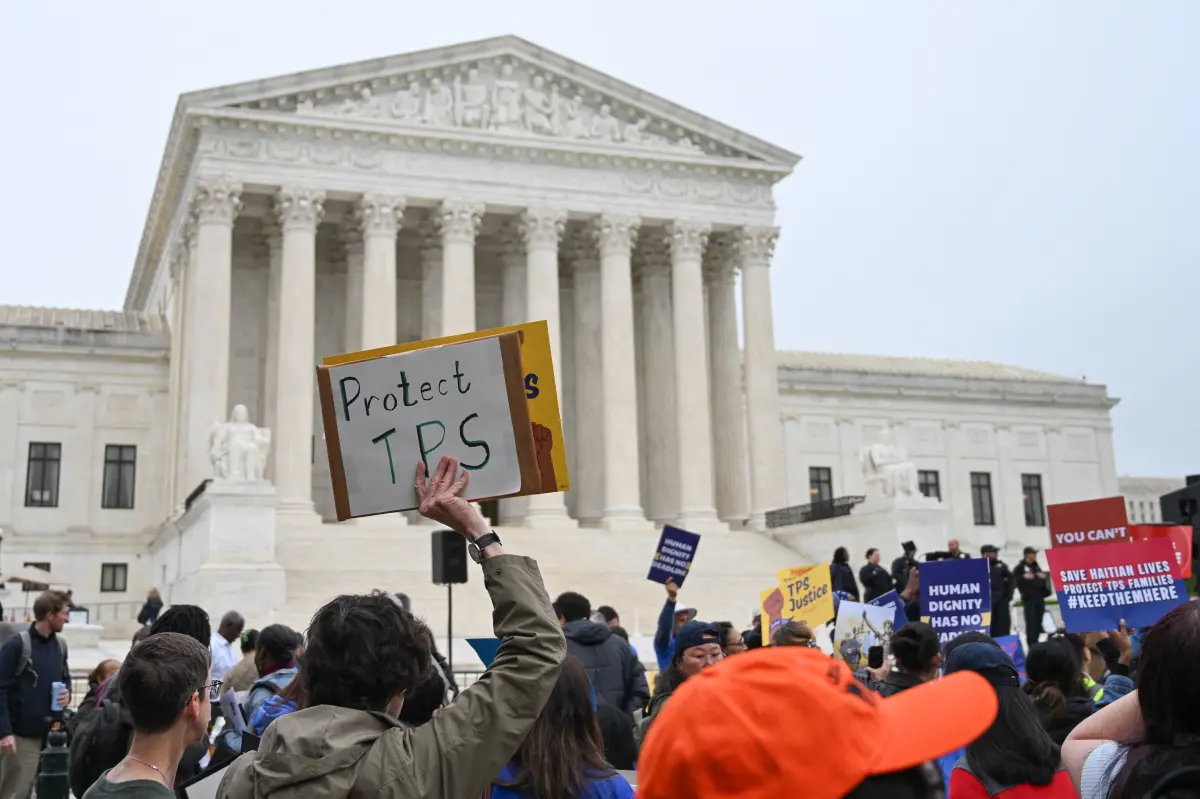
For thousands of families across the United States, a quiet Thursday morning in Washington, D.C., transformed into a day of profound grief and sudden, terrifying instability. The Supreme Court’s 6-3 decision, which cleared the way for the federal government to terminate Temporary Protected Status (TPS) for more than 350,000 Haitians and 6,000 Syrians, did not just alter a policy; it shattered the fragile sense of security that hundreds of thousands of human beings had built over years, and in some cases decades, of living, working, and raising families on American soil. To understand the gravity of this ruling, one must look beyond the sterile columns of legal text and into the living rooms of families who began their journey to America fleeing the horrors of a brutal civil war in Syria or the catastrophic devastation of earthquakes, cholera outbreaks, and systemic violence in Haiti. These are people who have bought homes, started businesses, paid taxes, and raised American-citizen children, believing that the United States would remain a beacon of safety as long as their homelands remained unlivable. By ruling that the executive branch has the unilateral authority to strip away these protections without the oversight of the federal judiciary, the high court has effectively pushed these vulnerable populations to the edge of an abyss, forcing them to contemplate a future of forced return to places of active danger, or a descent into the perilous shadows of undocumented life in the only country they now call home.
Writing for the conservative majority, Justice Samuel Alito anchored the court’s decision in a strict, unyielding interpretation of the statute that governs the Temporary Protected Status program. The ruling asserted that the language of the law explicitly deprives federal courts of the jurisdiction to review administrative decisions concerning the termination of TPS designations, effectively closing the courthouse doors to those seeking relief from executive overreach. In Alito’s view, the statute leaves “no judicial review of any determination . . . with respect to the . . . termination” of these humanitarian protections, meaning that even if the administration’s decision-making process was deeply flawed, inconsistent, or politically motivated, the courts are powerless to intervene on non-constitutional grounds. This textualist approach treats the law as a closed, mechanical system, detached from the catastrophic human consequences of its execution. For the majority, the separation of powers dictates that Congress gave sole discretion over these designations to the executive branch, prioritizing bureaucratic finality and presidential authority over the fundamental human rights of the individuals affected. This legal philosophy, while intellectually consistent to its practitioners, stands in cold, stark contrast to the lived realities of those whose lives are governed by its dictates, illustrating a profound systemic disconnect where legal technicalities can swiftly dismantle decades of human progress and community integration with the stroke of a pen.
The lawsuits brought by the Syrian and Haitian groups were not merely academic challenges to administrative procedures; they were urgent, deeply personal pleas that accused the administration of acting out of a place of unlawful racial animus and political hostility rather than an objective, good-faith assessment of the conditions in their home countries. The plaintiffs argued that the decision to terminate their protected status was deeply colored by discriminatory motives, pointing to a well-documented pattern of public statements from the administration that disparaged immigrants from African, Caribbean, and Middle Eastern nations. To suggest that Haiti or Syria is currently safe enough for the repatriation of hundreds of thousands of people is to ignore some of the most severe humanitarian crises of our generation. Syria remains a shattered landscape, fractured by over a decade of civil war, arbitrary detentions, and ruined infrastructure, where returnees face the very real threat of state-sponsored violence or death. Similarly, Haiti has been gripped by unprecedented levels of gang warfare, economic collapse, and administrative chaos that make daily survival an agonizing struggle. By presenting evidence of these ongoing crises, the plaintiffs sought to demonstrate that the termination of their status was a political theater built on prejudice, exposing how minority communities are often used as bargaining chips in broader geopolitical and domestic culture wars.
This ruling highlights a fundamental contradiction at the heart of the Temporary Protected Status program, which was originally conceived as a short-term humanitarian safety valve but has evolved into a long-term foundation for hundreds of thousands of lives. When foreign nations are struck by wars, plagues, or natural disasters, the U.S. government has historically stepped in to offer TPS, allowing affected citizens already in the country to live and work legally until the crisis subsides. However, because many of these crises persist for decades, “temporary” status has frequently stretched across generations, creating a subclass of residents who are deeply integrated into the American fabric but perpetually kept in legal limbo. Over twenty or thirty years, these individuals have become essential pillars of their local communities—working as nurses, construction workers, teachers, and business owners, while bringing up children who know no other home but the United States. They have lived under the constant, agonizing psychological weight of eighteen-month renewal cycles, always aware that their lives could be disrupted by a shift in political winds. The Supreme Court’s decision has realized their worst fears, transforming a chronic state of anxiety into an acute existential crisis and revealing how easily the legal structures we rely on for protection can be dismantled when they are built on temporary executive grace rather than permanent legislative security.
Before this Supreme Court intervention, the lower federal courts had served as a vital shield for these immigrant communities, issuing injunctions and stays that temporarily halted the deportations while the merits of the lawsuits were debated. These lower courts had recognized the irreparable harm that would be caused by uprooting hundreds of thousands of people, agreeing that there was sufficient reason to scrutinize whether the administration’s actions violated the law or were driven by discriminatory intent. The dissenting opinion on the Supreme Court, championed by the court’s three liberal justices, echoed these concerns, warning that the majority’s ruling sets a dangerous precedent by cloaking executive actions in a shroud of judicial immunity. The dissenters argued that shutting down judicial review in these cases leaves vulnerable populations defenseless against potential executive tyranny and bias, undermining the judiciary’s essential role as a check on abuse of power. They emphasized that when groups allege that a government decision was made with discriminatory intent, the courts have a moral and constitutional duty to examine those claims, rather than retreating behind a hyper-technical reading of statutory bars to avoid addressing the systemic injustices occurring right before their eyes.
As the dust settles on this landmark ruling, the immediate future for the affected Syrian and Haitian communities is defined by a desperate, heartbreaking uncertainty. Families are now faced with impossible choices: separating to keep their American-born children safe in the United States while the parents face deportation to unstable countries, uprooting their entire families to move to places of active danger, or retreating into the margins of American society to live in constant fear of immigration raids. The economic and social ripple effects of this decision will be felt across American cities, as neighborhoods lose cherished neighbors, schools lose dedicated students, and local businesses lose valued employees. In the wake of this judicial defeat, advocacy groups and community leaders are pivoting their efforts toward Congress, pleading for a permanent legislative fix that would provide a pathway to citizenship for long-term TPS holders. This crisis serves as a powerful reminder of the human cost of policy decisions, challenging the national conscience to decide whether the United States will remain a country defined by cold, bureaucratic exclusion, or one that honors its historical promise to offer refuge, dignity, and a permanent home to those who have contributed so much to its collective story.