





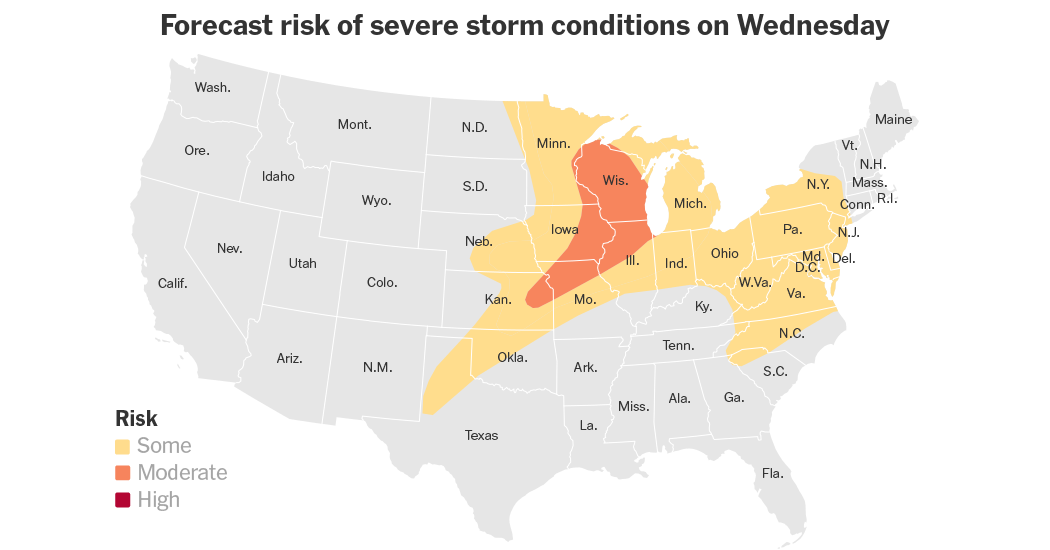
The transition from a peaceful mid-week routine to a state of high alert is a familiar yet jarring experience for residents of the American Midwest. On a seemingly ordinary Wednesday, abstract weather forecasts materialized into a stark reality as a massive, volatile storm system swept across a vast corridor stretching from Texas all the way to Southern Canada, centering its fiercest energy directly over the Great Lakes region. In communities across Illinois, Wisconsin, Iowa, and Missouri, the sky underwent a dramatic, bruising transformation, shifting from daylight into an ominous, moving canvas of bruised purples, deep greens, and charcoal grays. The air pressure dropped noticeably—a heavy, thick dampness clashing with a sudden cold front—which is a physical sensation that often signals to locals that it is time to seek shelter, clear outdoor furniture, and prepare for the worst. For hundreds of thousands of families, the afternoon became a race against nature as heavy rain began to fall in sheets, accompanied by thunderous booms that rattled windowpanes and jagged bolts of lightning that illuminated the darkening landscape. Tornado sirens began their eerie, rising-and-falling wail across rural towns and suburban neighborhoods, transforming the quiet rhythm of a working Wednesday into a shared, anxious vigil. While the central threat of these storms had been anticipated by meteorologists for days, the actual arrival of the squall line brought a sudden, visceral reminder of the raw power of the atmosphere. Neighbors texted one another warnings, parents hurried to pick up children from school ahead of the downpour, and farmers in the fields kept one eye on the cloud bases, watching the dark skies rotate with a mixture of awe and trepidation. This was not just a passing spring shower; it was a sprawling, destructive force that demanded immediate respect and attention, reminding everyone in its path of their vulnerability to the elements.
As the storm system marched eastward, its disruptive impact was felt immediately across the region’s vital infrastructure, leaving a trail of darkened homes and stranded travelers in its wake. In Illinois and Wisconsin, the physical consequences of the storm materialized in a coordinate blackout that severed modern conveniences from daily life. By late afternoon, more than 300,000 utility customers in Illinois were plunged into darkness, quickly accompanied by over 90,000 of their neighbors in Wisconsin who also lost power. In an instant, the hum of refrigerators, the glow of television screens, and the comfort of air conditioning ceased, replaced by the quiet flicker of candlelight, the glow of smartphones, and the stressful calculations of how long the food in the freezer would remain frozen. Simultaneously, the transport hubs of the Midwest were thrown into absolute chaos as Chicago’s major airports, which serve as crucial atmospheric gateways for the entire nation, wrestled with cascading flight cancellations and delays. Thousands of air travelers found themselves trapped in bustling, overcrowded terminals, watching flight information screens melt into rows of red cancellation notices, signaling missed weddings, lost business deals, and delayed family reunions. Adding to the collective anxiety were the rare and terrifying “particularly dangerous situation” tornado warnings issued by the National Weather Service for parts of Iowa, Missouri, and Wisconsin. This specific, urgent designation is reserved for instances where there is a high confidence that an incredibly destructive, long-track tornado is imminent, sending a chill through residents who clustered in basements and interior bathrooms, clutching flashlights, weather radios, pets, and loved ones while listening to the fury of the wind outside.
Behind every statistic of power outages and flight delays is a massive human effort working diligently to restore order and safety amidst the environmental chaos. Utility workers became the unsung heroes of the night, stepping directly into the hazardous conditions to mend the broken grid. Thomas Francis, a spokesperson for ComEd, the primary utility provider in Illinois, explained that the outages peaked at a staggering 286,000 customers in the early evening, as the brunt of the storm discharged heavy rain, lightning, and destructive winds across the state. In times of crisis, the operational strategy of these utility companies is deeply humanized, prioritizing life and safety above all else. Crews were dispatched into the driving rain and pitch-black dark not just to flip switches, but to address downed live wires that posed an immediate, lethal threat to unsuspecting citizens. The priority hierarchy of restoration efforts speaks to a community’s core values, focusing first on critical infrastructure such as hospitals, nursing homes, and fire and police stations—lifelines that must remain operational to protect the sick, the elderly, and the vulnerable. Residents were urged to take shelter and actively report any fallen power lines, fostering a cooperative dynamic between the public and emergency responders. This cooperative spirit is vital, as the physical labor of clearing fallen trees, replacing snapped utility poles, and splicing severed lines is slow, dangerous work that requires hours of patient, meticulous effort under the worst possible conditions. The sight of utility trucks lining up in the dark became a beacon of hope for communities waiting for the lights to come back on.
The occurrence of such severe weather inevitably raises questions about our ability to predict, understand, and prepare for these atmospheric temper tantrums. Meteorologists often find themselves in a difficult position; they can look at complex global computer models and predict up to a week in advance that the ingredients for a severe weather outbreak are coming together. However, our sophisticated technology still struggles with the incredibly complex and delicate physics required to pinpoint exactly where a specific cell will initialize or which neighborhood a tornado will strike. This forecasting limitation can create a frustrating paradox for the public, who may feel a sense of false alarm when a predicted storm misses their town, or conversely, feel blindsided when a storm develops with sudden, devastating localized intensity. The psychological weight of this uncertainty falls heavily on both the forecasters, who bear the responsibility of keeping the public safe without causing undue panic, and the residents, who must decide whether to cancel their plans based on a percentage probability. This nuance highlights the ongoing struggle of human science against the fluid dynamics of our atmosphere. Every storm is a unique puzzle, influenced by micro-climatic factors like local topography, soil moisture, and sudden shifts in wind direction that run circles around even the fastest supercomputers. Understanding this scientific frontier helps us appreciate the heavy reliance on immediate radar observations, localized weather balloons, and local spotters who provide the ground-truth data that saves lives when minutes matter most.
In the background of these immediate local struggles lies a broader, global conversation about the changing nature of our planet’s climate. While scientists have successfully established clear, robust links between global warming and extreme weather events like prolonged heatwaves, devastating droughts, and more intense hurricanes, the relationship between climate change and tornadoes remains one of the most complex and elusive mysteries in modern meteorology. A warming atmosphere holds more moisture and warmth, which are the fundamental fuels for severe thunderstorms, yet the specific wind shear conditions required to spin up a destructive tornado are highly sensitive and do not correlate with rising temperatures in a simple, linear fashion. This scientific nuance is crucial, as it prevents researchers from making blanket statements about whether climate change is directly causing more frequent or more powerful tornadoes. Instead, scientists observe shifting patterns, such as a potential eastward migration of “Tornado Alley” away from the dry Great Plains and into more densely populated areas of the American South and Midwest, posing a different kind of ongoing risk to human lives. Acknowledging these scientific uncertainties is not a sign of weakness, but rather an invitation for deeper study, emphasizing that even as we work to mitigate our carbon footprint, we must simultaneously invest in local resilience and adapt our building codes to withstand a future where extreme weather may become more unpredictable and severe. It connects the immediate lived experience of a dark, storm-battered night in the Midwest to the global effort of understanding a planet in transition.
Ultimately, surviving a severe storm system is less about the technicalities of meteorology and more about the enduring strength of human connection and community readiness. When the sirens finally fall silent and the clouds begin to break, revealing the aftermath of the storm, the true character of a community shines through in the immediate search for safety and recovery. Preparation is the bridge that spans the gap between fear and agency, transforming potential victims into active caretakers of their own safety. Simple acts, like compiling emergency contact lists, keeping flashlights with fresh batteries nearby, securing loose outdoor items, and establishing a safe designated meeting spot in the basement, provide a sense of control over a chaotic situation. Moreover, these storms serve as powerful reminders of our profound interdependence, prompting neighbors to check on the elderly resident down the street, share working generators, or help clear fallen branches from a driveway. In the face of nature’s overwhelming power, the resilience of the Midwest is defined not by the absence of storms, but by the coordinated, compassionate response that follows. As the power is slowly restored, flights are rescheduled, and communities begin the process of cleanup, there is a quiet, collective sigh of relief, paired with the enduring understanding that while we cannot control the weather, we can always choose how we stand together to face the storm.