







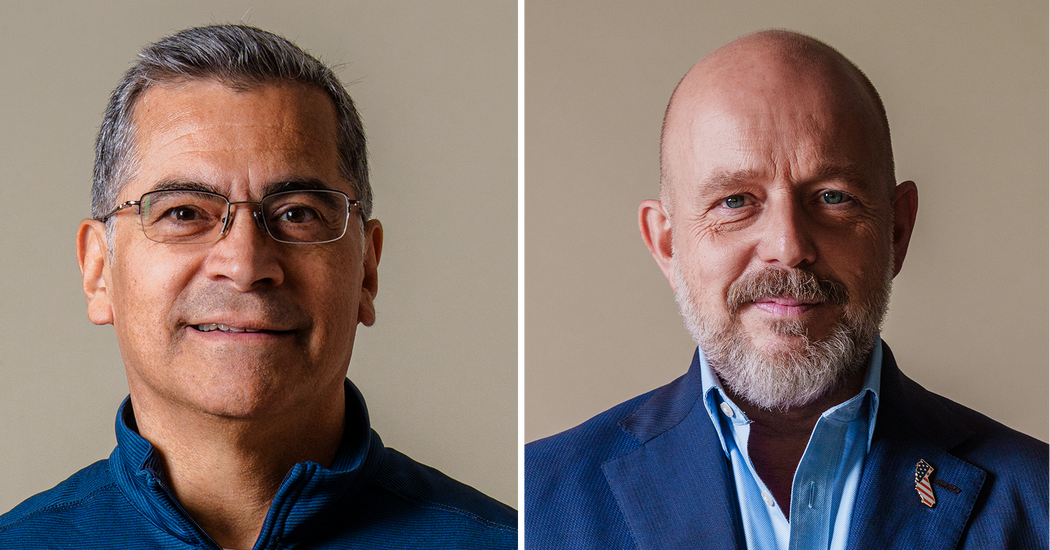
The dust has finally settled on one of the most expensive and fiercely contested primary elections in California history, leaving behind a fascinating political landscape and a clear vision of the two very different men who will vie for the state’s highest office this November. In a dramatic turn of events, Steve Hilton, a British-born former Fox News host endorsed by Donald Trump, clinched the crucial second-place spot, setting up a general election showdown against the former Biden administration official and California Attorney General, Xavier Becerra. The journey of these two candidates to the political spotlight occurred amidst an unprecedented financial storm, most notably defined by the historic, self-funded campaign of billionaire progressive Tom Steyer. Steyer, who poured an astronomical $216 million of his personal fortune into his bid, ultimately finished third, failing to qualify for the top-two system that defines California’s primary rules. In a remarkably humanizing moment that stood in stark contrast to the usual bitterness of defeat, Steyer gracefully conceded, acknowledging to his supporters that he understood why so many working-class voters simply could not bring themselves to vote for a billionaire. His candid admission reflected a broader, growing public exhaustion with the sheer volume of money in politics, clearing the way for a classic partisan battle to succeed Governor Gavin Newsom, who is term-limited and widely watched as a future Democratic presidential contender.
For Xavier Becerra, this victory is not merely a political milestone, but the culmination of a deeply personal, lifetime journey that symbolizes the changing face of California itself. At 68 years old, the son of working-class Mexican immigrants, Becerra’s rise to become the first Latino to emerge victorious from a modern California gubernatorial primary carries immense cultural and emotional weight for millions of residents. His journey to this moment was anything but guaranteed; ignored and dismissed early on by political insiders, he was even quietly urged by his own party’s chairman to abandon his seemingly doomed campaign just months ago. Yet, with a quiet, patient resilience that has long characterized his public service, Becerra stayed the course, finding an unexpected path forward after the sudden departure of Congressman Eric Swalwell from the race. In a modern political arena that increasingly rewards social media theatrics and loud, performative conflict, Becerra’s low-key, methodical, and moderate approach resonated quietly but powerfully with a broad coalition of voters and pragmatic business leaders—including real estate, technology, and healthcare interests—who preferred his steady hand over the progressive disruption advocated by Steyer.
Standing on the opposite end of the ideological and cultural spectrum is Steve Hilton, whose climb to the top of California politics reads like a cinematic tale of modern reinvention. The 56-year-old was raised in England, eventually rising through the ranks of British politics to serve as a top policy adviser to former Prime Minister David Cameron. In a move driven not by political ambition but by family, Hilton relocated to California so his wife could pursue her career in the fast-paced ecosystem of Silicon Valley, eventually falling in love with his adoptive home and becoming an American citizen just five years ago. Transitioning his natural charisma and quick-witted intellect from high-level policy rooms to the television screens of Fox News, Hilton built a passionate following among conservatives who appreciated his lively, often humorous style. Funded in part by media titan Rupert Murdoch and Google co-founder Sergey Brin, Hilton has run a campaign centered on reducing the cost of living by slashing taxes and regulations, pitching himself as the disruptive outsider needed to fix a state he argues has been broken by career politicians. Even as he tries to connect with everyday Californians, Hilton’s colorful campaign has featured moments of endearing awkwardness, such as a recent outreach event at a Mexican eatery in San Jose where his well-intentioned praise of a fast-food chain’s hard-shell shell as an authentic “street taco” drew good-natured teasing from the very voters he hoped to win over.
The upcoming November matchup is the exact scenario that Democratic strategists had quietly hoped for, revealing a highly calculated game of political chess that played out in the final weeks of the primary. Knowing that Donald Trump is deeply unpopular within the heavily Democratic state of California, Becerra’s campaign released highly targeted advertisements leading up to the vote that conspicuously branded Hilton as “Trump’s favorite.” While ostensibly serving as a warning to progressives, the ads were cleverly designed to do the exact opposite for conservative voters: signaling to Republicans scattered across the state to consolidate their support behind Hilton. This tactical move successfully elevated Hilton past Steyer, ensuring that instead of a brutal and incredibly expensive intraparty civil war between two Democrats in the fall, Becerra would face a Republican opponent who carries the polarizing weight of a Trump endorsement. Hilton, fully aware of this dynamic, has sought to bypass the national political noise by focusing his attacks directly on the everyday frustrations of Californians, framing Becerra as an extension of the current administration’s status quo and a career politician who represents the bureaucratic stagnation of Sacramento.
Beyond the ideological differences of the two candidates, the election has also shone a bright light on the mechanics of democracy itself, specifically California’s notorious delay in finalizing election results. Because of the vast volume of mail-in ballots and the state’s highly meticulous process for verifying signatures, the final results confirming Hilton’s second-place finish took a full week to emerge, sparking widespread public frustration. Standing outside the Los Angeles County Registrar of Voters, Hilton leveraged this delay to call for major systemic changes, urging the state to allocate more resources to expedite vote counting while actively advocating for a Republican-backed ballot measure that would mandate voter identification. In a rare break from Donald Trump’s rhetoric, Hilton actively defended the integrity of the state’s process, noting that his own legal team had monitored the counting process closely and found no evidence of fraud or rigging. Becerra, speaking to voters at a vibrant Latin American market in Los Angeles, pushed back strongly against the voter ID proposal, arguing that such measures would disproportionately disenfranchise vulnerable communities, though he agreed that more state resources should be directed toward making the vote-tabulation process faster and more efficient.
As the race shifts toward the general election, the lines of support are being drawn rapidly, setting the stage for a compelling debate over California’s future direction. Prominent national and state Democrats, including Governor Newsom and Vice President Kamala Harris, have quickly unified behind Becerra, with Harris publicly praising his calm, steady leadership and his willingness to fight for working families. For Hilton, the path to victory remains an uphill climb in a state where a Republican has not won the governor’s mansion in two decades, meaning he must somehow transcend the partisan divide and convince moderate and independent voters that a vote for him is a vote for tangible change rather than national polarization. Ultimately, when Californians cast their ballots this November, they will choose between two deeply human journeys: one of an immigrant’s son who climbed the ladders of American policy to represent his community, and the other of a naturalized citizen who left the corridors of British power to champion a conservative revival in the golden state.