




The promise of a career within the ranks of the New York City Police Department is deeply rooted in the noble, universally recognized ideals of public service, integrity, and communal safety. For Megan Kwan, a young, ambitious Asian-American woman who navigates her everyday life with a profound hearing impairment, securing a position within the department’s technology division was supposed to be the proud launchpad of a stable, meaningful career where she could utilize her specialized technical skills to serve her city. Relying on hearing aids and the meticulously acquired, exhausting skill of lip-reading to communicate in a fast-paced environment, Kwan began her professional journey with the NYPD as a hopeful college intern in 2021. Her diligence, sharp technical aptitude, and unwavering work ethic eventually earned her a hard-fought promotion to a full-time civilian role within the highly sensitive Cyber Security Team by 2025. It was a major milestone that should have been celebrated as a triumph of personal perseverance over physical adversity, demonstrating that a physical disability is no barrier to professional excellence. Instead, her transition into the permanent, everyday ranks of the department marked the silent beginning of a relentless, two-year psychological descent into an absolute, agonizing living nightmare. Rather than finding a professional sanctuary populated by honorable guardians of the law, Kwan unknowingly stepped into a hostile, deeply predatory ecosystem where her physical vulnerability and quiet disposition were viewed not with professional empathy or respect, but as an opportunity for raw, systemic exploitation. The loud, chaotic, and often overwhelming atmosphere of police headquarters, which already posed distinct daily sensory challenges for someone with profound hearing loss, quickly transformed into a minefield of unseen psychological, social, and physical threats. This tragic, jarring juxtaposition between her optimistic, barrier-breaking beginnings and the sheer depravity of what she was ultimately forced to endure highlights the agonizingly deep human cost of systemic institutional failure and the acute vulnerability of marginalized individuals in spaces where they are supposed to feel protected.
This agonizing workplace hell began to manifest in earnest in 2024 with the assignment of Officer Quilbvio Espinal to the Cyber Security Team, an individual who would quickly and systematically transform Kwan’s professional environment into a crucible of degradation, humiliation, and constant dread. Espinal did not merely view Kwan as a colleague, a fellow public servant, or a tech professional; instead, he targeted her through a highly distorted, predatory, and aggressive lens of racial and physical fetishism that completely stripped her of her professional identity and basic human dignity. The detailed lawsuit filed in a Manhattan court paints a deeply disturbing portrait of a relentless campaign wherein Espinal repeatedly subjected Kwan to an onslaught of unwanted sexual advances, openly boasting to other members of the department about his explicit, self-described “Asian fetish” and declaring repeatedly that he wanted to make her his “Asian wife” or his “baby momma.” Yet, the cruelty of his ongoing campaign went far deeper than unsolicited, highly inappropriate verbal remarks, tapping into a horrific, deeply malicious fusion of racism and ableism. Espinal began bombarding Kwan’s digital workspace and personal phone with a steady stream of explicit, graphic pornographic videos, including one particularly offensive and humiliating recording that explicitly mocked the way a deaf woman vocalizes during sexual intercourse. For Kwan, whose daily survival, personal identity, and dignity are inextricably linked to her hearing impairment, this was a devastating, deeply personal psychological blow that pierced through her professional defenses. The video was a calculated attempt to weaponize her disability against her, turning her physical limitations and the way she communicates with the world into a source of cheap, mocking office amusement. To be subjected to such intense, hyper-sexualized, and ableist abuse while trying to maintain absolute concentration on securing the city’s digital infrastructure created an agonizing, exhausting state of perpetual hyper-vigilance, leaving her fundamentally unsafe at her own desk.
In any healthy, modern, and accountable workplace, an employee facing such egregious, continuous harassment would find an immediate safeguard or a compassionate ally in leadership. However, the tragedy of Kwan’s experience was compounded by the active, eager participation of her direct supervisor, Sergeant Jayson Valentin, who should have been her first and strongest line of institutional defense. Rather than intervening to protect a vulnerable subordinate, enforce the department’s strict codes of conduct, or report Espinal’s blatant misconduct, Valentin chose to abandon his oath and join his subordinate in his relentless psychological and sexual siege. The lawsuit alleges that Valentin leveraged his position of authority to pepper Kwan with obscene, sexually suggestive texts, explicit propositions, and constant demands for nude photographs, even going so far as to send her an unsolicited, graphic photograph of his own genitalia. Together, the supervisor and the officer created a suffocating pincer movement of harassment, relentlessly badgering the young tech worker to engage in sordid threesomes and demanding her absolute sexual compliance under the threat of professional isolation. This coordinated, highly visible abuse did not happen in hidden corners or whispers; it transpired within the shared, open workspace of the police department, often in full view of other personnel who were fully aware of what was occurring. Kwan recalls with acute pain how her surrounding colleagues—other law enforcement officers who are rigorously trained to intervene in moments of public distress—chose to deliberately look away, ignore her obvious discomfort, or even laugh at the crude, locker-room spectacle unfolding daily at her desk. This collective shoulder-shrug and mocking laughter from other officers served to validate the abusers while isolating Kwan in a desert of profound, systemic indifference, showing how institutional silence can easily suffocate a victim’s silent plea for help and safety.
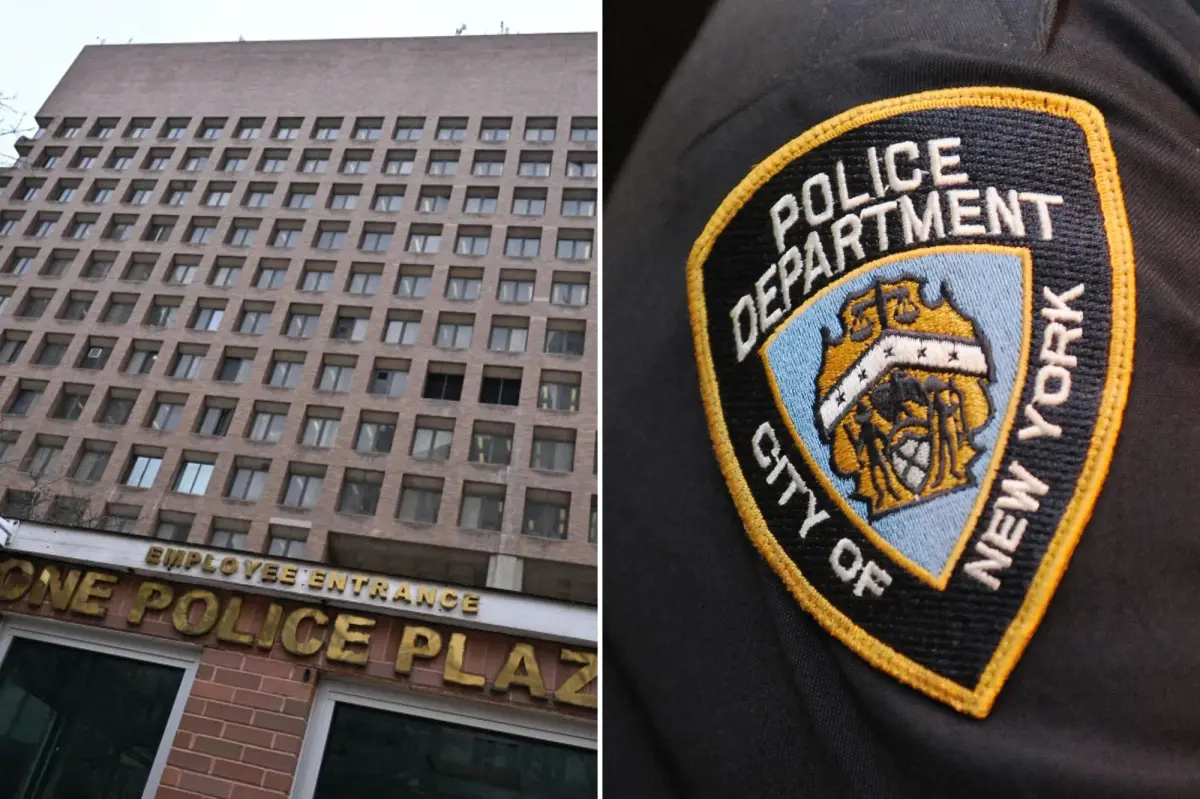
The psychological torture, digital harassment, and physical dread escalated to a point of sheer, life-threatening terror in March, inside the heavily secured and analytical confines of the NYPD headquarters at One Police Plaza. Frustrated by Kwan’s unwavering resistance, her quiet resilience, and her continuous refusal to capitulate to their persistent, aggressive demands for threesomes and sexual favors, the situation reached a volatile, terrifying boiling point for the spurned Espinal. In a shocking, unprecedented display of unchecked hostility and toxic masculinity, Espinal approached Kwan’s desk, drew his department-issued, loaded service firearm, and pointed it directly at her face. For a person who relies so heavily on visual clarity to navigate the world, the sudden, sharp presence of a lethal weapon in her immediate field of vision was an unspeakable horror that permanently shattered her perception of reality, sanity, and safety. “When he pointed that gun at my face, time stopped,” Kwan recounted to reporters, describing the agonizing, absolute silence of that frozen, life-altering moment at her workstation. In that terrifying instant, her thoughts immediately narrowed to the immediate, desperate realization that she was about to be executed at her own desk inside the very heart of the city’s law enforcement apparatus, and that she would never again survive to see, hold, or speak to the people she loved. The absolute audacity required for an active police officer to brandish a loaded department weapon against a civilian coworker inside police headquarters exposes a terrifying lack of discipline and a dangerous, systemic sense of impunity. It demonstrates how unchecked toxic behavior, when ignored by immediate leadership and enabled by peers, inevitably escalates from verbal degradation to life-threatening violence, turning a workplace into a potential crime scene.
The immediate fallout of that terrifying evening saw Espinal placed in handcuffs and arrested, subsequently facing criminal charges of menacing brought by the Manhattan District Attorney’s Office. Yet, the systemic institutional response that followed in the weeks and months since has done little to provide genuine justice, safety, or comfort, instead highlighting the double standards and protective shields built into the bureaucracy of law enforcement. Despite pointing a loaded gun at a civilian colleague’s face and subjecting her to two years of severe, documented harassment, Espinal remains on the city payroll, suspended with the luxury of full pay. Even more egregiously, Valentin, the supervisor who actively participated in the sexual and digital degradation of his subordinate and abused his power, has suffered no visible administrative consequences or disciplinary action; rather, he was rewarded with a highly sought-after promotion to the prestigious rank of lieutenant. This promotion stands as a grotesque monument to institutional complicity, sending a chilling signal to the entire department that enabling, participating in, or ignoring the abuse of civilian employees is no obstacle to career advancement and institutional success. The toxic response from the defendants’ legal representation further illustrates the combative, adversarial, and deeply dismissive landscape Kwan must navigate, with Espinal’s lawyer publicly branding the detailed and traumatizing allegations as “utterly preposterous, shameful, absurd, and entirely frivolous.” This defensive posturing and institutional insulation serve to gaslight the victim, minimizing the profound trauma of a woman who was forced to choose between her livelihood and her physical safety on a daily basis while the system shielded those who sought to destroy her, raising critical questions about systemic corruption.
In the face of this systemic betrayal and profound institutional failure, Megan Kwan has made the incredibly courageous decision to reclaim her narrative and her voice, transforming her private suffering into a loud, public demand for accountability, systemic reform, and justice. By filing a landmark civil lawsuit against her individual abusers and the NYPD as a whole, she has chosen to thrust her story into the political and public spotlight, absolutely refusing to carry the toxic burden of shame that rightfully belongs to the men who tormented her. “I am speaking out because no one should have to live through what I lived through and because I refuse to be made to feel ashamed for something that was done to me,” she stated, her words carrying the quiet, undeniable strength of a survivor who has reclaimed her agency in the aftermath of severe trauma. Her struggle highlights the unique, compounding vulnerabilities faced by women of color and individuals with physical disabilities within high-pressure, male-dominated institutions like the police department, where systemic biases can intersect to easily silence and marginalize the most vulnerable voices. Kwan’s journey is a powerful, sobering reminder that of all the compounding tragedies of her two-year ordeal, the most devastating aspect is that it was entirely preventable had anyone in a position of power chosen to act with basic human decency and professional responsibility. As her lawsuit progresses through the courts of Manhattan, it stands as an urgent call to dismantle the culture of complicity, demanding a future where no civilian worker is forced to endure terror under the very roof designed to uphold the law and protect human lives, demonstrating that courage can triumph over institutional silence.