





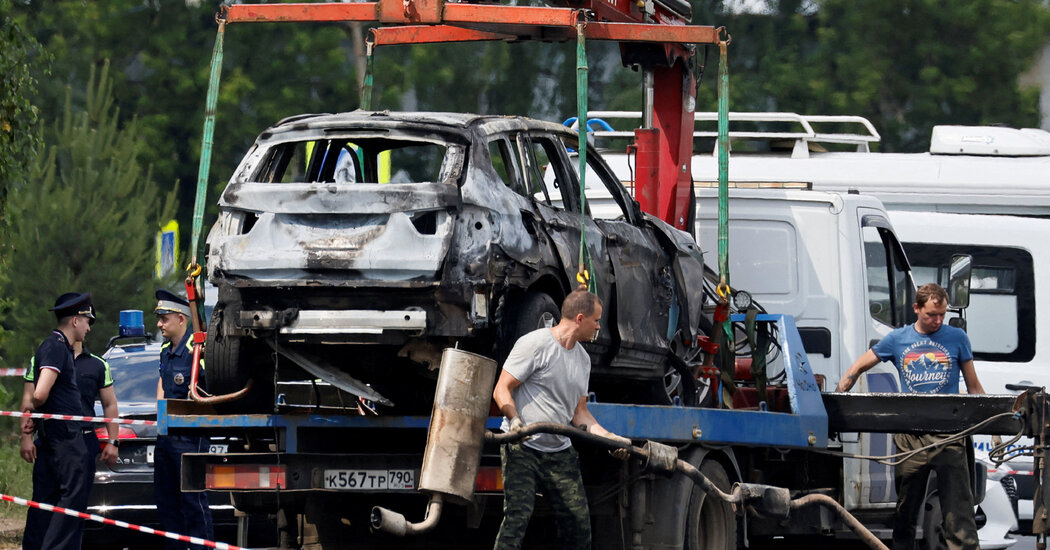
On a quiet Tuesday morning in Balashikha, a sleepy residential suburb just east of Moscow, the stillness of the dawn was abruptly shattered by a violent and terrifying roar. The sudden explosion of a commuter vehicle parked near a residential building did more than just tear through the steel and glass of an ordinary car; it sent figurative shockwaves through the very heart of the Russian military establishment. When the smoke finally cleared over the blackened asphalt, emergency responders discovered the lifeless body of the driver, who had died instantly in the blast. Almost immediately, both Russian and Ukrainian media, alongside senior intelligence officials in Kyiv, confirmed the identity of the victim as Damir R. Davydov, a senior officer in the Russian military. For the local residents who rushed to their windows in panic, the war that had for years seemed like a distant television broadcast had suddenly manifested on their doorsteps in a cascade of fire and twisted metal, proving that no one—not even those living in the heavily guarded capital region—is truly safe from the reach of this relentless conflict.
To understand the weight of this loss, one must look past the dry military titles and understand the human element of who Damir Davydov actually was. Davydov was not a frontline commander leading charges through the muddy, blood-soaked trenches of the Donbas, nor was he a highly decorated pilot navigating the skies over contested territory. Instead, he was a bureaucrat of war, a man whose daily life was defined by logistics, ledgers, and coordination within the supply department of the Russian military’s Main Missile and Artillery Directorate. His role was to ensure that the massive supply chains feeding ammunition and weaponry to the frontlines ran smoothly and without interruption. In the cold calculus of modern warfare, however, the officers who manage the flow of weapons are just as vital, and therefore just as targeted, as the soldiers who pull the triggers. Davydov’s death highlights the terrifying reality of being a cog in a massive military machine; a routine morning commute, starting with the simple turn of an ignition key, became his final, fatal moment as he was violently thrust from the mundane world of logistics into the deadly arena of targeted political assassination.
This latest strike represents a crucial piece of a broader, highly sophisticated shadow campaign being waged by Ukrainian special services deep inside the Russian heartland. As Kyiv’s conventional forces have successfully blunted Moscow’s highly publicized summer offensives on the physical battlefield, Ukraine’s intelligence networks have increasingly brought the war directly to Russia’s doorsteps. By executing precise, high-risk operations deep within enemy territory—ranging from long-range drone strikes on critical oil infrastructure to the clinical elimination of key military personnel—Ukraine is actively challenging the Kremlin’s narrative of domestic stability. This asymmetrical strategy relies heavily on psychological warfare, aiming to sow a deep, pervasive sense of paranoia and vulnerability among the Russian political and military elite. Every successful hit serves as a stark reminder to those in power that the protective shield of the state is remarkably porous, and that the consequences of Russia’s external aggression can strike back at any moment, turning quiet suburban streets into active combat zones.
The tragedy in Balashikha is part of a dark, repetitive pattern of violence that has begun to plague this specific neighborhood and the wider Moscow region. Only months earlier, in April 2025, the very same suburb was the scene of another high-profile assassination when Maj. Gen. Yaroslav Moskalik, a deputy head in the General Staff, was killed by a meticulously placed car bomb. This grim ledger of death grows longer with each passing season: late last December, Lt. Gen. Fanil Sarvarov met a similar fate, and a year prior, Gen. Igor Kirillov, who oversaw Russia’s nuclear and chemical defense forces, was assassinated by an explosive device concealed in a scooter parked near his home. The sheer variety and clinical execution of these attacks—utilizing everyday, unassuming civilian objects like commuter cars and motor scooters—have created a terrifying atmosphere where Russian officers must now look at their own neighborhoods with profound suspicion. The simple act of stepping outside, walking past a parked scooter, or starting a car has been transformed into an exercise in existential dread, leaving military leaders to wonder who among them will be next on the hit list.
In the face of these embarrassing security failures, the response from the Kremlin has been marked by a tense, heavily guarded silence that speaks volumes about the internal panic gripping the state apparatus. When pressed for details about the explosion that claimed Davydov’s life, Kremlin spokesman Dmitri S. Peskov offered only a brief, cryptic statement, noting that President Vladimir V. Putin had been briefed but that the details were strictly classified due to an ongoing criminal investigation. This tight-lipped posture is a desperate attempt to control the domestic narrative and prevent public panic, particularly after Putin had earlier condemned previous assassinations as “severe blunders” by the Federal Security Service (FSB) and demanded a swift end to such compromises. The cognitive dissonance is becoming harder for the government to manage, as state-controlled television networks continuously broadcast messages of military triumph and imperial strength, while the physical reality of smoking car frames and shattered residential windows publicly exposes the limitations of the domestic security services.
Ultimately, the fiery end of Damir Davydov’s life stands as a somber monument to a modern war that has completely dissolved the traditional boundaries between the frontlines and civilian sanctuaries. For the ordinary citizens of Balashikha and other suburbs around Moscow, the illusion of safety has evaporated, replaced by the unsettling realization that their high-ranking neighbors carry invisible targets on their backs that could endanger entire communities at any moment. As the conflict continues to drag on with no clear end in sight, this covert war in the shadows is likely to intensify, transforming ordinary residential areas into unpredictable battlegrounds where the line between peace and violence is as thin as a tripwire. The targeted assassination of military officers on Russian soil serves as a chilling testament to the human cost of a war that refuses to be contained, proving that as long as the violence continues to rage across the border, its destructive echoes will inevitably find their way back to the quiet streets of the capital, leaving a trail of smoke, fear, and shattered lives in their wake.