

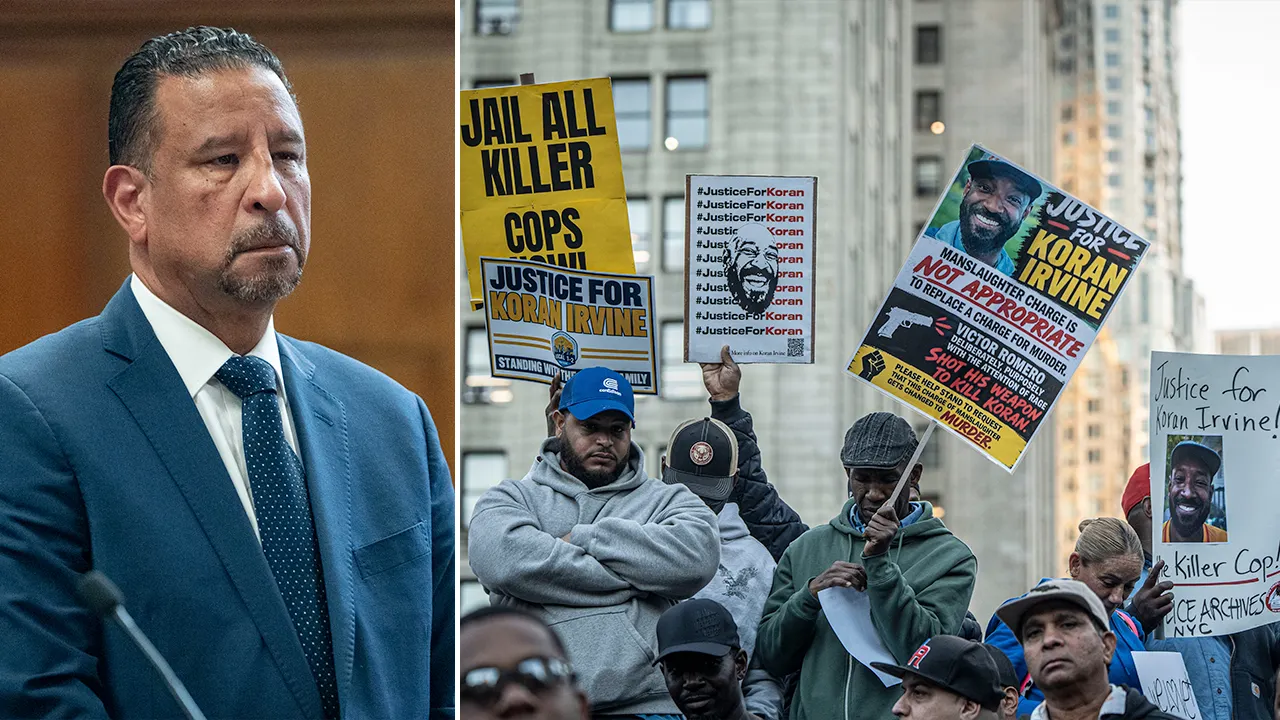
On a gray Tuesday morning, the sidewalk outside a Manhattan courthouse was not filled with the usual rush of lawyers and litigants. Instead, dozens of men and women in Con Edison work gear stood shoulder to shoulder, their faces tight with grief and resolve. They had come to do something simple and profound: show a grieving family that their loved one was not just a case number, not just a headline, but a brother. The man they were honoring was Koran Irvine, a 46-year-old husband, father of two, and a 20-year veteran of the utility company, whose life was abruptly and violently cut short the previous week on the George Washington Bridge. As the court date approached, the workers formed a quiet guard of honor, a human reminder that Irvine was more than the victim of an alleged road rage shooting. He was a friend, a colleague, a man whose laugh and presence were woven into the fabric of their daily lives. One Con Edison employee, visibly emotional, stepped outside the courthouse and spoke for many when he said, “We’re brothers here.” His words hung in the air, an echo of the solidarity that had drawn them all to this place, to stand in the cold, to bear witness, and to make certain that the man accused of taking their friend’s life would see that Koran Irvine was deeply loved.
The circumstances surrounding Irvine’s death are the kind that leave a community shaken, not only because they are violent but because they are so absurdly preventable. According to prosecutors, Irvine and Victor Romero were both driving toward the George Washington Bridge when a near collision occurred between their vehicles. What might have ended with a honk, a glare, or a muttered insult instead escalated into something unspeakable. Surveillance video allegedly shows Romero, a former NYPD detective, aggressively tailgating Irvine’s car before pulling up alongside it and firing at least one shot. The bullet struck Irvine, and the 46-year-old father was killed. The alleged shooter then sped away in an SUV belonging to the hedge fund that employed him as a driver and security guard, leaving behind a scene of confusion, chaos, and heartbreak on one of the busiest bridges in the world. For the next 24 hours, authorities launched an intensive manhunt, combing through footage, following tips, and eventually zeroing in on Romero. The former detective was arrested and initially faced first-degree manslaughter charges. But as the investigation deepened, a grand jury saw enough evidence to upgrade the charges to second-degree murder, a decision that brought a measure of relief to those who had been bracing for the possibility that justice might not be fully served. For Irvine’s family, the upgrade was a step toward accountability, though no verdict could ever bring him back.
The contrast between the two men at the center of this tragedy could not be more stark, and it is part of what has made the case so haunting. Victor Romero, 62, once wore the uniform of the New York Police Department. He had sworn to protect and serve, to uphold the law, to keep the peace. After his years on the force, he transitioned into private security, working as a driver and bodyguard for a hedge fund executive. That position put him behind the wheel of a powerful vehicle on the very roads he had once patrolled in service to the public. Now, he stands accused of using that vehicle as an instrument of rage, firing a gun at a stranger over what should have been a minor traffic moment. Romero appeared in court on Tuesday accompanied by his attorney and his own private security detail, a surreal sight given his alleged actions. He had previously posted a $1 million bail and entered a not guilty plea to the initial charges. When reporters approached him outside the courthouse, he offered no public statement, no words of remorse, no explanation. His silence only deepened the ache for those who had come seeking answers. For Irvine’s coworkers, the image of Romero flanked by security stood in sharp contrast to their own presence, ordinary working men and women standing in solidarity as a community should, with no armor but their shared grief.
Amid the procedural details of charges and arraignments, it is easy to lose sight of the human being whose life was stolen. Koran Irvine was not a statistic. He was a man who had spent two decades at Con Edison, building a career and a reputation. He was the kind of employee who showed up, who did the work, who made the place feel a little bit better just by being there. His coworker told reporters that their families often “hung out” together, that their children were friends. It is a small detail, but a revealing one. Irvine’s life was full of connections, of Sunday dinners and holiday gatherings, of playdates and school events, of the quiet, steady rhythms of family life. He leaves behind a wife and two children, a wife who must now explain to her kids that their father is never coming home, and children who will have to grow up with a hole in their hearts that no amount of time will fully mend. The Con Edison workers who showed up at the courthouse were not just fulfilling a workplace obligation. They were standing in for the millions of ordinary people who know, deep down, that this could have been any of them. Every time a driver cuts another driver off, every time tempers flare on a crowded highway, there is a flicker of the same darkness that allegedly consumed Romero. Irving’s colleagues were there to say: this is not acceptable. This is not normal. This grief is real.
The legal road ahead is still long. Romero is currently scheduled for a Supreme Court arraignment on November 23, where he will face the upgraded second-degree murder charge. His attorney, Alan Abramson, did not immediately respond to requests for comment, leaving the public to speculate about what defense might be mounted. Could this be argued as a moment of temporary madness? As self-defense stemming from a perceived threat? As an accident gone horribly wrong? The surveillance video, prosecutors say, tells a different story, one of deliberate actions, of a hand extended out a window, of a gun firing into another car. The manhunt that followed showed that law enforcement took the case seriously from the very first hours, and the grand jury’s decision to upgrade the charges signals a measure of confidence in the evidence. But for the family, the legal timeline is also a timeline of continued pain. Every court date is a fresh wound. Every hearing brings a new wave of anxiety, of anger, of hoping for justice and dreading that something might go wrong. Road rage shootings have become distressingly common in recent years, a symptom of a society that seems to be running on a short fuse, where a moment of impatience can escalate into violence with terrifying speed. This case, with its former detective turned alleged murderer, its working-class victim, and its stark setting on a bridge that thousands cross every day, has become a symbol of that epidemic.
As the story of Koran Irvine’s death continues to unfold, the most important thing is to remember him not for how he died, but for how he lived. He was a man who worked hard, who loved his family, who had friends who called him brother. He was someone whose loss has left a void that cannot be filled. The Con Edison workers who gathered outside the courthouse on Tuesday were not just making a statement about the case; they were making a statement about the kind of world they want to live in, one where a person is not just a stranger in the next lane but a neighbor, a colleague, a member of a shared community. They stood in the shadows of the criminal justice system, where the accused has the right to a defense and the presumption of innocence, but they also stood with the undeniable conviction that a life was cut short, and that someone must answer for it. When the court reconvenes in November, the focus will be on legal arguments, on evidentiary rulings, on the mechanics of murder charges. But outside the courtroom, in the hearts of those who loved Koran Irvine, the focus will remain on the vibrant man they lost, on the memories they carry, and on the stubborn, painful truth that one moment of rage rewrote the future for an entire family. For his children, for his wife, for his brothers at Con Edison, the wait for justice is agonizing. But they are not alone. In the quiet presence of dozens of coworkers, in the outstretched arms of a community, there is the promise that Koran Irvine will not be forgotten, and that his story will stand as a reminder that behind every road rage headline is a human being, a family, and a life that mattered.