





Rewrite the following content into a 2000-word, SEO-optimized article in English. Write it in the style of a professional journalist or news reporter. The article should be fully humanized, natural, and engaging — not robotic or repetitive.
Focus on clarity, flow, and storytelling while preserving the meaning of the original. Structure the article into 6 well-developed paragraphs with smooth transitions, strong headlines, and a professional tone. Use varied vocabulary, sentence lengths, and natural phrasing to make it read like human-written journalism.
Avoid keyword stuffing, but naturally integrate important SEO keywords throughout the article. Ensure the final article feels like it was written by a skilled reporter for a reputable news outlet.
For eight decades since World War II, members of neo-Nazi parties have never been directly elected mayor of any town in Germany, amid a postwar effort to shape its national identity around a rejection of the Nazi era.
On Sunday in a small town in eastern Germany, local residents are closer than ever to breaking with that consensus.
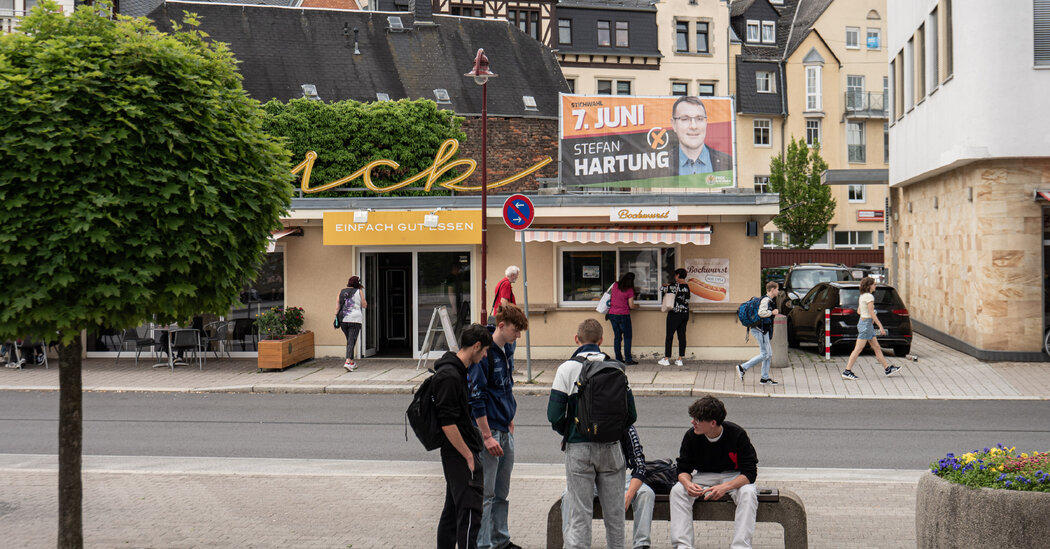
The front-runner in the mayoral election in the town, Aue-Bad Schlema, represents a fringe far-right party that Germany’s domestic intelligence agency has deemed an extremist group that poses a threat to the Constitution. The candidate, Stefan Hartung, says he is not a neo-Nazi, but acknowledges that he is also still a member of a larger party that Germany’s highest court has ruled is “similar in nature to National Socialism,” a formal term for Nazism.
Though just 19,000 residents live in the town, Mr. Hartung’s victory in the first round of voting in May has set off tremors across the country.
Whether he wins or loses the second round on Sunday, his presence in the runoff caps a growing realization in Germany that voting for the far right, even within living memory of Adolf Hitler, is no longer considered taboo. Germany’s biggest far-right party, Alternative for Germany, or AfD, is leading national polls and is projected to win two state elections in the fall.
“It represents a historic break, the likes of which we have not seen since the federal government was established” in 1949, said Benjamin Höhne, a political scientist in Chemnitz, a nearby city, who studies the far right.
“The deterrent effect of National Socialism no longer seems to matter,” Mr. Höhne added, “at least not among certain segments of the population.”
Mr. Hartung represents the Free Saxons, a tiny party that wants the state of Saxony to secede from Germany so as to more easily deport migrants. According to the German domestic intelligence agency, it is “led almost exclusively by well-known, longstanding representatives of the right-wing extremist scene.”
For years, Mr. Hartung was also a councilman for the National Democratic Party, or N.P.D. — a neo-Nazi group now known as the Homeland that the German domestic intelligence agency has said “has an antisemitic tradition reaching back to its origins.” The party is considered so extreme that the AfD, which is itself designated as a “suspected extremist” group by German intelligence, refuses membership to people who are also members of the Homeland.
In an interview, Mr. Hartung confirmed that he remained a member of the Homeland but said he did not consider himself a neo-Nazi or an extremist, dismissing that classification as politically motivated. “Nobody asked me if I wanted to be a far-right extremist,” he said.
By his account, residents support him because they believe he knows what he’s doing. “They know that I’m up to the job,” he said.
Although N.P.D. politicians were elected to statehouses in the past, they have always toiled in the fringes of politics in Germany. In 2017, the highest German court rejected a petition to ban the party because it concluded the party was too unpopular to damage German democracy, even if it tried. Two years later, an N.P.D. member was briefly appointed to run a small village after no other candidates came forward, but the decision was quickly reversed amid a national outcry.
But here in Aue-Bad Schlema, Mr. Hartung is close to power after tapping into worries about an aging population, aging infrastructure and a growing number of immigrants, particularly since Angela Merkel, when she was Germany’s chancellor, allowed hundreds of thousands of refugees, many of them from Afghanistan and Syria, to settle in the country a decade ago. According to official statistics, immigrants form roughly 8.5 percent of the town’s population, up from roughly 1 percent two decades ago.
Mr. Hartung has also capitalized on the perception that residents of eastern Germany have been neglected by the national leadership since the reunification of East and West Germany a generation ago.
“There’s been radicalization because people don’t get heard,” said Luise Weidauer, 39, a resident who expressed some reservations about immigration but declined to say if she had voted for Mr. Hartung. “We’re always being put into the brown corner,” said Ms. Weidauer, referring to a color associated with Nazism, adding, “I just wish people would listen to our problems with more empathy.”
Mr. Hartung first came to local prominence in 2013 when he helped organize torch marches to protest a home for asylum seekers. It helped him become the most recognizable politician in the area.
“He is better known than any of the other candidates and he also campaigned significantly harder,” said Jürgen Freitag, a reporter who has covered the town for years for the Freie Presse, a regional newspaper.
Mr. Hartung’s opponent in the runoff, Marcus Hoffmann of the center-right Christian Democratic Union, or C.D.U., is also handicapped by the reputation of his own party leader, Chancellor Friedrich Merz. Since his election last year, Mr. Merz has become unusually unpopular after the C.D.U. failed to make good on its pledge to fix the German economy.
Mr. Hartung has also been effective on social media, alternating between technocratic prescriptions for improving the city and more fear-inducing content, like a recent post about migrants getting into a brawl during a charity race in the city.
The town’s debate over immigration, which offers a window onto how such issues play out at a local level, centers largely on the bus stop in the central square. The square seems quaint to outsiders, featuring an old post office, a 1960s-style diner with a large neon sign and a kebab shop. But some locals complain that this is where young immigrants hang out and get into trouble.
Tony Neuss, who won 6 percent as the only left-of-center candidate in the first round of the mayoral race, said that this was a misperception, largely driven by the sort of social media outrage put out by Mr. Hartung and his followers.
“People who agree with him don’t even go to the Postplatz anymore because they are scared,” he told me, referring to the square. “So they just hear about how catastrophic it is and believe it,” Mr. Neuss said.
Mr. Hartung’s success is both good and bad for Germany’s largest far-right party, the AfD.
In the short term, it is a loss for the AfD, whose candidate won just 18.5 percent of the vote in the first round, well behind Mr. Hartung, who won 29 percent.
In the long term, the victory of a more extreme party makes it easier for the AfD to present itself as a more moderate option to wary voters in other parts of the country. The AfD has not endorsed Mr. Hartung, in part to distance itself from its smaller rival.
Mr. Hartung’s popularity also reflects the AfD’s success in normalizing anti-migrant discourse and encouraging even mainstream parties to mimic it. That process of normalization has, in turn, made candidates like Mr. Hartung seem more palatable to some voters, said Mr. Höhne, the political scientist.
“Right-wing populism is something akin to a portal that allows people to wander into the anti-democratic sphere,” Mr. Höhne said. “Once you have passed through this gate, the core ideology of right-wing extremism awaits at the end.”