





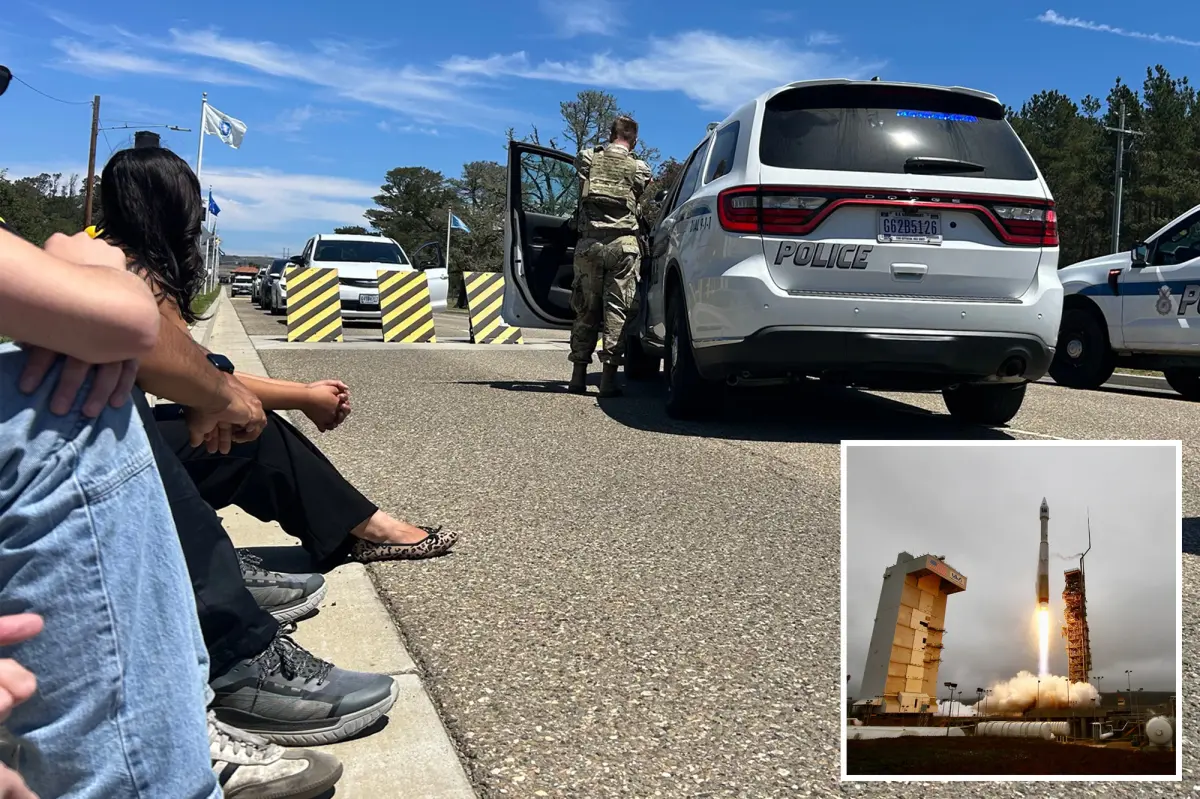
On an otherwise ordinary Monday afternoon, five journalists from local news outlets made their way to Vandenberg Space Force Base on California’s central coast. They had been invited to cover a ceremonial “golden shovel” groundbreaking for a new training facility for missile operators, an event scheduled for 1:30 p.m. The occasion was supposed to be a straightforward press opportunity: a symbolic photo-op with military officials, a few prepared remarks, and a story about the base’s evolving mission. Instead, those reporters found themselves caught in a scene more familiar to a security breach than a news gathering. The group included reporters from Your News Channel, Noozhawk, KSBY and the Santa Maria Times/Lompoc Record. They arrived at the front gate expecting to join the customary media caravan, a process that had apparently become routine enough that no one anticipated trouble. They waited at the entrance, credentials in hand, ready to be escorted onto the installation. For local journalists, such access matters; Vandenberg is not merely a distant federal facility but an important neighbor, a place whose launches and operations affect the community around it. The invitation to the groundbreaking seemed like another chance to document that relationship. But the welcome that followed was anything but routine. What should have been a simple entry quickly became a moment of confusion and fear, a jarring collision between the press’s expectation of official access and the military’s obligation to protect a sensitive installation.
The trouble began almost as soon as the convoy started moving. The reporters were following a military escort vehicle onto the base, a procedure that should have signaled official permission and safe passage. Then, without explanation, security officers stopped the group. The mood shifted instantly. Officers ordered the journalists out of their vehicles with their hands raised. Guns were drawn. Sirens blared. Barriers slammed down at the gate, cutting off any immediate exit or approach. For the civilians in that convoy, the world shrank to a series of shouted commands and unfamiliar weapons. Two military members traveling with the group—an enlisted service member and a junior officer—were handcuffed and taken away in base vehicles, according to Noozhawk. The civilian reporters were told to sit on a curb, where they waited under the gaze of security personnel. It is hard to imagine the thoughts running through their minds. They had arrived as invited guests, prepared to cover a hopeful event about the future of the missile force. Within minutes, they were being treated as potential threats. The presence of firearms made the situation feel dangerous, not just inconvenient. For people whose job is to document events, being inside the story is disorienting enough; being suspected in that story is deeply unsettling. The sense of order and predictability that had carried them through the gate was gone, replaced by a legal and security reality that seemed to make no distinction between an intruder and a reporter with a press badge.
The detention lasted more than thirty minutes. During that time, the groundbreaking ceremony proceeded without them, meaning the story they had traveled to cover would have to be learned secondhand or reconstructed from official materials. Eventually, every person in the group was cleared and released without further incident. No charges were filed, and no one was injured. Base personnel later apologized to News Channel reporter Jarrod Zinn for the mix-up. An apology, however, could not undo the experience. For the reporters, the day was not just missed—it was taken from them. They had done exactly what they were asked to do: shown up on time, followed instructions, and stayed with the escort. And still, the machinery of security treated them as an unknown and dangerous element. The fact that they were ultimately released may have resolved the immediate situation, but it also raised larger questions about how the military handles media access, especially in an era when security concerns are increasingly prioritized. Thirty minutes may not sound like a long time to someone unfamiliar with the power dynamics at play, but to a person sitting on a curb with armed officers around them, it can feel like hours. The reporters were not merely delayed; they were forced to experience, vividly and personally, what it means to be seen as a potential threat. That kind of experience stays with people.
Vandenberg officials said the incident stemmed from a breakdown in communication, and they cited a troubling pattern of unauthorized entry attempts at the base. In a statement, the base explained: “Vandenberg Space Force Base is experiencing an increased number of unauthorized entry attempts. When media entered the installation there was a breakdown in communication and movement continued prior to verification. Every potential unauthorized presence must be treated as a legitimate threat until proven otherwise. While we recognize this may have been unsettling, the security of the base and its personnel is our priority.” The statement is understandable in its broad strokes. The military has a charge to protect its people, its infrastructure and its missions. A space launch and missile operations base especially cannot afford to let unverified individuals move freely through its gates. Still, the statement also exposes a troubling gap between security logic and press expectations. If every potential unauthorized presence must be treated as a legitimate threat until proven otherwise, then even invited journalists can become collateral damage in a system designed to be cautious. The phrase “until proven otherwise” carries a heavy burden: it places the responsibility on the individual to prove they are not a threat, rather than on the institution to verify who they are before the guns come out. The key is coordination. When communication works, journalists can be cleared before they arrive, and escorts can move them through without incident. When communication fails, incidents like this one become possible. The base’s statement acknowledges the breakdown in communication, but it does not say whether any specific protocol will be changed to prevent similar confusion with future media visits.
Noozhawk Editor in Chief Tom Bolton responded with a measured but firm critique. “We respect the military’s need to provide security for the base,” Bolton said Wednesday. “But clearly what occurred was unfortunate and unnecessary, and potentially dangerous, as firearms were drawn.” His words reflect a delicate balancing act that local news leaders often face in covering military institutions. On one hand, they do not want to seem hostile to national security or give the impression that they are criticizing legitimate safety measures. On the other hand, they have a responsibility to speak up when something seems wrong, especially when the people involved were invited guests whose only mistake was following instructions. Bolton also said he hopes to speak with base leadership later this week about what happened and how to prevent another incident. That is a constructive response, one that acknowledges the need for security while also insisting on accountability and better processes. It also suggests that the relationship between the press and the military at Vandenberg may be repairable, but only if base leaders are willing to listen and adjust. The drawing of firearms is not a small matter; it raises the stakes of the encounter beyond simple inconvenience. A momentary lapse in communication can escalate to a life-threatening situation if someone moves too quickly or if a guard misreads a gesture. The journalists involved are now witnesses to that possibility. Their reporting, and their editor’s comments, aim to turn an unsettling experience into a lesson.
Looking back at what unfolded, the incident is larger than one botched security escort. It is a reminder of how quickly institutions can shift from treating people as participants to treating them as suspects. The press performs a public service by reporting on military activities, but the access required for that reporting depends on trust. That trust is fragile when protocols are not clearly structured, when credentials do not travel through the right channels, or when the fear of unauthorized entry overwhelms the recognition of legitimate visitors. The reporters at the gate that day were not there to test security or to expose secrets. They were there to document a building project, an important but modest story. Yet they became subjects of an authoritative, armed response that could have ended in tragedy. The military’s apology is a welcome first step, but it must be followed by actual change. That might mean clearer communication between the public affairs office and security personnel, better coordination before media events, and a more careful system for verifying visitors before they are allowed onto the base. It might also mean giving escort vehicles a special marker or notifying gate guards ahead of time so that a media caravan is not mistaken for an unauthorized entry. Whatever the fix, the goal should be to ensure that the people who cover Vandenberg can do so without being pulled from their cars, their hands raised, and their lives treated as potential security threats. If the “golden shovel” story got less attention than it deserved, another story emerged in its place—one about how far a community’s journalists must go to tell the simplest of stories, and how a security system meant to protect can also alienate the very people who are invited to build public understanding.