



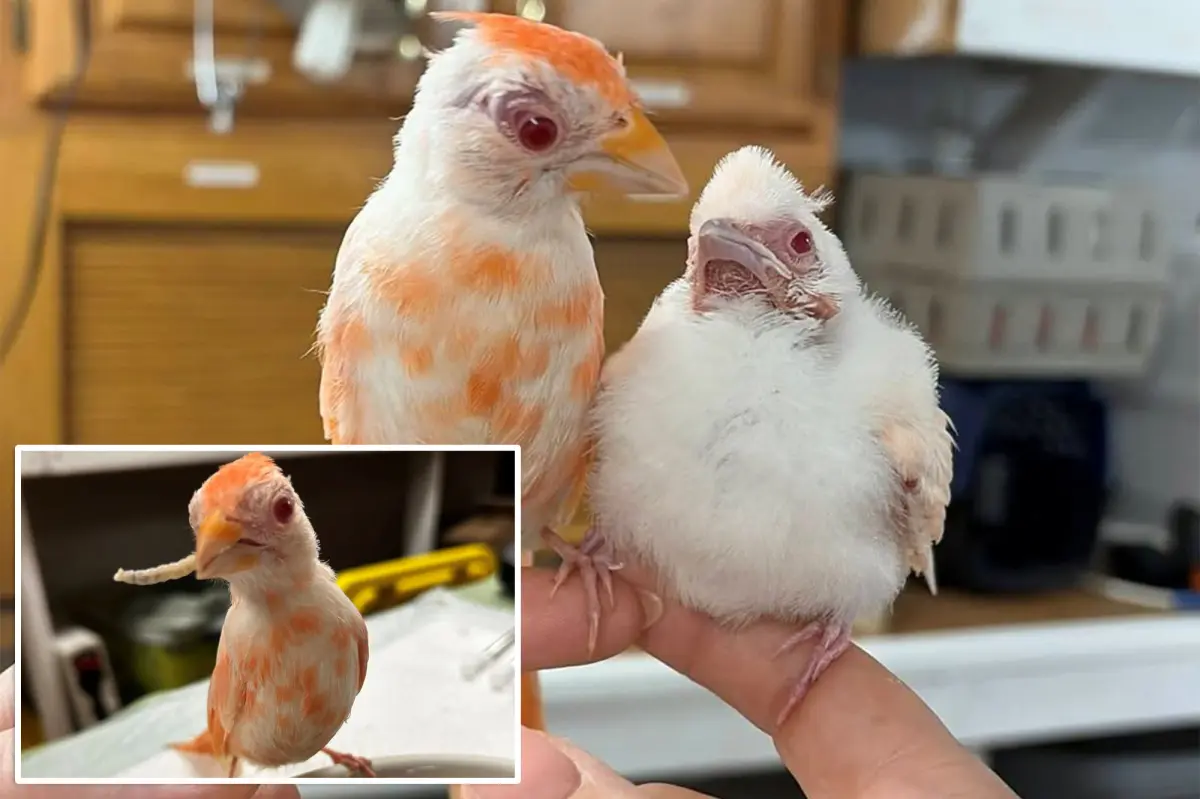
At Raven Ridge Wildlife Center in Washington Boro, Pennsylvania, there are moments that remind the staff why they chose this work—and then there are moments that stop them cold. One such moment came in July, when a rescuer arrived with a cardboard box, the kind you might find tucked under a car on a sweltering afternoon. Inside was a bird, injured and quiet, but when the box was opened, the room seemed to change. It wasn’t the familiar flash of scarlet or the soft brown of a female cardinal. It was white. Frosty—as they would soon call him—was an albino cardinal, a creature so rare that many wildlife rehabilitators go their entire careers without seeing one. The center posted on Facebook last week, still clearly moved by the encounter: “It wasn’t until we opened the box that we realized it was, in fact, an albino Cardinal. The chances of seeing an albino cardinal are extremely low.” That “low” is an understatement. According to the center, the odds of encountering a cardinal with white feathers are roughly 1 in 30,000. But true albino cardinals, birds that lack all pigmentation, are even rarer than that. Frosty was not just a white bird; he was a genuine biological anomaly, a creature of moonlight in a world of red and brown. For the team at Raven Ridge, the moment was both thrilling and humbling. They had been called to help an injured animal, and instead found themselves face to face with something almost mythical. The decision to take him in was immediate, and so was the sense of responsibility. A bird like Frosty doesn’t just need medical care; he needs a future. And in the wild, a future for an albino cardinal is fragile at best.
To understand why Frosty is so extraordinary, you have to understand what a cardinal is supposed to look like. Male cardinals are famous for their brilliant red plumage, a black face mask, and a sturdy orange-red bill. Females are more subdued—pale brown with warm hints of red in their crest, wings, and tail. Both are designed by nature to blend into their surroundings in their own way: males use color to attract mates and defend territory, while females use camouflage to stay safe on the nest. But albino cardinals break every rule. They lack melanin, the pigment that gives color to skin, feathers, and eyes. This means their feathers are pure white, and their eyes take on a reddish or pinkish tint. That unusual eye color is not just a cosmetic detail; it is a sign of a deeper problem. Albino birds often have poor vision, which makes it harder to find food, avoid obstacles, and spot predators. The white plumage, meanwhile, makes them impossible to miss. In a world of green leaves, brown branches, and winter snow, a white cardinal stands out like a beacon. Predators see it easily, and even other cardinals may treat it with suspicion. The center explained that albino cardinals face “significant survival challenges” precisely because of their conspicuous coloring. They are more vulnerable to hawks, cats, and other hunters, and their poor eyesight only adds to the danger. So when Frosty arrived, the staff knew that his story was never going to be a simple one. He was not just a rare bird; he was a bird in need of protection. And then, as if the universe wanted to test their sense of wonder, it happened again.
The second albino cardinal arrived not long after Frosty, and the staff at Raven Ridge could hardly believe their eyes. “Not only is it rare to see one albino cardinal, but we also admitted a second albino cardinal; we couldn’t believe that now we had two!” the center wrote. The odds of seeing one albino cardinal are already astonishingly low. To see two, in the same rehabilitation center, in the same season, feels almost impossible. It was a strange and beautiful twist of fate, but it was also a heartbreaking one. The second cardinal, who was never given a name, arrived with a severe ear infection. The team did everything they could—treated him, monitored him, hoped for him—but the infection was too much. Despite their best efforts, the bird died. There is a particular kind of grief that comes with losing an animal this rare. It is not just the loss of a life; it is the loss of a mystery, a chance to learn, a story that will never be told. But the staff at Raven Ridge chose to see the experience as something meaningful rather than simply tragic. “However, our team was pleasantly surprised and thrilled to have the opportunity to work with both Cardinals,” they wrote. That sentence says a lot about the people who do this work. They understand that wildlife rehabilitation is not about saving every animal. It is about showing up, offering compassion, and learning from whatever comes through the door. Even in loss, there is gratitude. Even in grief, there is wonder. To have held two albino cardinals in their hands, to have cared for them and studied them, is something no textbook could ever teach.
The challenges that albino cardinals face in the wild are not small. Their white feathers, so striking to human eyes, are a severe disadvantage in nature. Camouflage is a matter of life and death for most birds, and an albino cardinal has none. It cannot disappear into the shadows of a thicket or blend into the dappled light of a forest floor. Every movement is visible, every perch a potential target. Add to that the poor vision that often comes with albinism, and the odds become even steeper. A bird that cannot see well is a bird that cannot feed well, cannot navigate well, and cannot escape well. For a species that relies on quick reactions and sharp eyes, this is a heavy burden. The center noted that albino cardinals are more vulnerable to predators because of their conspicuous coloring, and that is perhaps the cruelest irony of all. A bird so beautiful is also a bird so exposed. Its beauty, in a way, is its danger. Frosty, however, has defied the odds so far. The facility reports that he is doing well and has “developed quite the personality.” He is eating, growing, and beginning to molt. As his old feathers fall away, new ones are coming in, and the staff have noticed “more color in different areas.” It is a fascinating development, one that raises questions about the exact nature of his condition and how his body is responding to care. But even with this progress, Frosty’s future is not in the wild. The center knows that his chances of survival there are slim. His white feathers would make him an easy target, and his vision may never be sharp enough to keep him safe. So Frosty will remain in captivity, not as a prisoner, but as a protected soul—a rare and gentle creature who will spend his life in the care of people who understand how special he is.
For the team at Raven Ridge Wildlife Center, Frosty has become more than just a patient. He has become a teacher. “This experience has been a valuable learning opportunity for our team, and we are grateful for the chance to work with this special Cardinal,” the center wrote. That gratitude is genuine, and it speaks to the heart of wildlife rehabilitation. Every animal that arrives at a center like Raven Ridge has a story, and every story offers a lesson. Frosty’s lesson is about resilience, about the quiet strength of a creature that should not exist but does. It is also about the responsibility that comes with caring for something so fragile. The staff have watched him grow, watched his personality emerge, watched him begin to molt and show new colors. They have seen him survive when the odds were stacked against him, and they have allowed themselves to be changed by that experience. In a world that often moves too fast, Frosty asks them to slow down, to observe, to appreciate the small details. His reddish eyes, his white feathers, his stubborn will to live—all of it is a reminder that nature is full of surprises, and that even the rarest creatures deserve a chance. The second albino cardinal may not have survived, but his brief time at the center was not wasted. He, too, contributed to the team’s understanding of these extraordinary birds. And Frosty, in his own quiet way, carries that memory forward.
In the end, the story of Frosty and the second albino cardinal is not just a story about birds. It is a story about the unexpected gifts that arrive in cardboard boxes, about the people who devote their lives to caring for the vulnerable, and about the strange, fragile beauty of life on this planet. The chances of seeing an albino cardinal are 1 in 30,000. The chances of seeing two are almost incalculable. And yet, for a brief moment in Pennsylvania, two of these impossible creatures were alive, under the same roof, cared for by the same hands. One of them slipped away, but the other remains—a living symbol of hope, rarity, and the quiet determination to survive. Frosty will never fly free in the wild, but he will live. He will eat, molt, and perch in the safety of a place that values him not for what he can do, but for what he is. And for the people at Raven Ridge Wildlife Center, that is enough. They did not set out to find a miracle. They simply opened a box, looked inside, and found one. In doing so, they were reminded of why they do this work: not for the recognition, not for the statistics, but for the chance to make a difference in the life of a creature that has no one else to turn to. Frosty is that chance. And he is still here, still white, still rare, still teaching everyone around him what it means to be alive.