

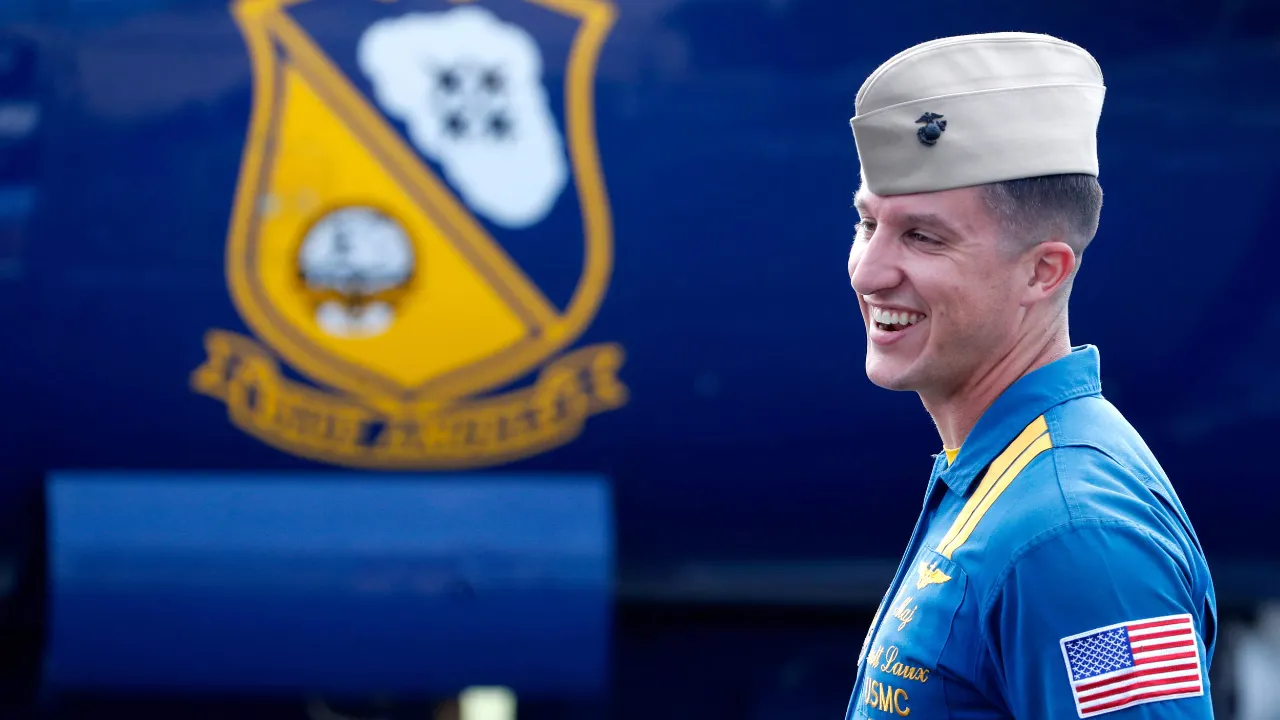
Some careers end with a landing, a handshake, and a retirement ceremony. For Major Scott Laux, the end came quietly, abruptly, and without public explanation. The Blue Angels pilot known as Blue Angel #6 was removed from the Navy Flight Demonstration Squadron for what officials described as failing to uphold the standards expected of its members. The announcement arrived Friday, just before the team’s season finale at Naval Air Station Pensacola, leaving the squadron to perform with five jets instead of the usual six. The Chief of Naval Air Training confirmed the removal to the Pensacola News Journal, and in a brief statement, the public affairs office said Laux would not participate in the team’s remaining performance this season. Fox News Digital reached out for more details, but as of Sunday morning, no further explanation had been offered. The timing was painful. This was supposed to be a homecoming—a celebration of the Blue Angels, their city, and the year’s flying. Instead, there was a gap in the formation and a silence where a biography had once been. For those who follow the Blue Angels, the news was stunning. Laux was a second-year member of the elite team, a Marine aviator with more than 1,300 flight hours and 169 carrier landings. He had earned his place among the best of the best. The Blue Angels are not just a demonstration team; they are the public face of naval aviation, precision, and discipline. To be removed from that team is a career-altering event. The statement did not say what he did or when he did it. It simply said he failed to uphold standards. In a world where every maneuver is measured in feet and seconds, where trust is a matter of life and death, standards are everything. But for the rest of us, the phrase is cold and opaque. It leaves more questions than answers. What happened? Why now? And what does it mean for a man who spent his life chasing the sky? Imagine the silence in the locker room after the announcement. Imagine the phone calls, the packing, the goodbye. For a fighter pilot, the Blue Angels are the peak—the absolute pinnacle of a profession already defined by excellence. There is no higher stage, no brighter spotlight. To be chosen is to be told that you are one of the best. To be removed is to be told that you are no longer worthy of that trust. It is a fall that happens in an instant, but it echoes for a lifetime.
The context makes the dismissal even more complicated. Months before the removal, in July, the Blue Angels performed a low flyover over Pensacola Beach that turned a day at the shore into a moment of chaos. The beach that day was packed. Families had set up umbrellas, children were playing in the surf. The jets appeared without warning, and the world seemed to shake. For a moment, the sky and the sand became one. Videos showed tents, beach chairs, and umbrellas tumbling across the sand as the jets roared overhead. The pass was so low that the wind it created sent debris flying and prompted safety concerns among beachgoers. It was a striking image: the very spectacle designed to inspire awe had, for a moment, frightened the crowd. Laux defended the team’s low-flying displays in an interview after the incident. “We appreciate the trust in support and it’s our privilege to be able to perform in that way,” he said. “We’re gonna keep bringing the heat and continue doing it safely.” It was a confident, almost defiant defense, the kind of response expected from a fighter pilot. But the public reaction was mixed. Some saw the flyover as a thrilling show of American power. Others saw a close call that could have ended in injury. The debate over the flyover was not just about safety. It was about the culture of a team that prides itself on pushing limits. The Blue Angels have always flown low and fast. That is part of their identity. The roar of the engines, the rush of wind, the heart-stopping proximity of the aircraft—these are the things that make the team legendary. But there is a difference between calculated risk and perceived recklessness. On the beach that day, the line between the two seemed to blur. And when Laux spoke about the incident, he did not sound like a pilot who thought he had done anything wrong. He sounded like a man who believed in the mission, who trusted his training, and who expected the public to trust him too. That trust, it turns out, is not automatic. It has to be earned again and again, with every flight, every maneuver, every decision.
The debate quickly became political. Acting Navy Secretary Hung Cao took to X to defend the flight, writing: “Flight debrief complete. No reprimands. No firings. No problem. That’s the sound of Freedom! Semper fi and Hooyah.” Defense Secretary Pete Hegseth went further, vowing more support and adding, “The flyovers will continue until morale improves.” The White House even posted a photo meme of the controversial flyover from its official X account, with the caption “It’s okay to love America.” For many, the response was a signal that the Navy was not going to bow to critics. The low pass was framed as an expression of patriotism, not recklessness. The leaders who defended the flyover were not just defending a maneuver; they were defending a vision of American strength. They saw the jets screaming over the sand as a reminder of the power that protects the country. The critics saw a risk to public safety that could have ended in tragedy. Both sides had a point. The flyover was breathtaking, and it was also dangerous. The Navy’s leadership chose to emphasize the former. The statement from Cao—“No reprimands. No firings. No problem”—was an attempt to close the issue. But the image of beach furniture flying through the air was hard to forget. And when news broke that a Blue Angels pilot had been removed for failing to uphold standards, it was natural to wonder whether the July flyover was connected. The Navy has not said. There has been no official link between the removal and the beach incident. But the timing—months after a public safety controversy—made the dismissal impossible to view in isolation. The Blue Angels are expected to walk a fine line: thrilling crowds while keeping them safe. That line, it seems, may have been crossed. Or perhaps the removal had nothing to do with the flyover at all. Without details, the public is left to guess, and the silence from the Navy only deepens the mystery.
What is known is that Laux was not at the NAS Pensacola Homecoming Air Show on Friday and Saturday. The team flew with five jets, and the usual six-jet choreography was adjusted to account for the missing aircraft. Laux’s role as the opposing solo is one of the most visible and demanding positions in the show. He flew with the lead solo in head-on crossing passes and mirror-image maneuvers, the kind of high-speed, close-quarters flying that makes audiences gasp and requires absolute trust between pilots. Without him, the routine had a hole that could not be filled by simply swapping pilots. The performance went on, but it was different. The air show continued, because air shows always continue. But the pilots who flew that day knew something was different. They flew the same maneuvers, but the rhythm was off. The solo routines were missing their mirror. The head-on passes had a different feel. The crowd saw a show; the pilots felt a loss. His photo and biography were removed from the Blue Angels website’s team page, though the bio remained accessible through a direct link as of Sunday morning—a digital ghost of a career that was still being written. The Navy has not said when Laux was dismissed or what conduct prompted the decision. The 2026 narrator, Lieutenant Commander Ronny Hafeza, might replace Laux on the 2027 team. Blue Angels officers serve three-year terms, one of them as narrator, which is how Laux began his time with the team. The fact that a replacement is already being discussed suggests that the Navy has moved on, even if the public has not. There is something unsettling about that. A man’s career ends, and almost immediately, the machinery of succession begins. But that is how institutions work. The Blue Angels must continue to fly. The show must go on. And yet, for Laux, the show has stopped. He is no longer listed with the team. His name no longer appears beside the others. The only trace of him is a cached page, a biography that describes achievements that no longer seem to matter. It is a lonely way to disappear from a team that once felt like family.
The story of Scott Laux is not just a story of a fall. It is also a story of an extraordinary rise. A native of Chantilly, Virginia, Laux graduated from the U.S. Naval Academy in 2012 with a degree in Chinese. That choice of major says something about his intellect and curiosity—this was not a man who took the easiest path. He was not just a pilot; he was a student of languages, a man who chose to study Chinese at the Naval Academy, a sign of strategic thinking. He earned his wings in 2015 and went on to fly F/A-18 Hornets with Marine Corps squadrons. He deployed to Japan and served aboard the USS Nimitz, supporting three operations during the 2020 carrier deployment: Resolute Support, Inherent Resolve, and Octave Quartz. Those names may not mean much to civilians, but they represent real missions, real danger, and real service. Later, Laux transitioned to the F-35C Lightning II, the most advanced fighter in the American arsenal, and served as an instructor pilot. That assignment is a mark of trust; the Navy does not let just anyone teach its pilots to fly a fifth-generation fighter. In September 2024, he joined the Blue Angels, one of a handful of aviators selected each year for the most visible flying job in the world. He spent his first season as the team’s narrator, the voice of the show, before becoming Blue Angel #6. His awards include two Navy and Marine Corps Commendation Medals and multiple unit awards. By any measure, Laux had achieved what most pilots only dream of. He had flown combat missions, landed on aircraft carriers, mastered the most advanced jets in the world, and joined a team whose name is known around the globe. And then, in a moment, it was gone. The details of his removal remain unknown, but the weight of it is clear. For a man who spent his life meeting every standard the military set before him, the accusation that he failed to uphold the standards of the Blue Angels is not just a professional setback. It is a personal blow, a rupture in the story he had written for himself. It is the kind of thing that makes a person question everything.
There is a tendency to reduce this story to a lesson about accountability. And it is true that the Blue Angels exist because of standards. The team’s name is synonymous with excellence, and excellence cannot tolerate shortcuts. If a pilot fails to uphold the standard, the team must act, even if it means flying with five jets at a homecoming show. But there is also a human dimension that is easy to miss. Major Scott Laux is not a symbol. He is a person who spent his life serving his country, who flew dangerous missions, who taught others to fly, who thrilled crowds with maneuvers that most people cannot imagine performing. He is a person who now faces an uncertain future, with a career cut short and a reputation marked by a single phrase: failing to uphold standards. We may never know exactly what happened. The Navy’s silence leaves room for speculation, but it also leaves room for grace. Perhaps the removal was justified. Perhaps it was the result of a single mistake. Perhaps it was something else entirely. What is certain is that the Blue Angels will continue to fly. The formation will be full again. The crowds will look up and cheer. But for those who know this story, the missing jet will be a reminder that even the brightest stars can fall, that discipline is the price of freedom, and that the men and women who fly these machines are human, after all. And that is precisely what makes their achievements so remarkable. The sky does not care about reputation. It only asks that you meet the standard. On Friday, the sky over Pensacola saw a five-jet show. It was beautiful, but it was incomplete. And somewhere, a pilot who once flew with the Blue Angels was watching the same sky, wondering what comes next. The answer is not written. But if his past is any guide, he will not stop moving forward. He has 1,300 hours of flight behind him, 169 carrier landings, and a lifetime of discipline. Whatever comes next, it will be faced the way he faced everything else—with his eyes open, his hands steady, and the memory of the blue and gold still burning in his heart.