

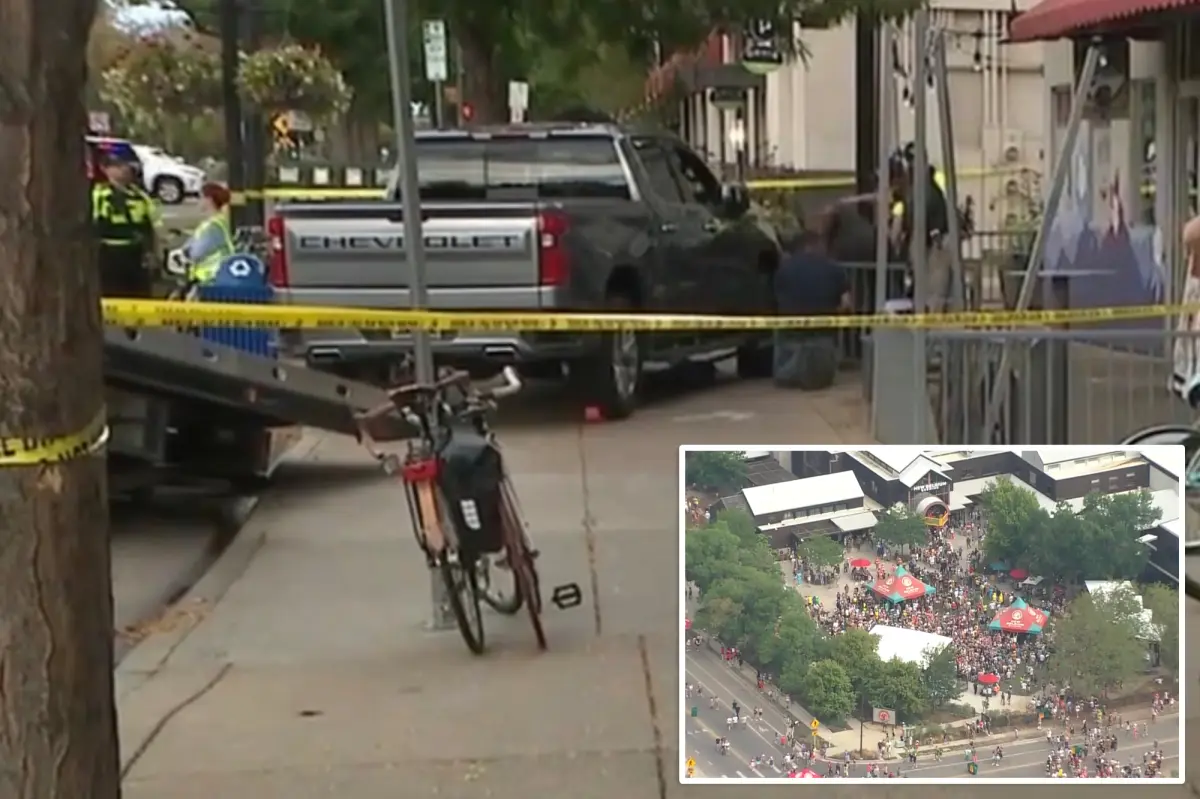
The morning had begun in the spirit of joy, the kind that settles over a town when neighbors gather to celebrate something they love. Fort Collins, Colorado, was alive with color and motion on that Saturday, as cyclists and spectators poured into the historic streets of Old Town for the annual Tour de Fat bicycle festival. There were costumes and bells, children chasing one another, families standing shoulder to shoulder on the sidewalks, and the easy hum of a community enjoying itself under a bright Colorado sky. It was the kind of scene that feels timeless and ordinary in all the best ways. But just before noon, that ordinary morning was violently interrupted. At 11:45 a.m., a Chevrolet pickup truck drove up onto a busy sidewalk, striking multiple pedestrians before slamming into a tree. In a matter of seconds, the festive atmosphere shattered. By the time the truck came to a stop, one person had been killed, several others were injured, and a community that had been celebrating life was suddenly gripped by shock, grief, and confusion. The Fort Collins Police Services later confirmed the death, though the victim’s identity had not yet been released. Six people, including the driver, were transported to hospitals with injuries of varying severity. The image of that cheerful sidewalk, populated by families and festival-goers, became the backdrop for a tragedy that no amount of preparation could have predicted.
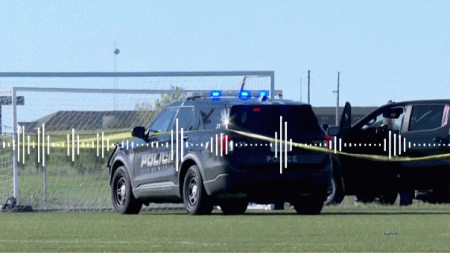
The details of the crash, pieced together by investigators, only added to the sense of senselessness. According to the Fort Collins Police Services, the driver had been in a parking space on Mountain Avenue and first reversed out, striking another vehicle. Then, instead of stopping or pulling away, the truck drove forward, mounted the sidewalk, and careened through an area where pedestrians had been walking. Witnesses described a chaotic scene of people scattering, some not fast enough. The truck did not stop until it plowed head-on into a tree, where it finally came to a rest. The area was crowded because of the bicycle festival, which had drawn throngs of people to the neighborhood. Police noted that there were numerous bystanders and patrol officers in the vicinity at the time of the collision, a fact that underscored how close this tragedy came to being even worse. One person was pronounced dead at the scene or after being transported, though the official statement was careful to note that the victim had not yet been identified. The driver, who was among the six taken to the hospital, survived. In the immediate aftermath, a key early finding emerged: police did not believe the pedestrians had been intentionally targeted. This was a crucial reassurance for a community that had already begun to wonder whether the crash had been an act of violence. But it also left a harder question: How could something so terrible have happened on a morning that had started with so much promise?
Police Chief Jeff Swoboda addressed the public with a tone that matched the gravity of the moment. “This was a tragic day for many in our community,” he said in a press release. His words carried the weight of a city that had lost one of its own and now had to find a way to grieve while still seeking answers. Swoboda acknowledged that the impact of the incident would extend far beyond the people who were physically injured. “We recognize the impact that this incident will have on those involved, the witnesses, and the responders,” he said. That recognition was important. In a moment when the attention naturally turned to the victims, the chief was also acknowledging the invisible wounds that would be carried by everyone who saw the crash unfold. Victim advocates were already on the scene or on their way, tasked with the difficult work of holding space for trauma, answering questions, and helping people begin the long process of recovery. Swoboda also expressed gratitude for the “quick response of our officers, the assistance of our emergency partners, and the community members who helped during this incident.” It was a reminder that even in tragedy, there were moments of grace — strangers rushing to help, first responders moving with precision, and a community refusing to look away from those who were hurting. The crash site was closed for roughly six hours as investigators worked to reconstruct every detail, but even after the road reopened, the emotional closure would take far longer.
The location of the crash made the tragedy impossible to separate from the event that had brought so many people to the street that day. The fatal collision took place less than a mile away from the main Tour de Fat bicycle parade, an annual gathering that draws large crowds to Fort Collins and has become something of a local institution. Tour de Fat is meant to be a celebration of cycling, community, and the quirky spirit of the town — a day when people dress up, bring their bikes, and enjoy a sense of shared belonging. That this tragedy would happen on the edge of such an event struck many as bitterly ironic. The presence of the festival also meant that the area was full of witnesses. There were patrol officers stationed nearby, and the sidewalks were lined with people whose day had been planned around fun, not fear. The Fort Collins Police Services assigned its Collision Reconstruction and Scene Handling Team to investigate the circumstances leading up to the fatal crash. One of the early focuses of the investigation was whether impairment had played a role. The fact that investigators were paying close attention to this detail suggested a methodical effort to determine exactly why the driver lost control or made the choices that led to the tragedy. Until that investigation was complete, many questions would remain unanswered. But in the meantime, those who had witnessed the crash were left with images that would not easily fade, and a community was left to wonder how a celebration could turn so quickly into a scene of devastation.
In the hours after the crash, the full human weight of the tragedy began to settle over Fort Collins. For every person injured there was a family waiting in a hospital corridor, hoping for good news, bracing for terrible news. For every witness there was a sleepless night ahead, a replaying of the scene, questions about whether there had been any warning, any chance to act differently. For the first responders who arrived at the scene, there was the heavy task of sorting through chaos, providing medical care, and maintaining calm while their own emotions churned beneath the surface. The police chief’s mention of victim advocates was a quiet acknowledgment of this reality. The response to a fatal crash is not just about clearing the road and filing reports. It is about holding the hands of people who are terrified, answering calls from loved ones who haven’t heard from their family members, and staying long after the cameras have gone home. It is about recognizing that the trauma of a single event can ripple outward through a whole community. People who had never met the victim found themselves in a state of mourning. People who had been at the festival but had not seen the crash found themselves grateful for their own safety and, at the same time, guilty for that gratitude. The human heart is not good at making sense of random violence, even when the violence is no one’s intention. It struggles to reconcile the joy of a bicycle festival with the image of a pickup truck crashing into a tree. It looks for explanations, for causes, for someone to blame. And when none of those things come easily, it is left with silence and the slow, painful work of healing.
That work now falls to investigators and to the community in equal measure. The Fort Collins Police Services Collision Reconstruction and Scene Handling Team is examining every element of the incident — the way the truck moved, the condition of the driver, the actions of everyone involved, the possibility that impairment or some other factor explain how a simple parking accident turned into a fatal crash. The initial investigation determined that the driver reversed from a parking spot on Mountain Avenue and struck another vehicle before driving forward onto the sidewalk and into the crowd. Reconstruction experts will painstakingly map those movements, interview witnesses, review surveillance footage, and piece together a timeline that might answer the lingering questions of a grieving community. Police have been careful not to draw premature conclusions, and they did not immediately identify the person who died. They also did not provide immediate updates on the condition of the six people taken to the hospital, leaving friends and loved ones to wait in uncertainty. The news organization that reached out to the police department did not receive an immediate response, which was perhaps a sign of how busy officials were trying to manage the aftermath. In the days ahead, there will be memorials, fundraisers, and quiet moments of reflection. There will be conversations about street safety, about festival security, about whether more could have been done to protect pedestrians. But for now, there is only the slow and necessary process of grieving. What happened in Fort Collins on that Saturday morning was not intentional, if the early findings are correct. But it was tragic, and its effects will be felt long after the wreckage is cleared. The city will heal, as communities often do, by leaning on one another. The festival will return. The streets will be filled again with laughter and light. But the memory of that moment — the sound of a truck thundering onto a sidewalk, the screams of frightened people, the silence after the crash — will remain with all who were there. And in the weeks to come, the community will be asked not to offer explanations, but to offer presence: to support the grieving, to listen to the witnesses, to thank the responders, and to never forget that even in the most beautiful of moments, life can change in an instant.