



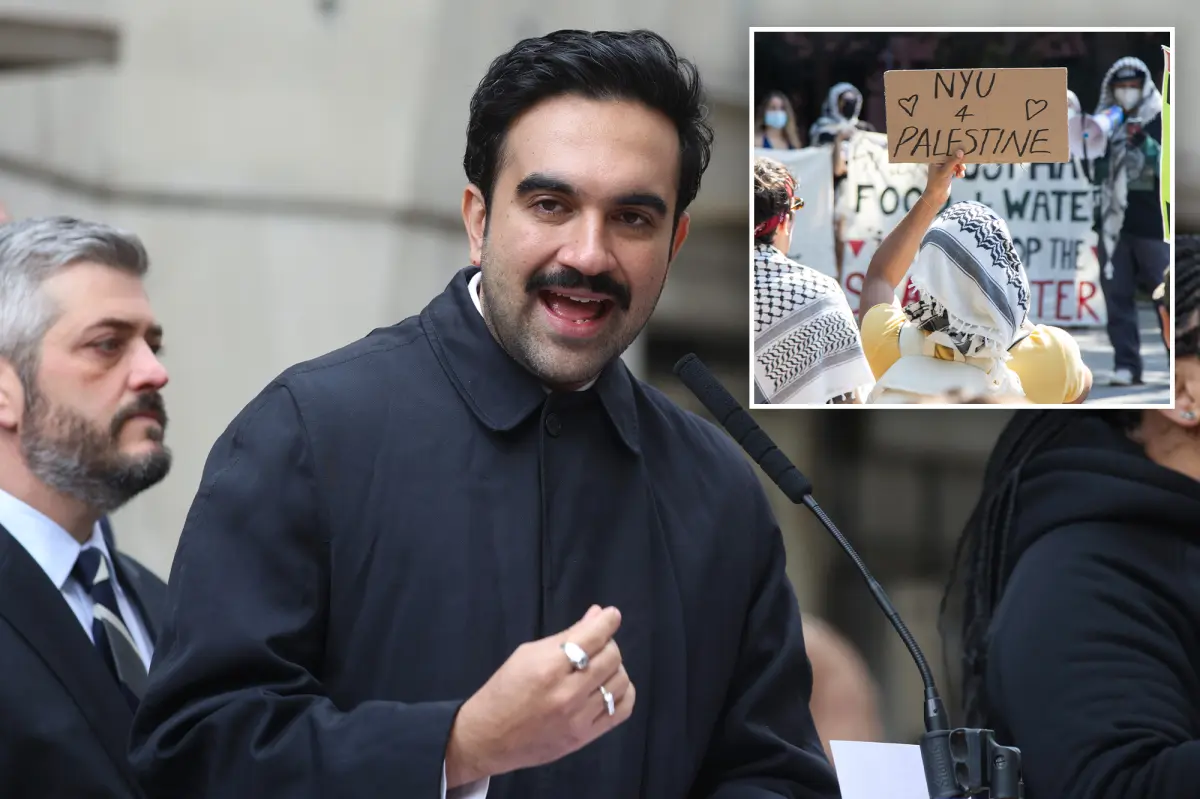
New York City has long prided itself on being a place where every community can find a home, where the streets are layered with languages and traditions from every corner of the globe. It is also a city defined by its universities, a global capital of learning where students and scholars come to question, discover, and shape the future. So when Mayor Zohran Mamdani’s administration released its “Strategy to Combat Antisemitism” in September, many hoped it would be a sweeping, inclusive plan reflecting the full breadth of Jewish life in the city. Instead, Jewish faculty and staff at two of the city’s most important academic networks—the City University of New York and New York University—say the plan misses something crucial: the very campuses where so many young New Yorkers first encounter hatred, and where Jewish academics are increasingly feeling pushed out. In a joint statement to The Post, the CUNY Alliance for Inclusion and the Faculty and Staff Against Antisemitism at NYU called the near absence of higher education from the strategy “a significant omission.” Their words carry the weight of experience: people who spend their days in classrooms, faculty meetings, and campus hallways, watching the temperature rise for Jewish members of their communities, and feeling as though City Hall is not fully seeing the problem. The mayor’s plan is long on noble promises—declaring that every Jewish New Yorker deserves to worship, raise a family, celebrate, and belong “fully and openly.” But for those who live and work in higher education, the gap between that beautiful language and the everyday reality on campus is hard to ignore.
The faculty groups were careful to explain that antisemitism in academia cannot be understood only through crime statistics or physical threats. Yes, hate crimes matter deeply, and Jewish students have been menaced and harassed on campuses across the country. But there is a quieter, more insidious form of exclusion that happens inside the structures of academic life itself. Antisemitism, they argued, can seep into departments, faculty governance, academic associations, professional networks, labor unions, and graduate-worker organizations. It shapes whose scholarship is taken seriously, whose viewpoints are treated as legitimate, and who is welcomed into the inner circles of intellectual life. A professor might find their research dismissed not because of its quality but because of their identity or their connection to Israel. A graduate student might fear that expressing a particular political view will destroy their chances of finding a mentor, a job, or a collaborator. A staff member might feel isolated in meetings where Jewish identity is mocked or where support for Israel is treated as a moral failing. This is not always loud or violent; sometimes it is a subtle pattern of exclusion, an ideological litmus test, a closed door. The groups also warned that intense criticism of Israel and Zionism can cross a line into outright antisemitism. They defined that line clearly: anti-Zionist rhetoric becomes antisemitic when Jewish, Israeli, or Zionist members of academic communities face exclusion, harassment, intimidation, ideological tests, professional retaliation, calls for violence, or unequal treatment simply because of who they are or what they believe. That definition did not appear in the mayor’s report, which, in thirty-three pages, never once mentioned Zionism and refused to adopt a formal definition of antisemitism. For the faculty groups, that was a red flag—a sign that the plan might be avoiding the hardest questions.
The data supporting their concerns is sobering. A survey of 209 Jewish-American professors conducted last year by the Academic Engagement Network and the Anti-Defamation League found that nearly three-quarters of respondents had observed anti-Jewish activity or statements by colleagues at their colleges. That is not an isolated incident or a handful of complaints; it is a systemic pattern reported by the people inside the institutions. Even more troubling, 43 percent of those professors said they felt unwelcome at faculty events, and nearly 40 percent felt they needed to hide their Jewish identity on campus. Think about what that means: in a profession built on open exchange and intellectual courage, a large portion of Jewish academics are editing themselves, staying quiet, and putting on masks just to get through the workday. They are not only worried about their comfort; they are worried about their careers. The professors raised a fundamental question for New York City’s institutions of higher education: Can Jewish members participate fully in university life while openly expressing their identities, affiliations, and views? It is a question that goes to the heart of academic freedom. If a Jewish scholar cannot openly discuss their heritage, their family’s history, or their support for Israel without fearing retaliation, then the university has failed its most basic mission. That is why the professors say the mayor’s report does not confront the real problem. A strategy that focuses on hate crimes but ignores the everyday climate of exclusion in departments and unions is a strategy that misses the forest for the trees.
So what do the faculty groups want? They want higher education to be an explicit and meaningful part of New York City’s response to antisemitism. They want the Mamdani administration to make colleges and universities a priority, not an afterthought. And they want the city to actually talk to faculty groups—not just to issue statements from City Hall, but to listen to the people who are on the ground, attending the department meetings, sitting on the hiring committees, and advising the graduate students. The professors believe it is possible to root out antisemitism in academia without sacrificing free speech. This is not about censorship or political correctness; it is about making sure that the open exchange of ideas does not become a cover for the exclusion of Jewish voices. They offered a powerful vision of what belonging should mean: “The promise that Jewish New Yorkers can belong ‘fully and openly’ should extend to the professor in a department meeting, the graduate worker in a union, the researcher seeking collaborators, the staff member at work, and the student in a classroom.” That sentence captures something essential—that belonging cannot be a slogan. It has to be experienced in the most ordinary moments of academic life. A professor should not have to brace herself before entering a faculty meeting. A graduate worker should not have to wonder if his union will stand up for him. A researcher should not have to search for allies who will not quietly distance themselves. A student should not have to hide a photo of their family in Jerusalem. These are the small, human realities that the strategy, as written, fails to address.
To be fair, the mayor’s report did not entirely ignore higher education. It mentioned the city Commission on Human Rights’ “Understanding Jewish Experience” training, developed in partnership with the Wagner College Holocaust Center, which covers the diversity of Jewish traditions and helps people identify civil rights violations. Mamdani himself visited the Kupferberg Holocaust Center at CUNY’s Queensborough Community College in April, meeting Holocaust survivors and CUNY scholars and leaders. The report also noted that the city Department of Education had adopted a practice common in higher education by hiring a K-12 Title VI coordinator to manage discrimination complaints, including those based on antisemitism. These are concrete gestures, and they matter. But they are also small in comparison to the scale of the problem. A training program, a visit, a coordinator—these are not substitutes for a comprehensive strategy that treats universities as central to the fight against antisemitism. The mayor also highlighted a major increase in hate crime prevention funding, from $3 million to $29 million annually, and said that his administration had kept a promise made during the campaign. That is significant, and it should be acknowledged. But the faculty groups are asking for more than money. They are asking for a shift in focus, a willingness to look directly at the structures of academic life and ask hard questions about who is being excluded and why. They are asking the city to stand with Jewish academics not just when they are attacked on the street, but when they are marginalized in the workplace, the classroom, and the conference hall.
In the end, the professors’ critique is not a rejection of the mayor’s plan; it is an invitation to expand it. New York City cannot truly combat antisemitism if it ignores the places where young people are formed, where ideas are debated, and where the next generation of leaders is being educated. Universities are not ivory towers; they are engines of culture and power, and the attitudes that develop there ripple outward into every profession and community. If a Jewish graduate student learns that it is safer to stay silent about her identity, she will carry that lesson into her career. If a professor learns that certain topics are off-limits, he will train his students to avoid them. That is how prejudice becomes normalized, and that is why higher education cannot be left out of the conversation. The mayor’s strategy rightly promises that every Jewish New Yorker deserves the same freedoms as every other New Yorker—to worship, to raise a family, to celebrate, to belong completely. Those are beautiful words. But the faculty groups are asking a simple and deeply human question: Do those words include us, in our own institutions, among our own colleagues? The mayor’s office declined further comment, leaving the question hanging in the air. Yet for the Jewish faculty and staff at CUNY and NYU, the answer will be found not in press releases, but in the everyday experience of walking into a department meeting, raising a hand to speak, and feeling, for the first time in a long while, that they are truly at home. That is the standard the city should be aiming for—and until higher education is at the center of the strategy, it will not be met.