


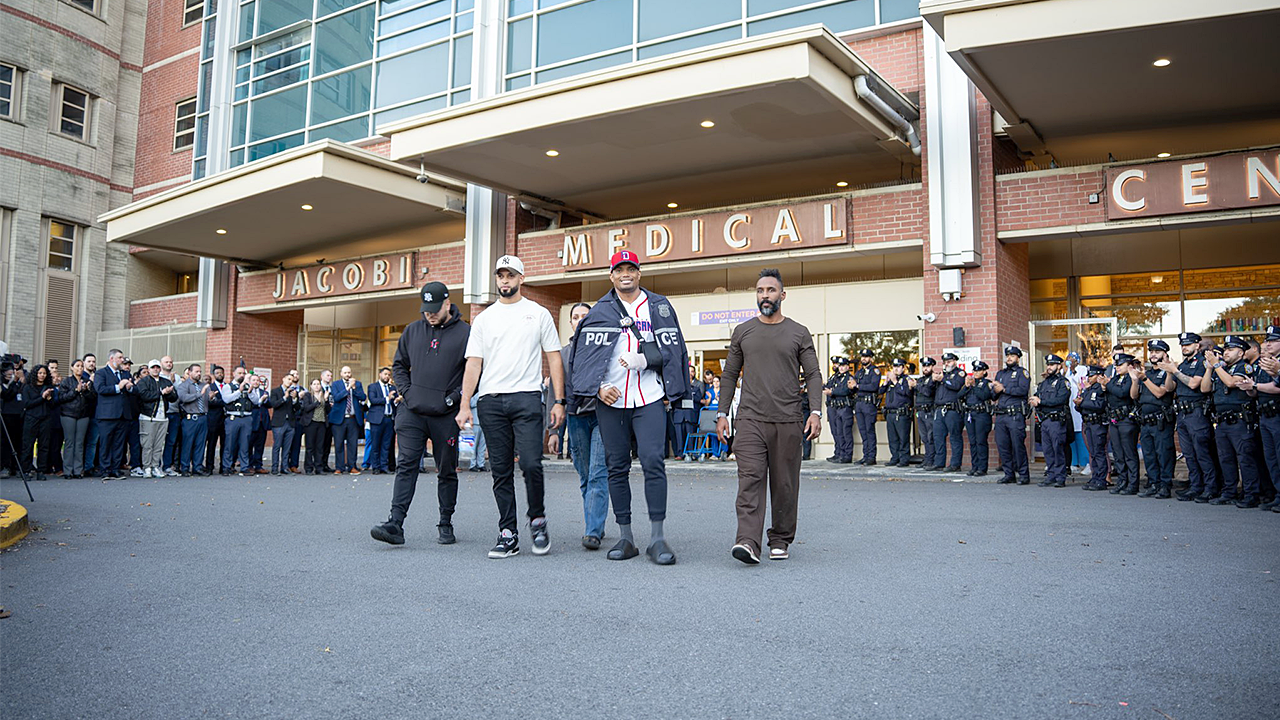
When Detective Jose Mercedes finally walked out of Jacobi Medical Center, the weight of what he had survived was written in the bandages and slow movements of his body, but his spirit was unmistakably intact. The 33-year-old, a ten-year veteran of the NYPD assigned to the 44th Precinct in the Bronx, had been stabbed and slashed seven times in a vicious ambush that could have ended his life. Yet there he was, speaking to the New York Post with quiet gratitude: “I’m feeling much better, thank you.” Those simple words were a profound relief to the colleagues, family, and friends who had spent days praying for him. The attack occurred on Oct. 2, while Mercedes was off duty, doing something utterly ordinary—cleaning out the trunk of his car. In that mundane moment, two suspects allegedly emerged from the shadows, targeting him for the gold chain around his neck. What followed was not just a robbery, but a brutal assault that left the detective fighting for his life on a city street, bleeding heavily from wounds to his neck and leg.
The details of the assault read like a nightmare that every officer fears. Mercedes was not in uniform, not on patrol, and not prepared for a battle, yet when the suspects ambushed him, he did not simply surrender. He fought back, using every instinct and ounce of strength he had to defend himself against the alleged attackers. The two men, later identified as D’Angelo Caraballo, 25, and Sneider Mejia, 24, reportedly ripped the gold chain from his neck and fled on a motorized bike, leaving the detective collapsed and covered in blood. A video obtained by the New York Post shows Mercedes being loaded into an ambulance, his clothing soaked in red, his face etched with pain and exhaustion. The footage is visceral, a stark reminder that violence can find anyone, anywhere, even when they are just going about their day. He was rushed to Jacobi Medical Center, where trauma teams worked to stabilize him. The fact that he survived seven stab wounds is extraordinary, a testament to his own resilience and the skill of the medical professionals who treated him. For days, the NYPD held its collective breath, and the Bronx community watched with heavy hearts as the detective fought through the pain and the long road to recovery.
When Mercedes was finally discharged, his homecoming was nothing short of emotional. Dozens of fellow NYPD officers gathered outside the hospital on Monday evening to honor their brother in blue. The sound of bagpipes filled the air, a mournful yet celebratory melody that echoed the pride and sorrow of the moment. As Mercedes was wheeled out, the crowd erupted in applause, their cheers a balm for the raw wounds of the past days. Then something remarkable happened: the detective, despite his injuries, stood up from the wheelchair, smiled, and flashed a thumbs-up to the crowd. It was a small gesture, but it spoke volumes about his character and his determination to not be broken. In that moment, he was more than just a victim or a patient—he was a symbol of courage, a man who had faced death and refused to let it take him. The scene was a powerful reminder of the bond that exists among law enforcement officers, a brotherhood and sisterhood that rallies around one of their own in times of crisis. His family stood nearby, their faces a mixture of relief and lingering worry, knowing that the physical wounds may heal but the emotional scars will take much longer.
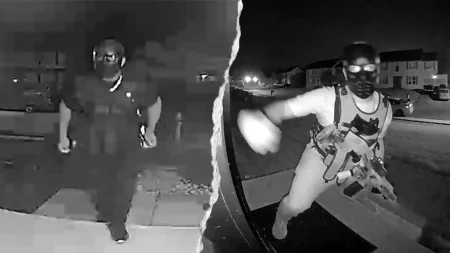
As Mercedes began his recovery, the search for his attackers quickly intensified. The NYPD identified Caraballo as the alleged slasher, the man who wielded the weapon and inflicted those devastating wounds, while Mejia was accused of driving the motorized bike used in the getaway. The investigation soon uncovered a troubling twist: both suspects were identified by federal authorities as illegal immigrants from the Dominican Republic, each with lengthy criminal records. This was not a case of first-time offenders or petty criminals; these were men with histories that should have raised red flags long before they ever crossed paths with Mercedes. After a coordinated effort, the pair were found hiding in the basement of a home in Lynn, Massachusetts, and taken into custody by the U.S. Marshals Service. The arrest brought a measure of justice to the detective and his family, but it also raised difficult questions about how such individuals were on the streets in the first place. In Lynn District Court, the two were ordered held without bail during a joint appearance, and they are expected to be returned to New York City to face attempted murder charges. For now, they remain behind bars, their alleged reign of violence halted.
The case has sent shockwaves through the law enforcement community and beyond, reigniting painful debates about officer safety, immigration enforcement, and the compounding failures that allow dangerous repeat offenders to remain at large. For Detective Mercedes, the attack was not an abstract policy issue—it was a street corner in the Bronx, a pair of hands reaching for his chain, a blade slicing through his skin. It was a moment of terror that no amount of training could fully prepare him for, and yet he endured. The fact that his alleged attackers were illegal immigrants with criminal records has added a layer of anger and frustration for many who feel that the system failed him. NYC’s sanctuary policies, which limit cooperation between local law enforcement and federal immigration authorities, are once again under scrutiny. But for those who stood outside the hospital, applauding his release, the focus was not on politics. It was on the man, the husband, the father, the son, the detective who had shown incredible bravery in the face of unthinkable violence. They saw his bloodied hands and his resilient smile, and they remembered that behind every badge is a human being, someone with hopes, fears, and a family waiting at home.
As the days go on, Jose Mercedes will continue to heal, surrounded by the love of his department and his community. He will undergo more surgeries, physical therapy, and the long internal process of making sense of a random act of violence that nearly took everything from him. But he has already proven something to the world: he is a survivor. His statement, “I’m feeling much better,” carries with it the quiet strength of a man who has stared into the abyss and chosen life. His recovery will be slow, but every step he takes, every laugh he shares with his colleagues, every moment he gets to spend with his loved ones is a victory. The alleged attackers, meanwhile, await their day in court, where they will be held accountable for their actions. And in the Bronx, a community is reminded that heroes walk among us, often unnoticed, until the unthinkable happens. Detective Mercedes’ ordeal is a story of tragedy and triumph, of pain and perseverance. It is a story that humanizes the men and women who wear the uniform, showing us that they are not invincible, but they are brave. His smile, that brave thumbs-up, will not soon be forgotten. It is a beacon of hope, a testament to the indomitable human spirit, and a reminder that even in our darkest moments, we can find the strength to stand up, dust ourselves off, and embrace the gift of another day.