






At Ground Zero, a light still shines on America’s darkest day, a quarter century after the world watched in horror as the Twin Towers fell. On the twenty-fifth anniversary of September 11, 2001, thousands gathered in Lower Manhattan, not just to mourn, but to promise that the names of the nearly three thousand people murdered by terrorists would never fade into history. There was something especially painful and beautiful about this year’s ceremony: many of the voices reading those names belonged to young people who were not yet born when the attack happened. They stood at the edge of the reflecting pool where their relatives’ names are etched in bronze, speaking aloud names that were once whispered in lullabies and shouted across playgrounds. The morning was bright and blue, just like that September morning twenty-five years ago, a sky that once held planes and then filled with smoke and ash. Now it held only clouds, but for the families below, the memory of that transformation remained sharp. These young readers, some hardly more than children, carried the weight of an event they never witnessed, yet somehow feel as their own. They spoke not as distant historians, but as deeply wounded descendants, their voices cracking with inherited grief. They were proof that loss is not measured only in years, but in the love passed through generations. This is the strange, sacred duty of the post-9/11 generation: to remember a moment they did not live through, to mourn people they never met, and to keep a light burning through the smoke and silence.
One young woman stepped forward to honor her grandmother, Barbara Walsh, an administrative assistant at Marsh & McLennan whose offices were in the North Tower, directly in the path of American Airlines Flight 11. She had never met her grandmother, but she spoke to her as if she were standing just a few feet away. “Grandma, I never got to meet you, but you’ve been with me my entire life,” she said, her voice trembling with emotion. The crowd of families, survivors, first responders, and dignitaries listened in heavy silence. The young woman explained that she could only visit the name etched on the memorial pool, that she could only touch the letters that formed the name of a woman she had only heard stories about. But even without memory, she carried pain and loss through her loved ones, through the broken spaces in family photographs, through the stories that always ended in tears. She admitted she was “just begging to scratch the surface of understanding the magnitude of what it must have felt like,” she said, trying to imagine the terror and love that collided in her grandmother’s final moments. She also recalled asking her uncle whether people her age would ever forget. He told her it was their job to make sure they never did. That promise brought her to the microphone. “To my family and everyone born after 9/11 who grew up carrying a loss that they never personally experienced, but still feel the sinking pain in their stomach at the mention of 9/11, I promise you, we promise we will remember.” The words hung in the air, an act of devotion not just to one woman, but to all those who have taken up the burden of memory with no childhood memories of their own to anchor them.
Another heartbreaking voice belonged to Manuel Damota, now twenty-four years old, who was just a four-month-old embryo in his mother’s womb when his father, Manuel Damota Sr., died at the World Trade Center. For the younger Damota, the tragedy was not a memory but a shadow that has followed him his entire life. He described the past twenty-five years as an “empty chair, empty plate” at the family dinner table, the place where his father should have sat, sharing meals and laughter, scolding him, teaching him, and simply being there. His words painted a portrait of a lifetime spent wondering. “A lifetime of wondering what you would think, what you would say, what kind of father he would have been and who I would have become if I had the chance to know him,” he said. He even wondered about the fights they would have had, the petty arguments and loud disagreements that are so ordinary between fathers and sons, but which were stolen from him before he could ever experience them. His father was a carpenter who had gone to the Windows of the World restaurant that morning for a meeting about upcoming work planned for the famous dining venue. He left behind an eleven-year-old son and a wife expecting another child. The young man said, “So many of us have empty chairs of our own. We carry their memories and their love.” His mother, Barbara, stood nearby, her eyes both sad and proud. After the ceremony, she told reporters, “My son never got a chance to meet his father, to do anything with his father.” But then she chuckled softly, adding, “He and his brother are very close. He and his father are exactly alike. In every way.” It was a bittersweet observation, a reminder that love leaves traces we cannot always see, that a child can mirror a father he never met, and that the threads of family are strong enough to stretch across the divide of death.
The number of Americans who have no direct memory of September 11 grows larger every year. The 9/11 Memorial & Museum estimates that a third of Americans alive today were not yet born when the attacks held the world transfixed in horror. For them, the event is history, forever frozen in grainy video and photographs, but not yet a living part of their own life story. During last year’s ceremonies, twenty-eight of the readers were born after the attacks, and this year that number remained significant, though organizers would not immediately confirm whether it had risen. What is clear is that young people are increasingly taking center stage in the annual remembrance. They are not just spectators; they are the voices that carry the names forward. To help educate this emerging generation, outreach efforts have expanded dramatically. City Council members invested one million dollars in programming to teach young New Yorkers about the significance of September 11, ensuring that the lessons of that day are not lost in textbooks and tweet threads. Actor Gary Sinise, best known for his role in “Forrest Gump,” also joined the mission, providing free trips for students to Ground Zero, the Pentagon, and the field in Shanksville, Pennsylvania, where Flight 93 came down. He lent his voice to a new documentary titled “The Heroism and Resiliency of 9/11: From Tragedy to Triumph,” a project designed to show young people not only the horror and destruction, but the extraordinary bravery and strength that emerged from the ashes. These efforts are about more than teaching facts. They are about helping a generation that never saw the towers against the skyline understand what it means to lose something so enormous and so intimate all at once.
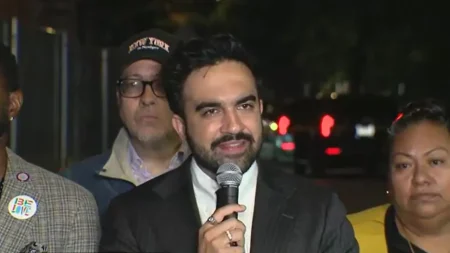
For older generations, the memory of September 11 remains painfully vivid, etched into their minds like a scar that never fully heals. Many of those now in their forties and fifties watched the tragedy unfold on classroom television screens, the grainy images of smoke and fire interrupting elementary school lessons and high school lectures. Some were children who played in Lower Manhattan playgrounds that were suddenly buried in clouds of white smoke, and who saw their parents crying in ways they had never seen before. One of those children was Zohran Mamdani, who was a nine-year-old student when the attacks occurred. Twenty-five years later, he attended the memorial for the first time as the mayor of New York City, the head of City Hall standing quietly among the families and dignitaries. His presence was a powerful symbol of the passage of time, showing how the children of that day have become the leaders of today. Around him stood Vice President JD Vance and former Presidents Bill Clinton, George W. Bush, and Barack Obama, alongside three former New York City mayors, Rudy Giuliani, Michael Bloomberg, and Bill de Blasio, each of whom had their own complicated relationships with that dark autumn morning. For Giuliani, who was mayor at the time, the ceremony must have felt like a return to the most defining and agonizing moment of his public life. For Bloomberg and de Blasio, who led the city in later years, it was a reminder that the aftermath of September 11 never truly ended. Together, these leaders represented the many political and personal chapters of a tragedy that has shaped America’s security, politics, and soul. And yet, in the end, they were not the focus. The focus remained on the names, spoken one by one, in the voices of the future.
Perhaps the most moving moment came when a young girl stepped up to read a tribute to her grandfather, Kevin Patrick Conners, a fifty-five-year-old military veteran who was working as a senior vice president of Euro Brokers, Inc., a brokerage firm with offices in the World Trade Center. She had never met him, but her voice carried all the love and sorrow of a lifetime of missing someone. “Not a day passes that we don’t think about,” she said, pausing to steady herself. “We love you. And I know you’re smiling at us.” It was a simple, profound declaration that seemed to capture the essence of the day. The empty chairs remain. The plates stay empty. The anniversaries pass with somber music and long lists of names. But the love does not die. It is passed down to children and grandchildren who never knew the ones they mourn, but who carry them fiercely in their hearts. They promise to remember, and then they prove it year after year, by standing in the cold, by crying over names, by telling stories they heard from grandparents and aunts and uncles, by placing flowers on memorial pools, and by refusing to let the world forget. The light shining on our darkest day is not a single flame, but millions of small lights, each one a person who was not there but insists on remembering. That is the true legacy of September 11, the commitment of the next generation to say, with trembling voices and open hearts: We never knew you, but we will never forget you. And that promise, made in the shadow of the towers that once stood tall, is what continues to hold us together, even in the face of unimaginable loss.