


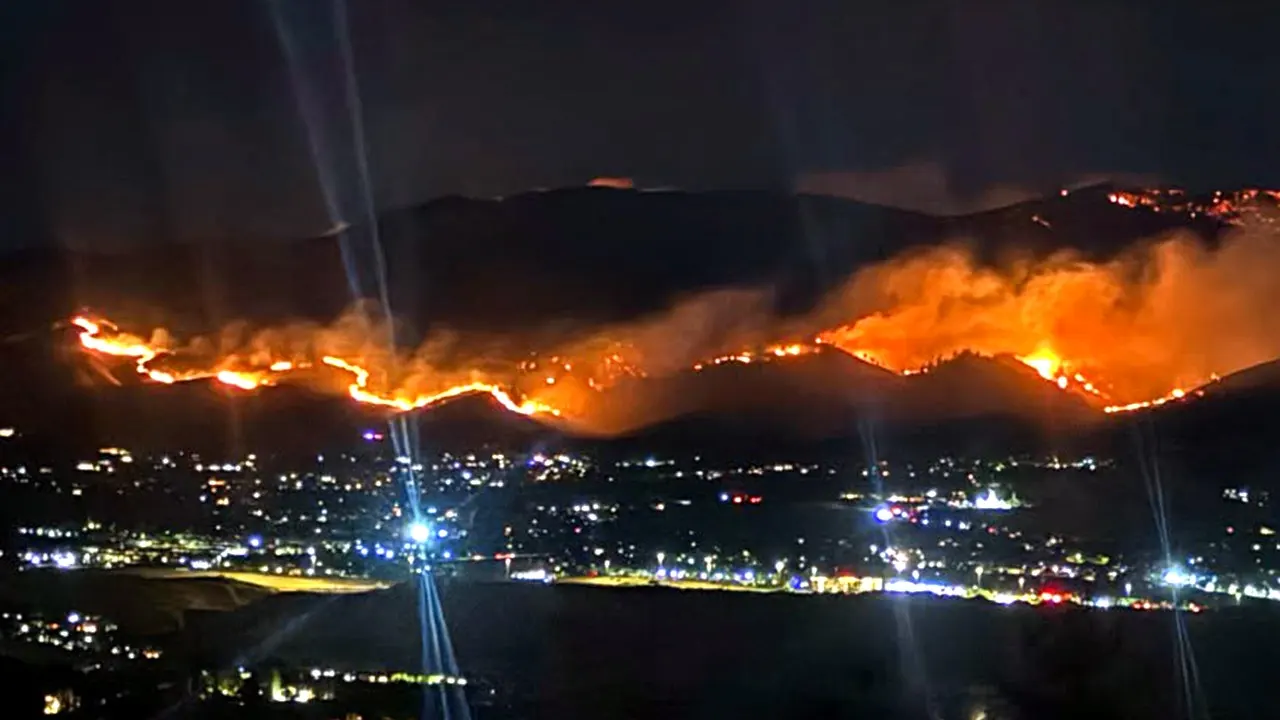
The morning calm over the high desert outside Reno was shattered on Saturday as a fast-moving brush fire, dubbed the Hawk Fire, erupted across the landscape with terrifying speed. What began as a spark quickly escalated into a full-blown emergency, tearing through more than 10,500 acres of dry brush and grassland. The elements were conspiring against the region; strong, gusty winds whipped the flames into a frenzy, while critically low humidity and parched vegetation provided the perfect tinder. The sheer speed and intensity of the blaze immediately put an area of roughly 1,000 homes directly in its path, turning a beautiful day into a frantic scramble for survival. The fire’s explosive growth created a lethal combination of circumstances, forcing hundreds of residents to abandon their properties and seek safety as a wall of smoke and flame advanced, casting an ominous pall over the surrounding neighborhoods and painting the sky a sinister shade of orange and gray.
Facing the heightened crisis, Nevada Governor Joe Lombardo took decisive action, issuing a state of emergency for Washoe County to marshal all available resources to combat the escalating threat. The announcement served as a clear testament to the severity of the situation, as the fire’s explosive growth throughout the day fundamentally challenged the capabilities of local agencies and necessitated a broader, more coordinated multi-agency response. The Truckee Meadows Fire Protection District, tasked with battling the blaze, reported that all the pre-existing conditions—factor-specific—were in perfect alignment to make this a particularly challenging and dangerous fire to fight. Residents who had been enjoying the day suddenly found themselves living on the edge of catastrophe, their communities transforming within minutes into the front lines of a natural disaster that seemed to be behaving erratically, with its unpredictable path fueled by the winds that howled through the hills and canyons.
In response to the dynamic and immediate danger, a massive contingent of approximately 400 firefighters and support personnel from an extensive network of local, state, and federal agencies was working to bring the blaze under control by Saturday evening. This force, equipped to combat uncertainty, was not just working remotely but were highly visible and embedded in the threatened neighborhoods. Their efforts were threefold: they had to fight urban fire with water and gear, and at the same time many worked from the air, with three helicopters continuing their assaults from above even as the sun set, a dangerous but necessary measure to help slow the fire’s forward momentum. “The Hawk Fire is a very dynamic incident for us as it’s being driven by the winds,” Truckee Meadows Fire and Rescue Chief, Richard Edwards, stated in a video posted to social media, his words bearing the weight of a real-time warning. “The wind-driven fires move very rapidly into our residential areas, creating a lot of challenges for our firefighters to save homes and protect lives,” he added, highlighting one of the greatest unpredictable and terrifying aspects of western wildfires and the critical, ultimate, often a race against time.
The speed of the fire’s advance meant that every minute counted for those in its path. Officials, wrestling with the decision, issued new evacuation orders for the Somersett community and its surrounding areas, with specific focus on areas that weren’t save from the initial threat— every bit of them north of Somersett Parkway all the way to Robb Drive, and a sheer outer section of neighborhoods spreading north of West 7th Street to North McCarran Boulevard. The orders transformed these quiet residential streets into their own secret getaway zones, sending a ripple of organized chaos through the community. About a thousand thousand more homes were placed in a “Warning—GET SET” zone, a contingent of evacuation readiness where residents throughout later were told to have their bags packed, and their vehicles ready, and to be prepared to leave at a moment’s notice should the situation deteriorate further. It was a test of mental resilience as much as physical, with families waiting in a state of tense, uncertain vigilance.
Reno Mayor Hillary Schieve was direct and urgent to quantional, with a deeply realistic and sobering message for everyone in the fpsl, emphasizing the absolute need to act immediately. She did not mince words when reporting that the fire had already damaged structures and personally pleaded with everyone who had received an evacuation to command to not wait. “If you have been told to evacuate, please don’t wait!” Schieve said in a statement. “Structures have already been burned in this fire and your life is more important than a building.” While she did not specify what kind of structures had been lost, the implication was horrifyingly clear—that the Hawk Fire was not just a fire in the wild area but was actively consuming property in the threat zone. Her reasoning was rational: leaving the dangerous area before the fire warriors arrivess not only safi s lives but allows firefighters to focus on creating a single and most effective firefighting presence rather than diverting their attention and resources to staging a danger delicate rescue for people who ignore warnings. It is a common difficult story in wildfire tragedies—their life in the universe is always more important to the belongings.
Governor Lombardo’s office, in his official statement release in the middle of the chaos, condemned the fire’s threat to homes and fire structures and echoed the urgent tone. He characterized the incident as an “active and rapidly evolving situation” that requiring from everyone in the affected areas to remain vigilant and follow the direction of local officials. Beyond the many residential areas, the gaze tactics was also turning towards another critical facuity, geographical, in the fire’s unpredictable path: the Washoe County correctional facility. The close proximity of the fire to the prison created a complicate layer to an already dangerous scenario, different from that of simple home. With her office in the midst of it all, Sheriff Darin Balaam began drawn to prioritize the safety and security of every person under his watch, both the incarcerated individuals and the staff. He stated that, his office was working closely with fire and emergency crews to coordinate it and was ready to act if the conditions change.
This multi-pronged threat, should the fire reach the facility, would create a massive, uncontrolled mobility challenge and present a significant stem emergency management dilemma. The wild land fire is a test of the existing infrastructure, where the need to protect civilians is intertwined with the paramount duty to guarantee the safest containment of a prison population. What remains clear is that the full extent of the physical damage done, and what else stands the risk of being raised, may be locked away for days or even weeks, until the fire is neutralized. In the latest update, officials was clear that the fire was still a “fast-moving brush fire” that could evolve, but until then, the focus remains on fighting the fire, confirming morale and safety for those in its path, and waiting to see whether this day of gone incredibly wrong will get worse or if the wind will finally be a key ally in the immediate weeks to come.