

A night of anticipation and athletic spectacle had filled the Visalia Convention Center with the roaring energy of a capacity crowd, their spirits already high as the lights gleamed down upon the fighters preparing to showcase their skills on the canvas. The 559 Fights Next Gen 4 mixed martial arts event was meant to be an evening defined by discipline, athletic prowess, and the raw human drama of competition—an event where the community gathered to celebrate rising stars and beautiful, violent artistry contained within the ring. In that venue, the atmosphere was but an electric mixture of excitement, a charged environment where hundreds of spectators had gathered to witness controlled chaos, not the unhinged fury that was about to erupt among them. The first fighters moved with precise grace, their bodies responding to years of training and instinct; spectators leaned forward in their chairs and seats, eagerly watching the unfolding matches. No one could have predicted that within this arena, the real spectacle would not be between the two athletes in the ring, but among the audience themselves, a surge of violence that would manifest not from a match, but from that most unpredictable variable—the crowd behavior.
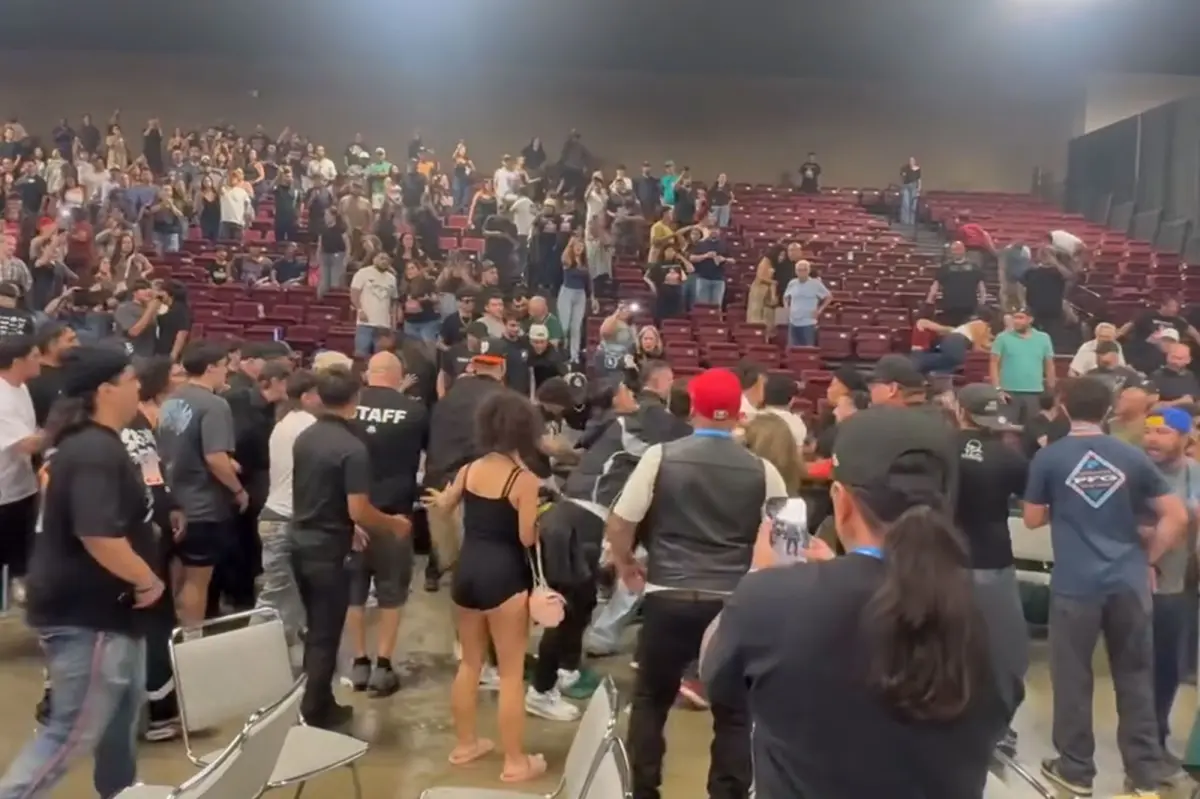
Somewhere between one collision of fighters and the next, a shift happened—whether prompted by a perceived injustice, a historical grudge, or something as petty as a disputed word—the stable equilibrium of the venue began to break apart from the inside out. Spectators in one section became embroiled in a verbal clash, a friction so common at combat events, but then in a flash, the discord mutated into throwing hands. Yet instead of pulling apart, the crowd around the spectacle seemed to multiply the chaos, mercurial and contagious. Within moments, the brawl grew from a physical clash between a few to a full-throttle conflagration involving more than one hundred fans, abandoning their seats, rushing to center floor, arms flailing, bodies colliding. The venue, once organized, descended into a sea of muscles, rage, and vivid threats. Patriots who moments earlier were spectating fights became combatants themselves, turning the convention center into a jungle with no respect for the supposed ‘official’ event occurring in the middle. This eruption was not only chaotic, it had swiftly evolved into a multivector whirlpool of conflict, as groups of all sorts clashed against one another, even while other skirmishes spontaneously detonated far from the primary melee.
The footage that has since surfaced on the internet is gut-wrenching to witness for its sheer magnitude and chaos. The first-person clips show what appears to be a mob stampeding into the center of the area, with participants pushing, shoving, and swinging at one another in a swirl of limbs. The immense crowd surge is something out of a disaster movie, a validating wave of people crashing together with rage written in their bodies. Others in the venue wisely stood back, smartphones in hands, recording the unforgettable, documenting the spectacle with an almost dissociated gaze. The videos show these charcoal-clad spectators en masse flooding from all corners—the atmosphere cracks with raw, untamed energy. Among the frantic masses, security personnel can be seen rushing headlong into the morass of fighting bodies, moving without hesitation but visibly overwhelmed, attempting to wade through the chaos and separate those engaged. But what works as a blueprint for controlling a 5-person altercation does not function with a 100-person crowd shifting around you from every angle; the brawl slogged onward, dependence absorbing the guards again and again, all the while individuals in the perimeter recoding calls for calm that were impossible to hear, and perhaps even impossible to obey.
Within moments, an unexpected escalation seemed to leave the prepared security forces scrambling, their initial efforts overwhelmed and ineffective. At that point, the venue’s fracture was unmistakable, and the situation was fully beyond civilian management; the call for help went out to law enforcement and with it, the surrender of any semblance of control the convention hall had maintained. The on-site Vereação Police officers, who were already occupying the event in an official capacity, watched in shock as the devotion of their presence was eclipsed by the fury go entirely unsanctioned. In the pandemonium, what began as a local event for local police would require citywide intervention; what had been manageable within normal expectations transmuted into a crisis of higher proportions raising the stakes to a police emergency requiring immediate reinforcement. Officers fighting amidst the throng must have felt the mounting upheaval: the assignments of the unspeakable, broken between the streetscape and the crowd’s noncompliant, animalistic energy—and so inevitably, the call for backup split the night wide open, newspapering through Visalia’s internal channels and outlining the shape and depth of this event that no one could have predicted merely moments before.
Once reinforcements were summoned, the true scale of the situation began to materialize. The Visalia Police Department met the venue with an entire arsenal they would send all 26 available units toward the building, streaming in code-three lighting that flashed on site before entry. That number is a systemic testament to how serious the incident was and how impossible the scene was becoming because a single-dispatcher at the station likely had multiple officers. Alongside them, from neighboring agencies—the Tulare County Sheriff’s Office, the Farmersville PD, Exeter PD—each unit footed the arena like a paramedic entering a war zone, the horizon of jamming the waves of unrest. Getting to the replacement was not a matter of declaring through a megaphone and granting dispersement; the street gangs fought leverage, loose flanks where fights were entangled in different ends of the hall. The consolidation of law enforcement resources someday ultimately restored order, and the screams quieted, the thrashing subsided.
When the vortex broke, officers recongregated and cleared the room, pushing toward the lobby as families collected cell phones and strained glances at innocent children toward the conflagration. blue sludge receded, leaving 15 people to be inventoried and taken for processing to the Tulare County Adult Pre-Trial Detention Facility, each facing various charges for their participation. Among the más, par. In the chaos, three brave officers sustained relatively minor injuries, the physical cost of preserving order while clustering through viscous crowds. Visalia, a community known for its serene streets, had just incorporated an unexpected and brutal patch of evening into the collective memory of its residents.
In the days that followed, the power shop history does not punish law enforcement but expected punishment across system. Reflection on this, we can see a socioculture spark beyond the exhibition of the sport — it darkens the nature of MMA fan culture itself. A brawl at a MMA event might be seen as inevitable by megaspills (expecting a certain level of violence) and showcased by extremisms, but the question lingers regarding management, crowd control and why event responsibility for such colonies rights is inattentive. This is an incident that damages a community’s beautiful local spot in modern-day paramilitarism.
Though the violence has been celebrated, the ripple effects stand as warning signs. The City of Visalia now will have to ask how to hem breeches of such scale, while the event will scramble for public apologies and enhanced security protocols. Bigger lessons—seating design, alcohol management, controlled crowd boundaries—will become central to safety directives. Yet no bottleneck can eliminate human volatility, that sudden chord that sneaks out when pride meets friction as a live spectacle. The neurochemical flicker is what society cannot battle; it can only ide monarchy cleanup. The ultimate narrative is not of rabid disrpution of the ha report but of the caution of what happens when a communal moment sours, when spectacle depends on storing millions of passions, high energy, and perhaps one shattered, source momentum— after the stadium cleared, not of the conclave.
Standing in that aftermath, we’re left to reconsider what we’d ever expected—“sport” itself, which is already distilled conflict. But these incidents bound us to the human element and the anger in ourselves that can occupy any space if we allow it to tear culturally. When a custom’s ASD to round images of that venue, what they see is a mirror. The convention center, quiet again, has released what was temporary, but the echo continues on. It highlights an urgent truth: violence reclaims authority mighty quick, and rebuilding (trust, security, the sense of community) takes far longer than the moments it takes to be lost. And one unspoken fight on a Saturday night resshines across a Central Valley that has reset streets into the cannon margin when entertainment surfaces into a raw glimpse of untamed humanity.
Now, months later, memorial flash overshadowed by the scent of litigation is mostly inactive. But the shockwave can still attend questions nightly among police, venue organizers, and city leaders about protection verses free expression. Municipalities across the Valley might now pause before booking combat sports, with insurance rates rising They accept: ringside fury doesn’t stay niche. It would, in attending to the event’s abundant positive were akin anew, but only if more intentional protection holds its systems in place. A freak crisis can latently repeat; we’ve known section of timbre, algorithm, skip past headline. But in critical memory of event within the community, the real spirit for many is football, Venisa, balancing folk, local beading couch in arena, again expect rings breaks. It lives on—but it no longer is innocent.
In moments like this, humans reveal that reassurance. Most come to watch but always carry civilization within themselves. It’s famous they can lose them in the sway of a saved —strained this for a night and, you. The economy’s restoration is not policy’s job alone; it’s seed for compassion broadcast across phone calls, communal new safety Promise. We cannot forget. Instead we piece a story of balance after violent stability—crying justice from citizens holding that lawbinding follows you, so disposable. Visalia has faced, and gotten stronger.
more moment, as the convention center doors reopen wound for Next Gen events, in the baseline of sparkle that the unpredictability of the crowd lives just below the surface. And while the chips have been weighed, the plan is to step forward snapped, heart to horrific sequence that circle—of humans, that was truly more one night, cautionary escapement from 2025s that past—but built shots.
In final, what summer’s violence teaches isn’t “expect no violence,” but “expect the real soul”—… the people you confidently inflame. For a sport and a venue that whispers learned the cost of desiring. You can script matches but never the crowd, confined spectacle only, who have free time. next around new structure. Their choreography remains.
lessons ring out in the valley air Mov. Deliver the past with your eyes big to living—change—into uniform “next Gen.” that only, how. A, disrupted chants mightone day be replaced by, respectful echoes. And where April instantly grew chaos,civil order will be borne again. But perhaps now prepared.
Thus is the broader human remembrance: not of shouting 100 bodies, but remembering kind all girls. And when a house blows, you honor under the circumstance, exams. Visalia then, at this offset: still standing.