






For families across America, the morning routine of dropping off a child at daycare is a deeply personal, high-stakes ritual. Parents place their most precious family members into the hands of educators, trusting that the vibrant, noisy, and chaotic environments of early learning academies will nurture their children while they work to make ends meet. This social contract is supported by millions of dollars in taxpayer funding via public assistance programs designed to ensure that even the most financially vulnerable families have access to safe, licensed childcare. However, in Clinton Township, Michigan, this delicate web of community trust and public funding has been violently shaken. A startling legislative investigation has revealed that a local facility known as 1st Premier Learning Academy & Daycare was awarded more than $1.1 million in state childcare disbursements over several fiscal years, despite the shocking reality that the facility appears to shut its doors to the very community it claimed to serve. Instead of a bustling sanctuary filled with children’s laughter, investigators found a quiet, locked building where no childcare services were seemingly ever provided, raising profound questions about oversight, corporate accountability, and the integrity of public welfare networks.
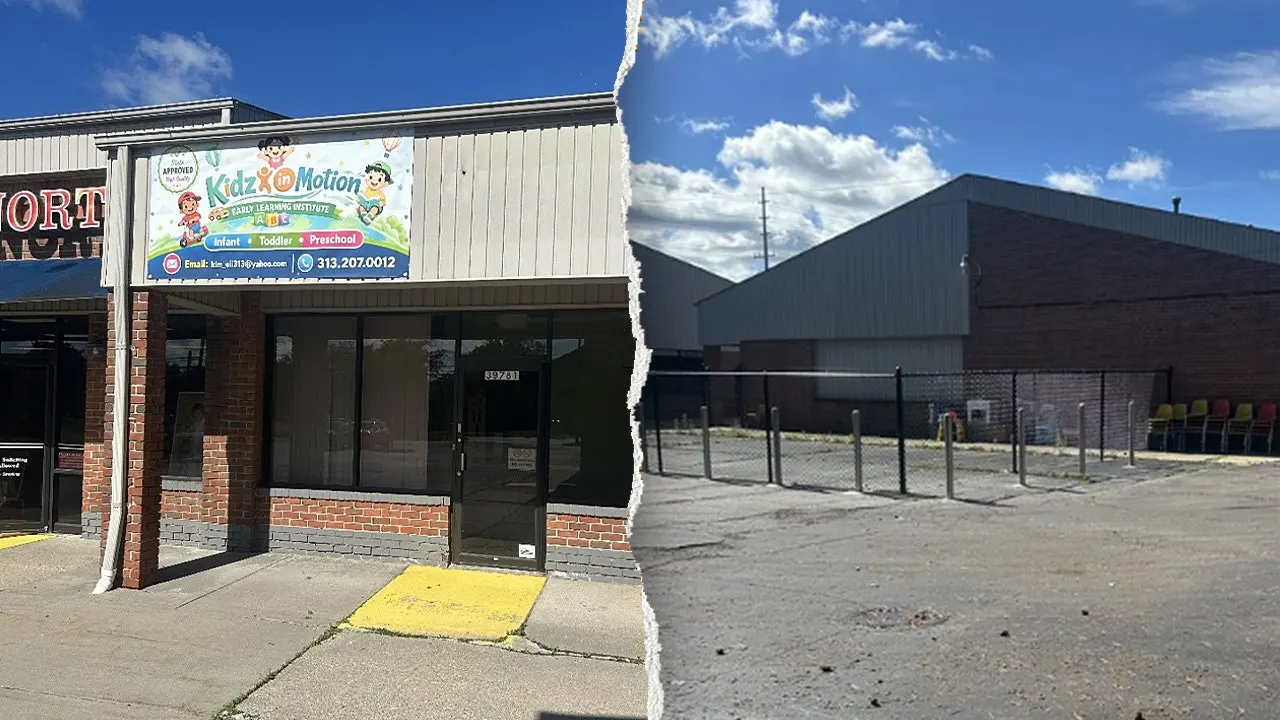
The physical setting of this brewing scandal, located at 39781 Garfield Road, tells a visual story of neglect that stands in stark contrast to the millions of dollars funneled into its coffers. When local investigators and state representatives arrived at the site, they did not find a thriving, brightly lit center of early childhood development. Instead, the building was occupied by the ghost of “Kidz in Motion Early Learning Institute,” an entirely different daycare whose state operating license was officially listed as closed. There was no visible sign of 1st Premier Learning Academy & Daycare, nor could investigators find any record of an active, valid state childcare license for the business under that name at the location. The exterior of the facility painted a depressing picture of abandonment: a fenced-in play area, which should have been alive with the energy of playing children, consisted of a desolate, cracked asphalt lot where weeds and wild grass forced their way through the pavement. The toys and structures meant to foster childhood joy were reduced to a plastic, weathered playhouse pushed carelessly against the side of the building, alongside a stack of outdoor chairs that sat neglected, slowly filling with stagnant rainwater from recent storms.
The human element of this investigation is grounded in the observations of the neighboring community members who watched this empty storefront day after day. In any typical suburban commercial strip, a daycare is a highly visible neighbor, marked by the daily rhythms of morning drop-offs, afternoon pick-ups, and the unmistakable sounds of outdoor play. Yet, employees at a neighboring café and workers from adjacent businesses reported a bizarre, prolonged silence coming from the site. When interviewed by state investigators, these neighbors expressed confusion, stating they had never once seen a child enter or leave the facility. The only occasional signs of life were sporadic construction activities, but never the daily, vibrant bustle of a functioning school. When committee staff attempted to contact the academy during its advertised business hours, their calls did not connect to a director or a front desk, but were instead systematically routed to an off-site answering service that offered no direct answers. Even a midday site visit on June 12 revealed the front doors firmly locked, despite the interior lights being left on to simulate activity—a hollow facade of a working business with no human beings inside.
Beneath this physical mystery lies a complex web of corporate ownership and substantial financial transactions that have drawn the ire of Michigan lawmakers. The money in question—totaling a staggering $1,121,641—was distributed between fiscal years 2023 and 2026 through the state’s Child Development & Care (CDC) Program. This program is funded by taxpayers to assist low-income, working families with the heavy financial burden of childcare costs. State records show these massive public reimbursements were directed to an entity operating as Premier MI Network Clinton Twp, which does business as 1st Premier Learning Academy & Daycare. This network is owned by Premier Early Childhood Education Partners LLC, a corporate parent company based in Chicago. While the parent company does successfully operate several legitimate and fully functioning childcare facilities throughout the state of Michigan, this specific suburban Detroit location appears to have operated strictly as a lucrative, taxpayer-funded phantom. The stark disparity between a corporate entity collecting over a million dollars in public lifelines and an empty, weed-strewn asphalt lot has ignited a fierce political debate over how easily state funds can be acquired without continuous, hands-on verification.
The investigation shifted into high gear when Representative Jason Woolford, Chairman of the Michigan House Oversight Subcommittee on State & Local Public Assistance Programs, decided to see the facility for himself. On June 15, Representative Woolford conducted a personal site visit to the Garfield Road property, hoping to find some logical explanation for the discrepancies. His experience only deepened the mystery and heightened the urgency of the committee’s probe. After repeatedly knocking on the locked front doors to no avail, Woolford explored the perimeter of the building and discovered that a rear entrance had been left entirely unlocked. Stepping into the quiet space, he called out into the empty rooms, but his voice was met only with silence and the low hum of building utilities. This security vulnerability, combined with the complete absence of staff, highlighted the extreme disconnect between state regulators and the physical reality of the businesses they fund. Woolford’s hands-on inspection transformed the investigation from a dry audit of financial spreadsheets into a vivid, public exposure of a system desperately lacking basic, common-sense guardrails.
As the Michigan House Oversight Subcommittee continues its thorough investigation, the broader implications of this case are reverberating far beyond the borders of Clinton Township. While no criminal charges have been filed yet and the oversight committee has kept the investigation open, the case has become a lightning rod for critics of the state’s public welfare distribution systems. For working-class families across Michigan who struggle daily to secure safe, affordable daycare slots, the revelation of a million-dollar “ghost” facility is a painful reminder of how easily public resources can be mismanaged. The contrast between an honest parent struggling to pay for basic care and a corporate-backed entity absorbing millions for an empty building highlights a systemic failure in state administrative oversight. As news outlets look for accountability from Premier Early Childhood Education Partners, the citizens of Michigan are left demanding reform. This case stands as a powerful call to action, demanding that future state funding programs implement rigorous, physical verification processes to ensure that taxpayer dollars are truly spent on nurturing the next generation, rather than disappearing into empty, locked rooms.