




The heartbreaking reality of America’s deeply fractured immigration enforcement system was laid bare on a Houston street this week, resulting in the tragic and unnecessary death of Lorenzo Salgado Araujo. Federal officials have now admitted a devastating truth: the 35-year resident of the United States, a devoted father of three and a respected local homebuilder with absolutely no criminal history, was never the intended target of the Immigration and Customs Enforcement (ICE) operation that claimed his life. In what is being described as a catastrophic case of mistaken identity, federal agents under the Department of Homeland Security (DHS) had been surveilling a property based on a law enforcement tip, focusing on two white vans. When agents spotted Salgado Araujo driving a similar white van and believed he physically resembled a suspect who had a final order of removal, they initiated a fateful traffic stop that rapidly spiraled into a nightmare.
The moments leading up to the fatal gunfire remain a subject of intense scrutiny and immense grief. According to statements released by the DHS, officers attempted to pull Salgado Araujo over, but they claim he ignored their commands and attempted to use his vehicle to ram an officer in an effort to flee. In what the agency describes as an act of self-defense, an officer opened fire. However, the narrative is severely complicated by a glaring lack of transparency: the ICE officers involved were not wearing body cameras during the encounter. What does exist is a deeply unsettling video captured by a bystander, which shows a black unmarked vehicle angled sharply toward a white van with its doors flung open. On the pavement lay a bleeding, handcuffed Salgado Araujo, shaking and groaning in agony, while three other men—including his own brother—were detained in handcuffs nearby, forced to watch the horrific scene unfold.
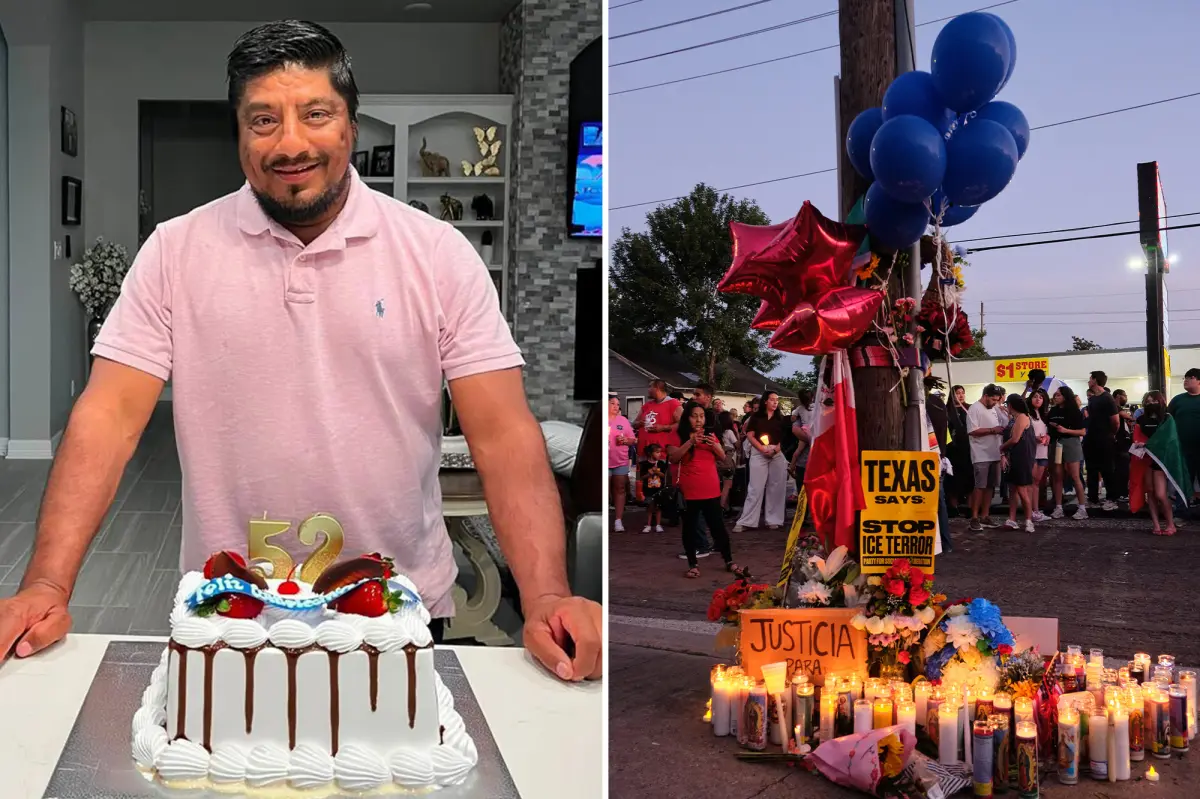
To his family and the community he helped build, Lorenzo Salgado Araujo was the furthest thing from a threat; he was a gentle patriarch and a testament to the American Dream. Having lived in the United States for three and a half decades, he was on the cusp of finally securing his official legal status when his life was abruptly cut short. His eldest son, Ronaldo Salgado, a local schoolteacher, spoke of his father not with anger, but with a profound, quiet dignity, paintng a portrait of a simple, hard-working man. He described a father who rose with the sun every morning to go to work, who loved nothing more than returning home to pet his dog, sit on his porch, and listen to music. Ronaldo expressed a fierce desire that his father be remembered not as a statistic or a victim of a botched raid, but as a dedicated family man who taught his children that honest, hard work was the key to a good life.
The fallout from the shooting has quickly reached the halls of Congress and triggered multiple investigations. Representative Sylvia Garcia, a Texas Democrat, has been demanding answers from federal authorities, confirming that acting ICE Director David Venturella personally admitted to her that officers mistook Salgado Araujo for another individual. Yet, despite accepting responsibility for the mistaken identity, federal officials have notably refused to release the name of the actual target they were searching for that day. This lack of initial transparency has only fueled public outrage and raised urgent questions about the tactics, training, and oversight of armed federal immigration agents operating within local residential neighborhoods.
In the wake of the tragedy, local and federal watchdogs are scrambling to piece together exactly what went wrong on that Houston street. The Department of Homeland Security’s Office of Inspector General has launched a formal investigation into the shooting to determine if proper protocols were followed and how a routine surveillance operation could end in a wrongful death. Simultaneously, Harris County District Attorney Sean Teare announced that his office is aggressively pursuing its own independent investigation. Teare promised a thorough, unbiased review of all available evidence within their reach, mirroring the community’s demand for local accountability when federal actions result in the loss of a resident’s life.
As the investigations proceed, Lorenzo Salgado Araujo’s family is left to mourn a loss that can never be prepared for or fully repaired. His death stands as a grim reminder of the human cost of aggressive immigration enforcement policies that rely on high-stakes assumptions and lack basic modern accountability measures like body-worn cameras. For a man who spent thirty-five years quietly building homes, raising a family, and waiting patiently for his paperwork to be finalized, the system did not offer protection—it offered a tragic end. His family now faces the monumental task of seeking justice for a beloved father whose only crime was driving a white van home from work.