







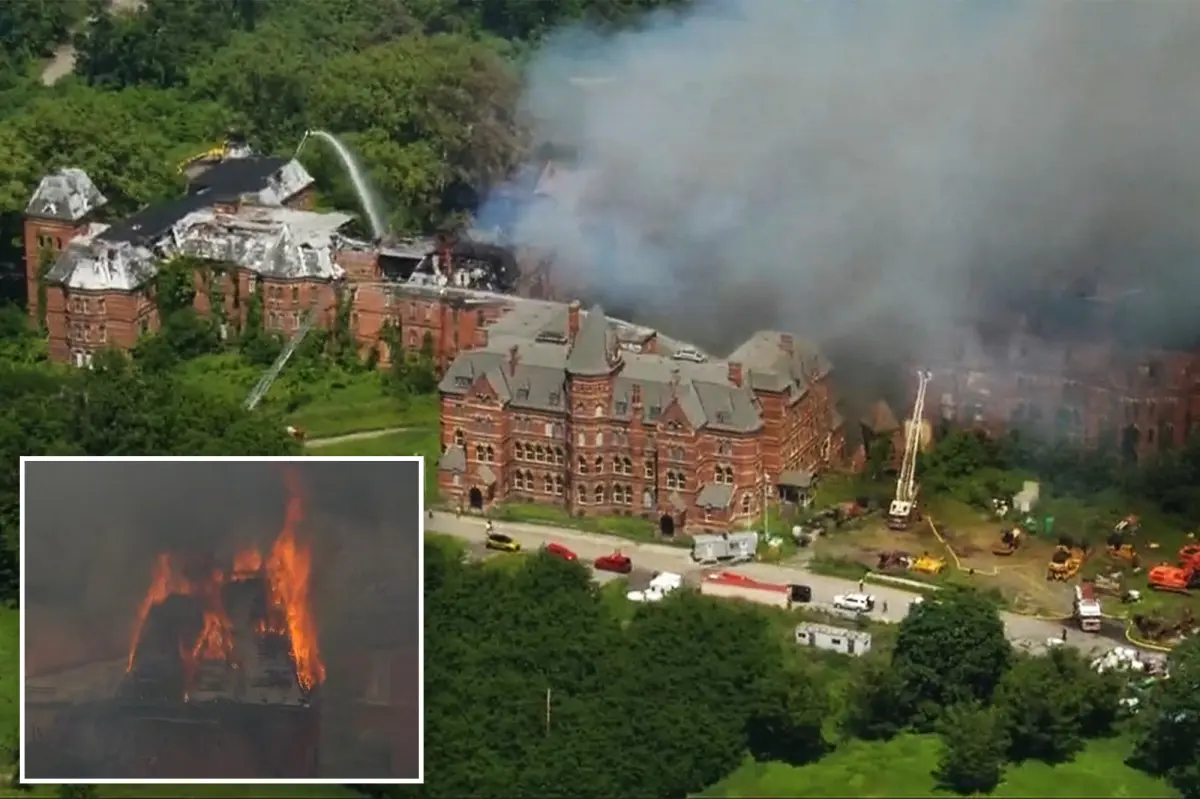
On a seemingly quiet Wednesday morning in Poughkeepsie, New York, the tranquil rhythm of the Hudson Valley was abruptly shattered by an ominous column of dark, billowing smoke that quickly dominated the horizon. It was around eleven o’clock when an alert bystander first noticed the gray plumes rising from the dense canopy of trees surrounding the long-abandoned campus of the Hudson River Psychiatric Center. Phoning 911, the caller set off a massive emergency cascade that would draw eyes from all across Dutchess County, as the smoke grew so thick and towering that it could be easily seen from several miles away, drifting over the Hudson River and signaling a disaster of historic proportions. For local residents, the sight was a jarring, deeply unsettling reminder of the massive, haunting presence that had sat quietly on the hill for decades. What began as a localized flicker of flame inside one of the campus’s many dormant structures rapidly escalated into a raging, multi-alarm inferno, transforming a quiet mid-week morning into a theater of frantic emergency response and immense public anxiety. As sirens began to echo through the streets of Poughkeepsie, mobilizing departments from miles around, the community watched in collective disbelief as one of the region’s most magnificent, albeit controversial, historical landmarks was devoured by wild, unchecked flames. The immediate emotional response of onlookers was a mixture of awe, profound sadness, and deep concern for the safety of the first responders rushing toward the danger. This was not merely a routine suburban fire; it was the sudden, violent destruction of a tangible link to the past, forcing the entire community to pause and bear witness to the terrifying power of an untamed blaze consuming history piece by piece.
To understand the profound impact of this disaster, one must look back to the origins of the Hudson River Psychiatric Center, an institution deeply woven into the historical fabric of the state of New York. Established in the post-Civil War era in 1867, the facility was designed during a period of revolutionary change in psychiatric care, when grand, therapeutic architectural designs were championed as vital tools for healing the human mind. Over the decades, the sprawl grew to encompass 150 acres of picturesque land, dotted with stunning, high-Victorian Gothic style buildings crafted from rich brick and heavy, ornate woodwork. Recognizing its profound historical, architectural, and cultural value, preservationists succeeded in having the sprawling campus placed on the National Register of Historic Places in 2007, years after the facility had officially shuttered its doors and ceased treating patients. For generations of Hudson Valley residents, the hospital was more than just a collection of buildings; it was a major local employer, a place where ancestors worked, and a sanctuary where thousands of vulnerable souls sought refuge and recovery over a spanning history of more than a century. Even in its state of abandonment, the campus retained a poignant, silent dignity, its towering spires and weathered facades standing as monuments to a bygone era of architectural ambition and medical history. The fire did not just threaten wood and stone; it threatened to erase the physical memories of the countless doctors, nurses, and patients who lived, worked, and sometimes died within those historic walls, stripping the community of a silent, majestic sentinel that had witnessed the evolution of Poughkeepsie from a 19th-century river town into a modern suburb.
The fury of the blaze itself was nothing short of spectacular, captured in dramatic aerial footage that quickly circulated across news outlets and social media, showcasing the terrifying speed with which the historic structures were consumed. The fire reportedly ignited deep within the heart of the old Avery building, a structure renowned for its aging wooden framing and historic architecture, and quickly capitalized on the dry, vulnerable materials that had sat undisturbed for years. Feeding on decades-old timber and fueled by drafty, vacant corridors, the flames spread with malicious speed, leaping across the narrow spaces to engulf two neighboring buildings on the campus. The wild footage captured a hellish scene: thick plumes of charcoal-black smoke punching through the roofs, while vibrant orange fireballs licked the sky, swiftly reducing intricate, century-old gables and wooden support beams to ash. These structures, built in an era before modern fire-retardant materials and sprinkler systems, were tragically perfect tinderboxes, having baked in the elements for years without active maintenance. The sheer speed of the spread highlighted the precarious nature of abandoned historical architecture, where the very elements that make a building beautiful—such as seasoned heartwood, open interior layout designs, and soaring ceilings—also make it incredibly vulnerable to catastrophic destruction once a spark takes hold. Watching these grand structures, which had survived more than a century of harsh northeastern winters and summer storms, succumb so quickly to the relentless heat was a visceral, heartbreaking demonstration of how quickly decades of human craftsmanship and irreplaceable heritage can be utterly obliterated in a matter of hours.
Confronted by a disaster of this scale, the call for help brought together a massive, heroic coalition of local emergency responders, triggering an immense logistical operation that tested the limits of regional firefighting capabilities. More than a dozen independent fire departments from across Dutchess County and the surrounding areas rushed to the scene, their crews immediately confronted by a tactical nightmare of monumental proportions. Because the sprawling, 150-acre psychiatric campus had been decommissioned for years, the localized infrastructure was entirely inadequate for a fire of this magnitude, leaving responders without easy access to reliable, high-pressure hydrants on the property. Dutchess County Executive Sue Serino highlighted these severe challenges in a public statement, explaining that the sheer size, age-worn condition, and vacant nature of the structures demanded a colossal, exhausting effort requiring immense water transport networks and concentrated manpower. Firefighters had to establish complex water shuttle systems, hauling thousands of gallons of water over long distances to feed the aerial ladders pouring streams of water onto the towering inferno. The physical toll on these brave men and women was immense; working under the oppressive weight of heavy turnout gear in close proximity to a raging furnace, one firefighter suffered a severe, heat-related injury and had to be treated on the scene by emergency medical services. Fortunately, due to the vacant status of the buildings, no civilian injuries were reported, but the sheer endurance, bravery, and coordination required by the regional crews prevented a tragic situation from cascading into an even wider, uncontrollable community disaster.
While the immediate danger has subsided and the smoke has finally cleared, a shroud of mystery and frustration continues to hang heavy over the charred remains of the campus. Investigators are currently working tirelessly to determine the exact origin and cause of the devastating fire, a task made infinitely more difficult by the heavily compromised structural integrity of the burned buildings. Crucially, officials have pointed out that the long-abandoned campus has not been connected to the regional electrical grid for many years, a chilling detail that effectively rules out an electrical short or utility malfunction as the culprit behind the spark. This haunting reality leaves behind a narrow, troubling list of possibilities, including accidental ignition by trespassers seeking shelter, vandalism, or intentional arson, casting a dark shadow over the site’s vulnerability to human interference. This tragedy also shines a harsh spotlight on the stagnant, frustrating history of the property’s stalled redevelopment plans, which have lingered in a state of bureaucratic limbo for years. Despite grand visions of transforming the sprawling, prime 150-acre Hudson Valley parcel into a vibrant, mixed-use community hub with housing, retail, and preserved green spaces, no tangible progress had been made, leaving the majestic campus to rot in silence while waiting for a revitalization that never came. The fire serves as a stark, painful reminder of the hidden costs of property neglect, proving that when historic treasures are left abandoned and unprotected from the elements and human curiosity, their ultimate fate is often decided not by developers, but by tragedy.
In the final analysis, the tragedy at the Hudson River Psychiatric Center is a poignant eulogy for a vanishing piece of Hudson Valley heritage, a physical loss that leaves a permanent scar on the landscape and the collective memory of Poughkeepsie. It is a deeply humanizing event that forces us to confront how we treat our historical spaces, highlighting the delicate, fleeting line between preservation and irreversible ruin. As the soot settles over the historic Avery building and its companion structures, local residents are left to mourn not just the loss of physical wood, brick, and stone, but the irreplaceable spirit of a place that once represented hope, refuge, and human connection for generations gone by. The ashes of this historic landmark stand as a silent, powerful warning to other communities harboring their own neglected monuments of the past: architectural treasures cannot wait indefinitely for salvation, for time and neglect are unforgiving enemies that eventually demand a heavy price. Moving forward, the community must grapple with the empty spaces left behind by this disaster, hoping that the remaining structures on the historic campus can somehow be protected from a similar, tragic fate. Ultimately, this fire is a somber reminder that history is not a permanent fixture of our world, but a fragile, living legacy that requires active stewardship, respect, and protection if it is to survive the passage of time and continue inspiring the generations of tomorrow.