





-
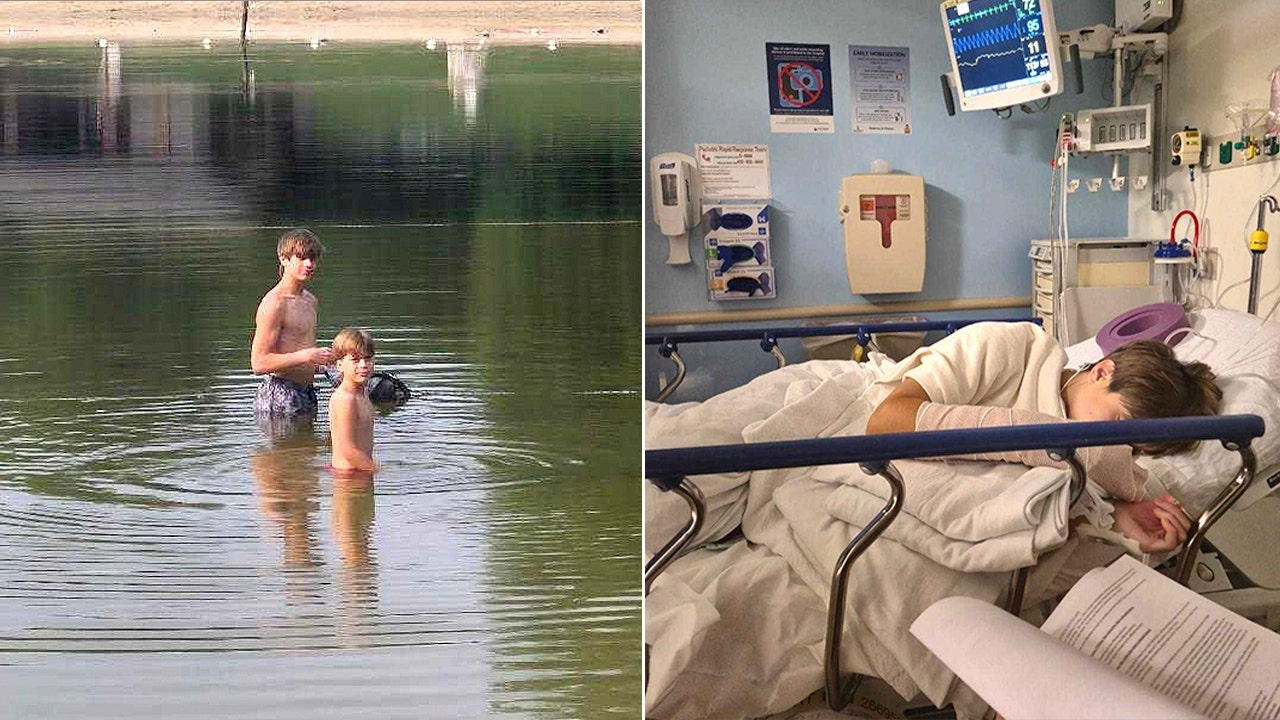
The Cebula family had no reason to expect anything but a carefree summer afternoon when they headed to Cunningham Falls State Park in Frederick County, Maryland, in late July. For years, they had swum in the same stretch of Hunting Creek Lake, a place that felt familiar, safe, and reliably full of the simple pleasures of childhood: cool water, dappled sunlight, and the sound of laughter echoing off the trees. Thirteen-year-old Dominick Cebula was doing what he had done many times before—floating and swimming in the designated area, his face dipped below the surface as he watched fish darting through the clear shallows. His mother, Alishia, and his eight-year-old brother were on the shore, their attention half on him and half on the ordinary rhythm of the day. Then, without warning, the ordinary shattered. A beaver—not the small, shy creature most people picture, but a massive, four-foot-long adult—came charging from the deeper part of the lake, moving with a strange and terrifying purpose. It did not surface, pause, or veer away. It made a straight line toward Dominick, and before anyone could fully understand what was happening, it had struck his chest and latched on. His mother and younger brother watched from the bank in frozen horror, unable to do anything but witness the unthinkable. What should have been a golden summer memory had instantly become a live nightmare, and the family would later describe that moment as the start of a long, painful ordeal that none of them could have possibly anticipated.
-
In the chaos of the attack, Dominick was not just bitten; he was brutally and relentlessly mauled. His aunt, Leigh Cebula, would later describe the animal in vivid, almost unbelievable terms, emphasizing that this was no cute, cuddly creature out of a children’s story. “This four-foot-long beaver—not a cute little cuddly beaver—this thing was as big as his eight-year-old brother,” she said. “It came out of nowhere from the deep of the lake, beelined straight toward D, and began biting and attacking him.” She stressed that Dominick had not provoked the animal in any way. He had not poked it, chased it, or cornered it. He was simply swimming, minding his own business, and the beaver attacked with an almost predatory aggression. The animal locked its teeth into him and began shaking its head violently, the way a dog shakes a toy. Dominick’s father, Jeff Cebula, described the terrifying struggle, explaining how his son tried everything to free himself. “He grabbed its head and a leg, and he tried to get it off of him,” Jeff said. “At that point, he kind of felt that it was locked onto him. And then it started shaking its head, kind of like a dog would do.” Somehow, with strength born of sheer terror and adrenaline, Dominick managed to pry the beaver off his chest. He tried to back away, his hands raised in a desperate, instinctive gesture of surrender. But the animal was not finished. It lunged at him again, sinking its teeth into his right hand, and Dominick had to fight it off a second time. The entire episode was brutal, prolonged, and utterly unprovoked—a scene straight out of a nightmare that left the boy bloodied, shaken, and fighting for his life.
-
The immediate aftermath of the attack was a blur of sirens, panic, and desperate urgency. Emergency responders quickly realized that Dominick’s injuries were far too severe for a routine ambulance ride to the nearest hospital. His chest wounds were especially concerning, and the paramedics feared that his lung might have been punctured. They made the decision to airlift him to Johns Hopkins Hospital, one of the region’s most renowned medical centers. As the helicopter lifted off, Dominick’s family clung to hope and prayed that the damage was not as catastrophic as it initially seemed. At the hospital, doctors went to work assessing the full extent of his injuries. They cleaned the wounds, treated him, and immediately began the grueling series of rabies post-exposure treatments, a standard but critical protocol after any animal bite from a potentially rabid creature. “It was so traumatic. He was lifeflighted to Johns Hopkins because the paramedics were worried his lung was punctured. Luckily it wasn’t,” his mother, Alishia Cebula, recalled. That small relief—the knowledge that his lung had not been punctured—was a glimmer of hope in an otherwise terrifying situation. But the physical damage was still substantial. Earlier in September, Dominick underwent surgery to repair a severed nerve in his finger, a direct result of the beaver’s powerful bite. In the weeks following the attack, his life became an exhausting cycle of medical appointments, specialist visits, and the painful, repetitive rabies vaccine injections. Yet through it all, his family remained grateful that the nightmare had not been even worse. “He is doing much better. He just had surgery on 9/4 to repair a severed nerve in his finger,” Alishia said. “He had a lot of appointments, especially with the rabies vaccines he had to get. Thank God for the vaccine. Luckily, we’re getting to the end of this traumatic event.”
-
For the Cebula family, the emotional scars have been just as deep as the physical ones. A day that should have been remembered for sunshine and laughter is now forever marked by the image of a giant beaver attacking their son and brother in the water. Dominick’s aunt, Leigh Cebula, took to a family-organized GoFundMe page not only to raise money for his mounting medical bills but also to share the raw, unfiltered truth of what happened. Her words painted a vivid picture of a peaceful family outing turned violent, and of a boy who nearly lost his life in a place where he had always felt safe. The family has swum in that same area for years, she said, and they had never once seen a beaver there before. The sudden, unprovoked violence felt random, almost senseless. What made it even harder was that Dominick’s mother and younger brother had to watch the entire attack unfold from the shore, powerless to intervene. Those images are not easily erased. For Dominick, the trauma is ongoing. He has had to relive the attack during every medical appointment, every vaccine, every moment when he catches a glimpse of his healing wounds. His family has had to comfort him, reassure him, and quietly carry their own fear and heartbreak. They are grateful he is alive, but they know the road to recovery—physically, emotionally, and psychologically—is long. While the family is hopeful that he will regain full use of his hand, the emotional toll of knowing that a wild animal targeted him so deliberately is something that will take much more time to heal. In their words, there is both profound relief and lingering disbelief, a mixture that any parent or sibling can understand.
-
The Cebula family’s ordeal was not an isolated incident, and that has made the tragedy resonate even more deeply across the community. Less than two weeks after Dominick was attacked, on August 5, a 19-year-old fisherman at the same park was bitten on the ankle by a beaver. Then, in a third attack, a 10-year-old girl was bitten while wading in the water at Seneca Creek State Park, another nearby park in the area. Suddenly, the idea of a gentle, harmless beaver had been replaced by something far more sinister and alarming. Authorities later confirmed that the beaver that attacked Dominick tested positive for rabies, a finding that explained its bizarre and vicious behavior. Rabies can cause animals to act aggressively, seemingly without cause, and this rabid beaver had clearly lost all natural fear of humans. The attacks prompted an urgent public health response. Swimming access to Hunting Creek Lake at Cunningham Falls State Park was closed, and officials issued warnings to visitors to stay away from the water and to report any unusual wildlife sightings. The series of incidents served as a stark reminder that wildlife, even animals that seem familiar and benign, can pose a serious threat when infected with a disease like rabies. For the Cebula family, the knowledge that Dominick was attacked by a rabid animal provided some explanation but also added another layer of fear. Rabies is almost always fatal once symptoms begin, which is why the post-exposure vaccine was so critical. The fact that Dominick received prompt medical care likely saved his life, but the what-ifs are impossible to ignore. The family knows how lucky they are, and they hope that by sharing their story, other families will understand just how important it is to take any wildlife encounter seriously—and to seek immediate medical attention after any animal bite.
-
As Dominick continues to recover, his family has been overwhelmed by the outpouring of support from friends, neighbors, and even strangers who were moved by his story. The GoFundMe page has become a rallying point for people who want to help ease the financial burden of his medical care, and the messages of encouragement have been a source of comfort in the darkest moments. Dominick, the family says, is a resilient boy, and his courage throughout this ordeal has been remarkable. He has endured painful surgeries, countless needle sticks, and the emotional weight of a violent attack, yet he is slowly returning to the boy they know and love. His mother, Alishia, speaks with gratitude and hope, acknowledging that while the event was traumatic, they are now “getting to the end” of it. There will always be a before and an after for the Cebula family—a clear line dividing the summer day that changed everything from the life they are now rebuilding. But they are not doing it alone. Their story has touched many hearts, and the kindness of others has reminded them that even in the wake of a senseless attack, there is goodness in the world. The beaver was euthanized after testing positive for rabies, and park officials have taken steps to ensure the safety of visitors, but for this family, the healing is deeply personal. They have learned to appreciate each small victory, each day that brings Dominick closer to full recovery, and each moment of normalcy that feels like a gift. They hope that their experience will serve as a warning to others, not to live in fear, but to be aware and vigilant when enjoying the outdoors. In the end, Dominick’s story is one of survival, family strength, and the remarkable capacity to find hope after a brush with tragedy. The lake that once held such happy memories may never look quite the same, but the family is determined to move forward, together, with gratitude for the life that was saved and the faith that brighter, safer days lie ahead.
Maryland family speaks out after ‘4-foot-long’ rabid beaver attacks 13-year-old boy
Keep Reading