







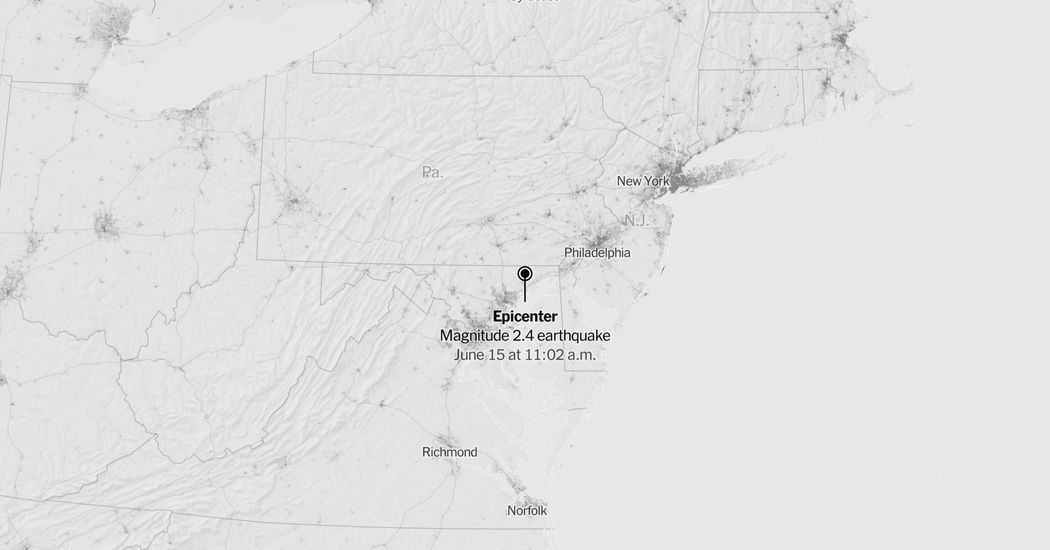
A Morning Disturbance: Minor Magnitude 2.4 Earthquake Gently Shakes Northern Maryland
On a quiet Monday morning, a sudden, subtle tremor rippled beneath the rolling hills of Harford County, Maryland, reminding residents that the Earth beneath their feet is never truly silent. The United States Geological Survey (USGS) officially recorded a minor, 2.4-magnitude earthquake at exactly 11:02 a.m. Eastern Time, pinning the epicenter approximately five miles northeast of Bel Air North. In a region far more accustomed to the humid anticipation of summer storms than tectonic shifting, the brief event produced what seismologists classify as “weak” shaking, characterized primarily by a low-frequency rumble or a fleeting vibration similar to a heavy cargo truck rumbling down a nearby suburban avenue. While the physical impact of a magnitude 2.4 event is rarely enough to cause structural damage or disrupt daily municipal operations, the psychological novelty of such an occurrence invariably ignites a flurry of local curiosity, prompting neighbors to look out their windows in search of passing construction equipment before realizing that the tremor originated miles beneath the soil. Initially registered through a network of highly sensitive regional seismometers, the event serves as a vivid reminder that the Mid-Atlantic, while generally considered a seismically quiet and stable intraplate zone, remains susceptible to the latent energies stored within ancient bedrock. As emergency management officials monitored phone lines and social media feeds for reports of damage—of which there were none—scientists immediately began gathering data from around the region, recognizing that every minor fracture and shudder provides invaluable clues about the silent, slow-moving structures that define the geologic basement of the American East. This delicate shaking, felt by those in quiet indoor settings, highlights the fascinating nature of intraplate seismicity, where the ground beneath historic suburban communities occasionally reminds humanity of the restless, dynamic forces operating far below the manicured lawns and paved highways of modern Maryland.
The Silent Giants Beneath: Decoding the Unique Seismology of the East Coast
To understand why a minor earthquake northeast of Bel Air North can provoke such widespread fascination, one must delve into the ancient geological architecture that distinguishes East Coast seismic activity from its seismically hyperactive counterpart on the West Coast. While California sits atop the highly volatile, shifting margins of active plate tectonic boundaries characterized by young, warm, and highly fractured rock that rapidly absorbs and dampens seismic energy, the eastern half of the North American continent is built upon an incredibly old, cold, and rigid basement of metamorphic and igneous craton. This dense, unyielding crystalline rock acts as an incredibly efficient acoustic and kinetic conductor, allowing seismic shock waves to travel vast distances with minimal loss of power, meaning that even a relatively low-magnitude event like Monday’s 2.4-magnitude tremor can be felt across a much broader geographic footprint than a similarly sized quake in California. Millions of years ago, during the various mountain-building epochs that raised the Appalachian chain and assembled the supercontinent of Pangea, massive crustal stresses sheared, folded, and cracked the regional geology, leaving behind a complex web of deep-seated, deeply buried fault networks. Although these ancient faults are no longer active plate boundary zones, they periodically slip and crack under the continuous, agonizingly slow stress of westward continental drift, releasing pent-up pressure in the form of brief, localized tremors. Because these ancient faults are buried under miles of sedimentary rock and soil, mapping them with absolute precision is an ongoing challenge for modern geophysicists, who must rely on these occasional, minor tremors to locate the silent lines of stress that run beneath Maryland’s picturesque horse farms, forested state parks, and bustling suburban developments.
Measuring the Tremor: How the USGS Analyzes Shake Severity and Tectonic Shifts
In the immediate aftermath of any seismic occurrence, the United States Geological Survey serves as the primary scientific authority, rapidly collecting raw telemetry from hundreds of monitoring stations to calculate the quake’s exact location, depth, and magnitude. The process of assessing an earthquake’s impact relies on two distinct measurements: the USGS magnitude, which represents the absolute quantity of physical energy released at the epicenter, and the intensity, which evaluates the actual, observed effects of the shaking on human populations and built infrastructure. Seismologists utilize the Modified Mercalli Intensity scale to categorize this shaking, and while the Bel Air North event was categorized with a shake intensity of three or greater—which the USGS officially defines as “weak”—the agency noted that the physical vibrations of such events can easily travel beyond the immediate zone illuminated on preliminary hazard maps. As data continues to trickle into the regional analysis nodes, researchers often revise the earthquake’s reported magnitude slightly upward or downward based on refined wave-form calculations, while simultaneously updating their shake-severity maps to reflect the crowd-sourced testimonies submitted to the USGS “Did You Feel It?” online portal. This collaborative, citizen-science database allows ordinary Marylanders to contribute directly to the scientific record by describing whether they heard a sharp sound, felt a sway, or noticed hanging objects gently swinging, translating subjective human experiences into valuable scientific metrics that help refine emergency threat assessments and engineering standards for generations to come. Through this blend of advanced digital telemetry and grassroots public reporting, seismology transforms a fleeting, mysterious physical sensation into a highly detailed, publicly accessible map of the Earth’s subterranean movements.
A History of Ripples: Maryland’s Surprising Legacy of Seismic Activity
Although Maryland is not traditionally viewed as an earthquake hotbed, the state has a long and surprisingly documented history of minor to moderate seismic events that have occasionally disrupted the peace of its historic coastal and valley communities. Perhaps the most famous modern catalyst for public awareness regarding East Coast seismic vulnerability occurred in August of 2011, when a powerful 5.8-magnitude earthquake centered near Mineral, Virginia, sent violent shockwaves traveling north, cracking the stone crown of the Washington Monument, shaking the brick foundations of historical Annapolis, and causing widespread panic across Baltimore and Harford counties. Historically, however, Maryland has experienced localized tremors originating within its own borders, such as the numerous small events associated with the Lancaster Seismic Zone to the north, or the minor fault lines traversing the Piedmont province, which have periodically generated brief, harmless vibrations for centuries. These localized tremors are typically shallow, occurring just a few miles beneath the surface, which concentrates the kinetic energy directly upward and results in a sudden, sharp jolt that can startle local wildlife, rattle kitchen cabinetry, and temporarily disrupt the calm of suburban neighborhoods before dissipating harmlessly into the earth. By examining these historical precedents alongside Monday’s 2.4-magnitude event, geologists gain a clearer perspective on the long-term seismic cycle of the Mid-Atlantic region, reinforcing the understanding that while major catastrophic events remain exceptionally rare, the Earth’s crust beneath Maryland is continuously settling and adjusting to global tectonic forces. Each minor shake serves as an active chapter in our ongoing efforts to understand the quiet tectonic history of the East Coast, proving that geologic evolution is a slow, continuous process that occasionally makes itself heard.
Rumors and Reality: How the Community Reacted to the Harford County Shake
Within minutes of the 11:02 a.m. tremor, the quiet digital landscape of Harford County erupted into a flurry of activity as local community groups, neighborhood forums, and social media platforms became real-time forums for collective bewilderment. Because a 2.4-magnitude earthquake produces a vibration so subtle that it mimics everyday mechanical events, many residents initially dismissed the sensation as the passing of a heavily loaded semi-truck, a routine blasting operation at a nearby limestone quarry, or perhaps a localized thunderclap from an isolated cloud overhead. However, as matching descriptions began to multiply online from Bel Air North to Forest Hill, the realization set in that the source of the disturbance was not industrial or atmospheric, but deeply telluric, prompting a collective sigh of relief that no damage or injuries had occurred, accompanied by a lighthearted wave of neighborhood humor. This digital phenomenon highlights a uniquely modern aspect of low-intensity natural hazards, where the speed of internet communication outpaces official scientific confirmation, allowing communities to bond over shared, fleeting anomalies before federal agencies can publish their verified telemetry. Local emergency dispatchers, accustomed to managing vehicular accidents and weather emergencies, noted a temporary uptick in non-emergency inquiries from curious citizens, showcasing the enduring human instinct to seek clarity and connection when the foundational assumptions of a steady, unmoving Earth are temporarily brought into question by the gentle shudders of nature.
Preparing for the Unexpected: Building Resilience in Historically Quiet Zones
While a minor earthquake like the one experienced northeast of Bel Air North poses no immediate danger to life or property, it serves as an excellent, low-stakes educational catalyst for reviewing infrastructure resilience and community earthquake preparedness. Unlike regions along the Pacific Rim where strict seismic building codes have been integrated into municipal planning for over a century, East Coast infrastructure—composed of aging brick masonry, historic colonial frame structures, and standard suburban housing—was largely designed without rigorous seismic hazards in mind, making it uniquely vulnerable to larger, albeit rare, geological disturbances. Emergency management professionals and geologists agree that the best time to cultivate public hazard awareness is during these completely harmless events, using the fleeting media attention to educate families on basic safety maneuvers like the “Drop, Cover, and Hold On” technique and the importance of securing heavy furniture to wall studs. As environmental changes and infrastructure modernizations dominate modern civic planning, maintaining a healthy respect for the quiet, subterranean forces of the Earth ensures that Maryland’s communities remain resilient, safe, and intellectually engaged with the dynamic planet they inhabit. Ultimately, Monday’s harmless tremor serves as a gentle whisper from the deep past, a reminder that the majestic landscape of Maryland, from the shores of the Chesapeake Bay to the peaks of the Blue Ridge, is part of a living, breathing geological canvas that continues to write its history one small shake at a time.