




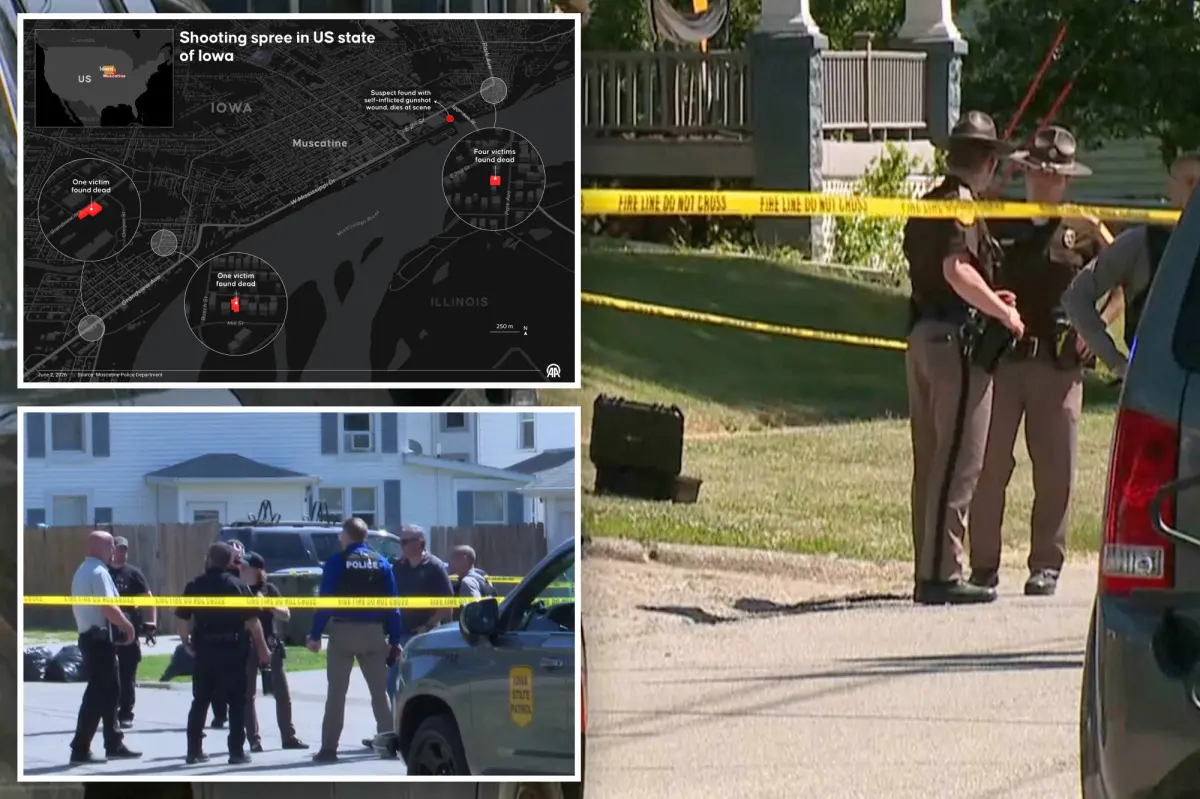
In the quiet, tightly knit community of Muscatine, Iowa—a scenic, historic river town of roughly twenty-three thousand people where life typically moves at a gentle, predictable pace—the unthinkable shattered the suburban peace on a seemingly ordinary Monday afternoon. Neighbors who had spent decades exchanging pleasantries over garden fences, waving to familiar faces during morning commutes, and watching each other’s children grow up found themselves frozen on their front porches, watching a real-time nightmare unfold in their own backyards. The physical and emotional center of this sudden, chaotic storm was a modest, well-kept family home that property records show had belonged to fifty-two-year-old Ryan Willis McFarland for more than twenty years. This house, which had long served as a symbol of suburban stability and quiet Midwestern domesticity, was overnight transformed into a heavily secured crime scene, swarming with forensic investigators and law enforcement personnel. To those who lived nearby, McFarland was not a looming threat, a social outcast, or a volatile stranger; he was a highly recognizable, deeply familiar fixture of their neighborhood, someone who had spent two decades planting deep roots, raising his children, and physically walking the very streets that would eventually be cordoned off with yellow police tape. Yet, beneath this carefully constructed veneer of routine parenting and neighborly friendliness lay a dark, simmering pressure cooker of hidden desperation, financial anxiety, and psychological instability that eventually erupted into an unprecedented outburst of violence, shaking the foundation of the entire community. The tragedy, which would ultimately claim the lives of six innocent family members before claiming McFarland’s own, began to leak into the open air just minutes before the emergency sirens began to wail, leaving behind a neighborhood haunted by the incredibly fragile, terrifyingly thin boundary between the peaceful lives they thought they knew and the ultimate capacity for destruction hidden behind closed doors.
The first overt sign of the impending catastrophe came around noon on Monday, when next-door neighbor Melissa Weggen overheard a deeply unsettling, highly erratic soliloquy drifting from the street outside her home. She witnessed McFarland walking past her property, visibly agitated and shouting alarming, existential pronouncements into the empty air, muttering about the futility of financial struggles and the ultimate finality of human mortality. “Don’t worry about money,” he was heard declaring to no one in particular, his voice carrying a chillingly detached weight, “everything goes away when you die.” Though Weggen initially dismissed the outburst as merely unusual behavior in an area where occasional shouting or street noise wasn’t entirely foreign, the profound, life-altering gravity of his words became terrifyingly clear just ten minutes later when a massive, mechanized wave of emergency responders, police cruisers, and heavily armed tactical officers swarmed the quiet street. From her front porch, Weggen watched in absolute disbelief as officers quickly established a perimeter, positioning themselves around McFarland’s home with weapons drawn and shouting demands through crackling bullhorns for anyone inside to exit with their hands raised. The tense, high-stakes standoff was met with an oppressive, deafening silence from within the house, prompting law enforcement to breach the barricaded residence, where they made the grim and heartbreaking discovery of four deceased individuals inside. By the time officers had crossed the threshold, however, McFarland had already slipped away unnoticed, fleeing his long-time home on foot and leaving behind a scene of unspeakable domestic carnage that would soon expand far beyond the walls of his primary residence.
The urgent search for the fleeing suspect was short-lived but ended in further tragedy along Muscatine’s nearby riverview trail, a scenic recreational path overlooking the Mississippi River that is normally a sanctuary for local joggers, families, and nature enthusiasts. Officers tracked McFarland to this location, but as they closed in and attempted to de-escalate the situation, the fifty-two-year-old turned his weapon upon himself, ending his own life in a final, violent act of self-destruction while still actively communicating with negotiating officers. The horror, however, did not conclude with his death, as investigators quickly realized that the scope of McFarland’s destructive rampage extended far beyond his immediate household and into other corners of the community. Pursuing leads, emergency contacts, and welfare checks, police discovered a fifth victim, an adult male, shot to death inside a home located approximately two miles away from the initial crime scene on the other side of town. The trail of violence stretched even further to a local commercial business, Willits Metalworks, where responding officers uncovered a sixth victim, another adult male who had been fatally shot at his place of employment. Law enforcement officials, clearly shaken by the sheer scale of the atrocity, officially characterized the multi-location killing spree as a calculated “act of evil” that appeared to have stemmed entirely from a deeply rooted, catastrophic domestic dispute. While the specific identities of the deceased were withheld during the initial stages of the investigation, authorities confirmed the devastating reality that all six victims were believed to be members of McFarland’s own family, highlighting the deeply personal and tragic nature of the dispute that wiped out multiple generations in a single afternoon.
The ripple effects of this profound loss immediately tore through the local educational community, as administrators confirmed that two of the victims were young students within the Muscatine Community School District, while two others were dedicated school staff members who had spent years serving the district. The loss of these individuals cast a heavy, suffocating pall over local classrooms, turning places of learning, laughter, and development into spaces of collective grief, profound confusion, and agonizing, unanswered questions for teachers and students alike. The pain was deeply personal for young residents like twenty-year-old Sarah Ziegenhorn, who had grown up in the neighborhood and graduated from high school alongside McFarland’s daughter. Upon hearing the news of the police swarming the familiar home, Sarah immediately reached out to her former classmate in a desperate attempt to offer comfort, only to be met with an agonizing silence that spoke volumes about the tragedy unfolding in her friend’s life. Remembering the suspect’s daughter as an incredibly sweet, profoundly empathetic young woman who possessed a large heart, liked everyone, and constantly thought about the well-being of others, Sarah and her mother were left to contemplate the unthinkable reality of what their peer might have endured inside that home. This sudden vacuum of communication and the realization that entire families had been permanently fractured transformed the tragedy from a distant news headline into an intimate, agonizing reality for Muscatine’s youth and educators alike, who must now find a way to navigate a future permanently scarred by the sudden, violent absence of their classmates, colleagues, and mentors.
What makes this tragedy so uniquely difficult for the neighborhood to process is the stark, seemingly irreconcilable contrast between McFarland’s final monstrous acts and the gentle, family-oriented persona he had carefully projected to the community for over twenty years. Melissa Weggen recalled him not as a dangerous or unstable man, but as a decent, polite neighbor who was deeply integrated into the routine fabric of the street, frequently going on leisurely walks with his wife, their youngest child, and their beloved pet pugs. In a touchingly normal detail that now feels painfully ironic and deeply disturbing, Weggen remembered how the couple would almost always be holding hands during their walks, displaying an outward affection and domestic harmony that gave no hint of the violent storm brewing behind closed doors. This sharp juxtaposition of a hand-holding, dog-walking family man with a cold-blooded mass murderer has left the community questioning their own instincts and the safety of their quiet neighborhood, struggling to understand how such profound darkness could coexist with such seemingly warm, mundane displays of familial love. The realization that a neighbor can be smiling and holding hands with his spouse one day, and perpetrating a multi-location massacre of his own family members the next, has shattered the comforting illusion of predictability that small-town residents often rely on to feel safe in their homes, leaving them to wonder what other secrets might be hidden behind the closed curtains of their quiet street.
Perhaps no encounter illustrates this tragic duality more painfully than the final conversation shared between McFarland and another neighbor, Austin Loughead, just twenty-four hours before the murders took place. On a peaceful Sunday afternoon, Loughead was out in his yard, patiently teaching his young son the milestone skill of riding a bicycle, a universal, heartwarming scene of father-son bonding. McFarland, watching the scene unfold from a distance, called out with a warm, genuine smile, expressing a heartfelt sense of pride in the young boy’s progress and offering encouragement that left Loughead feeling a sense of deep neighborly warmth. “He’s doing really good. I’m really proud of him,” McFarland had yelled over, a brief, fleeting moment of human connection that would become a haunting memory just one day later when those same streets were blocked by yellow crime scene tape, flashing emergency lights, and the heavy presence of law enforcement. The memory of that simple, encouraging smile and those warm words of praise now hangs heavily over Loughead and the rest of the community, serving as a bitter, heartbreaking reminder of how quickly a life, a family, and an entire neighborhood’s sense of security can be utterly destroyed. In the wake of this unimaginable tragedy, Muscatine is left with the agonizing task of mourning six innocent lives, trying to heal the deep wounds inflicted upon their schools and streets, and wondering how a father’s pride could turn so swiftly, violently, and inexplicably into an act of absolute ruin.