




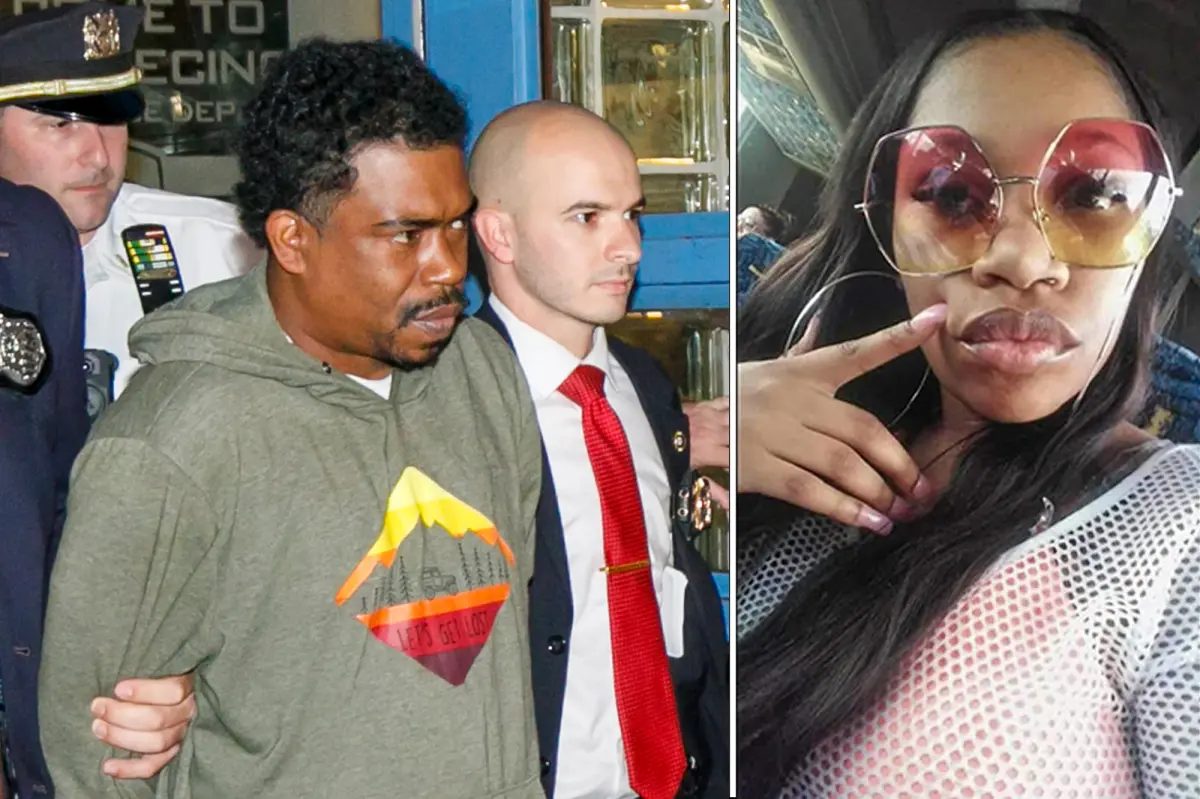
On a Saturday morning that should have been like any other, a Washington Heights neighborhood found itself at the center of a tragedy no one could make sense of. Police announced that Tiliek Shamel Thompson, a 41-year-old man, had been charged with murder in the death of Lovay Williams, a 27-year-old mother whose life was cut short in the most brutal way imaginable. Williams was beaten to death in front of her 7-year-old daughter, a detail so painful it seems almost impossible to absorb. The little girl did not just lose her mother; she was forced to witness the final moments of her mother’s life, an image no child should ever have to carry. Thompson, who had been named as a person of interest in the investigation, surrendered at the 33rd Precinct station house earlier that day. Photos obtained by The Post showed him flanked by detectives, walking out of the precinct after being processed. The visual was a stark reminder that someone was now being held accountable, but for those who loved Lovay, it was not a moment of celebration. It was a moment of stunned sorrow. A young woman was gone, a little girl was motherless, and a community was left to wonder how a familiar face could be connected to such horror. The arrest answered one question—who would face charges—but it opened a longer and more painful set of questions about love, violence, and the invisible struggles that can exist behind closed doors.
Thompson’s attorney, Neville Dexter, confirmed that his client had walked into the precinct and turned himself in. “He’s at the precinct right now,” Dexter said before the arrest was announced, offering a glimpse of a legal process unfolding in real time. What made the surrender significant was that Thompson had initially been identified by police only as a person of interest, not an outright suspect. In the days between the killing and the arrest, the public had begun to speculate. Dexter said someone had been using social media to implicate his client, and he urged people to hold off on judgment. “Everybody should reserve judgement,” the lawyer said. “We don’t know what happened.” Those words carry a certain weight in any criminal case. They are a reminder that the court system exists to determine facts, not to be driven by outrage or rumor. But for a family in mourning, such caution can feel impossible. The charge itself is a statement that law enforcement believes Thompson was responsible. The legal journey is only beginning, with arraignment, evidence, and eventually a trial likely to follow. Thompson is 41, more than a decade older than the woman he is accused of killing, and according to those close to Williams, the two had a history, making the case even more complicated. This was not a random attack by a stranger, at least not according to the people who knew them. It was allegedly an act of violence between people who shared a relationship. That reality makes the case more intimate and more disturbing, because it forces the mind to consider what could have gone so wrong that a mother ended up dead in her own apartment, with her child nearby.
The events that led to the arrest began on September 6, when officers were sent to 535 W. 156th Street near Amsterdam Avenue for a wellness check. It was shortly after 1:30 p.m., and someone had apparently been concerned enough about Williams to ask police to make sure she was all right. What they found inside the apartment was a scene of unimaginable violence. Williams was unresponsive, with injuries to her face and neck, and medical personnel pronounced her dead at the scene. She was 27 years old. She was a mother. She was someone with a family who never imagined their lives would be shattered by a knock on the door. The apartment on West 156th Street, which should have been a private sanctuary, became the site of a homicide investigation. And perhaps most disturbing of all, her 7-year-old daughter was inside the apartment at the time. The phrase “inside the apartment” does not begin to capture what that means. A child was present during the attack on her mother, and that child’s life will never be the same. Investigators would later move through the building, gathering evidence and speaking to neighbors, while the community reeled from the news. The details that emerged were fragmentary but devastating: a young woman beaten to death, a child left to witness something no child can process, a suspect who was known to the victim. In the days that followed, the apartment building became a place of grief and vigilance. People left tributes, hugged each other, and tried to make sense of a tragedy that seemed to defy explanation. But no amount of flowers or candles could bring Lovay Williams back. No memorial could erase the memory of what happened inside those walls. The only small measure of progress came when Thompson was taken into custody, an event that gave the family something they had been desperately waiting for: an arrest.
In the aftermath of the murder, Lovay Williams’s family did what families do when grief is not yet settled: they demanded answers, and they demanded accountability. Her brother, Nuquan Williams, spoke to The Post before Thompson’s arrest, and his words were raw with anger and pain. “Man up to the things you did!” he said. “It was horrific. You don’t deserve to walk the streets and enjoy life when you took a life.” Those sentences are not legal arguments; they are the cries of a brother who has lost someone he loved in a way that was not just sad, but violent and degrading. He called the killing horrific, and it was. A 27-year-old woman was beaten to death in front of her child. There is no version of that story that is not horrific. Nuquan spoke directly to the killer, even before the killer had been charged, because the family knew who was responsible. They were not protected by the legal presumption of innocence; their certainty came from the pain of surviving a loss that did not feel accidental. They wanted Thompson to face what he had done, not just to satisfy a court, but to acknowledge the humanity he had taken. For many families, an arrest is the beginning of justice. For Nuquan, it was likely the beginning of a long process of confronting a crime that had changed everything. He did not ask for revenge. He asked for responsibility. That is a simple demand, but it is one of the hardest things in the world to get when someone has been killed. The family needed to hear someone say, yes, I did this. They needed to know that the person responsible would not be free while Lovay was in the ground.
Asia Walker, who described herself as Williams’s “God sister,” offered a different kind of grief—the confusion of someone who knew both the victim and the accused. She said Thompson and Williams had been together “for a while,” and that familiarity made the violence even harder to understand. “It’s confusing to me because we knew this man for too long,” Walker said. “I don’t even know what caused this. I can’t remember her saying they even argued before.” The statement is heartbreaking, because it suggests that no one saw this coming, not the victim, not her family, not her god sister. Domestic violence often lives in the shadows, hidden behind closed doors, and abuse can escalate in ways that surprise even the people closest to the couple. But Walker’s words also reflect the particular horror of losing someone to someone you trusted. There is no outside monster to hate; there is a familiar face, a partner, someone who was once welcomed into the family. Walker said Thompson turning himself in would bring relief, not because it would bring Lovay back, but because it would remove the threat he posed and allow her niece to begin to heal. “Honestly, I know we ain’t gotta worry about him hurting nobody else and my niece can be at ease,” she said. “Tomorrow will be a little better for me. I could sleep at night.” Sleep. It is such a basic human need, yet after a violent loss, sleep becomes a luxury. Walker was not asking for vengeance. She was asking for the ability to close her eyes without fear. Her words evoke the exhaustion of grief, the never-ending spiral of worry, and the fragile hope that an arrest can break the cycle. She was thinking of the child—Williams’s daughter—who now needs safety, stability, and time to process a loss that should never have happened.
Outside the apartment building on West 156th Street, a makeshift memorial now marks the spot where a young life ended. Balloons, flowers, and candles rest against the wall, sagging in the weather but refusing to disappear. They are symbols of a community trying to honor a woman whose life was stolen, and they serve as evidence that Lovay Williams mattered. The memorial will not last forever; the balloons will fade, the flowers will wilt, and the candles will burn out. But the grief behind them will not. A 7-year-old girl will grow up without her mother. A brother will carry the memory of his sister’s brutal death. A god sister will replay every conversation, looking for signs that she missed. A neighborhood will remember the day the police answered a wellness check and found a murder scene. Thompson’s arrest is a significant step, but it is not the end. The legal system will move slowly, and the family will have to relive the details of that day in court. The phrase “everybody should reserve judgement” may be legally correct, but for a family in mourning, the verdict has already been delivered by their loss. They want justice. They want accountability. They want the person who took Lovay Williams from them to understand the depth of what he has done. None of that can give Lovay back to her daughter. None of that can undo the terrifying image of violence in a small apartment. But perhaps it can allow a little girl to breathe, knowing that the man who hurt her mother is off the streets. Perhaps it can allow her god sister to sleep at night. In the end, what happened in Washington Heights was not just a murder; it was a rupture in the lives of everyone who knew and loved Lovay Williams. The arrest is a first stitch in a wound that will not fully close. But the community has promised to remember her, to support her daughter, and to keep asking for the justice she deserves.