






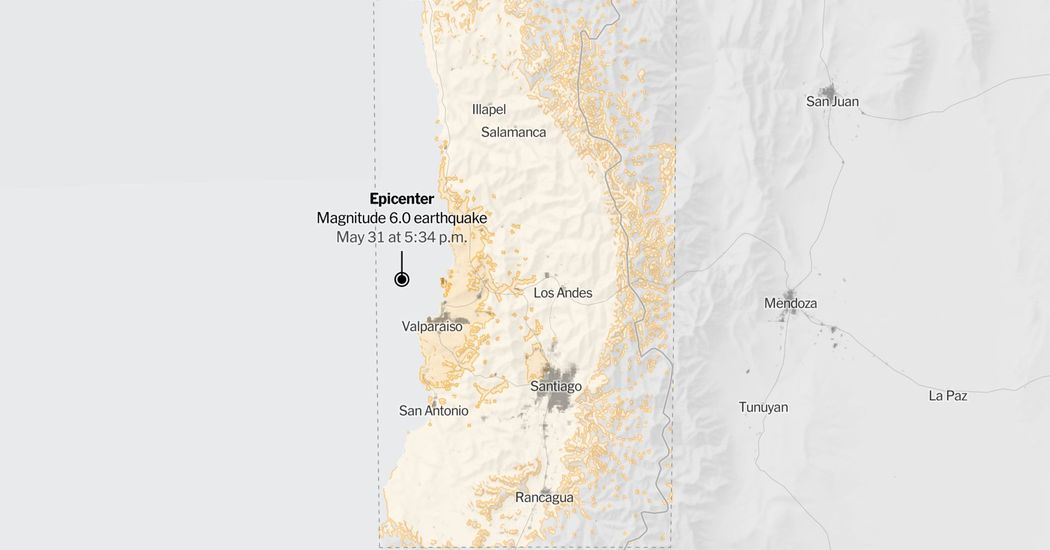
Seismic Activity in Chile: Strong 6.0-Magnitude Earthquake Visualized Off the Coast of Valparaíso
Sunday Shockwave: Strong Offshore Tremor Rattles Central Chile
A sudden, powerful tremor disrupted the late Sunday afternoon calm along the central coast of Chile, when a strong 6.0-magnitude earthquake erupted deep within the South Pacific Ocean. This event rattled vibrant coastal communities and served as a stark, physical reminder of the region’s notoriously volatile tectonic foundation. According to official telemetry compiled and finalized by the United States Geological Survey (USGS), the submarine seismic disturbance occurred at precisely 5:34 p.m. Chile Standard Time (CLST). The agency’s spatial data positioned the epicenter approximately 22 miles northwest of the historic, bustling port city of Valparaíso, a picturesque metropolitan area renowned for its steep hillsides, colorful architecture, and vital maritime trade. Although seismologists quickly categorized the localized shaking intensity as a 3 or greater on the Modified Mercalli Scale—which designates the surface sensation of this specific tremor as relatively “weak” in terms of its potential to inflict immediate structural damage—the physical sway was felt broadly by thousands of residents and weekend travelers across the sprawling coastal zone. Inside residential high-rises and commercial plazas, hanging light fixtures swung rhythmically, windows rattled in their frames, and a wave of intuitive emergency actions took place as people recognized the low-frequency rumble of a submarine plate boundary rupture. In the immediate aftermath, local municipal offices and civil defense networks mobilized swiftly to assess the structural integrity of critical infrastructure, including the historic funicular elevators of Valparaíso, regional transport arterials, and crucial shipping terminals. This unexpected offshore event temporarily halted quiet weekend routines, transforming the late afternoon into an active, synchronized exercise in real-time scientific analysis, emergency communications, and community-wide vigilance.
The Tectonic Crucible: Why Chile’s Margins Remain a Hotbed of Seismicity
To fully comprehend the geological significance of Sunday’s offshore tremor, one must examine the complex and unforgiving subterranean landscape of the Chilean margin, which is globally recognized as one of the most seismically dynamic zones on Earth. This relentless activity is driven primarily by the ongoing, slow-motion collision between two massive tectonic plates: the heavy, oceanic Nazca Plate and the lighter, continental South American Plate. The Nazca Plate, composed of dense basaltic crust, continuously slides eastward toward the South American continent at a rate of approximately 6.5 centimeters per year, forcing its way downward into the mantle along a massive subduction zone demarcated by the deep Peru-Chile Trench. This collision is not a smooth, frictionless slide; instead, the colossal masses of stone lock together under immense pressure, bending the overlying continental shelf and accumulating massive reserves of elastic energy over decades and centuries. When the frictional lock at the plate interface finally fails, the stored strain energy is released instantaneously, fracturing the rock mass along the fault plane and projecting violent seismic waves outward. Historically, this subduction zone has been the birthplace of some of the planet’s most catastrophically energetic natural disasters, including the legendary 1960 Valdivia earthquake of magnitude 9.5—the strongest ever recorded in human history—and the more recent 2010 Maule earthquake of magnitude 8.8. The city of Valparaíso itself occupies a frontline position along this geological battleground, notably experiencing a devastating magnitude 8.2 earthquake in 1906 and a significant magnitude 6.9 event as recently as 2017. Sunday’s magnitude 6.0 earthquake represents another release of this localized tectonic strain, highlighting how the fault segments northwest of Valparaíso remain a highly active laboratory of plate collision where even moderate slips can alter the balance of surrounding subterranean stresses.
Decoding the Shake: How Seismologists Map and Measure the Invisible Energies
In the minutes following the initial shockwave, the complex mechanisms of global seismology swung into action, leveraging telemetry from international sensor arrays to translate invisible kinetic movements into a detailed portrait of the event. The United States Geological Survey (USGS) utilized sophisticated waveforms to pinpoint the earthquake’s epicentral coordinates and evaluate its physical magnitude, which was measured at a strong 6.0 on the Moment Magnitude Scale. While magnitude quantifies the raw energy generated at the subterranean fault source, seismologists rely on the Modified Mercalli Intensity (MMI) scale to map the actual human and environmental impact across different geographical zones. According to the USGS ShakeMap, a broad coastal zone experienced a shake intensity of 3 or greater, which designates the physical sensation as perceptible but largely benign to modern structures, though experienced as a distinct wobble by people indoors, particularly on upper floors of high-rise apartment complexes. To comprehensively analyze the vulnerability of the region, seismologists overlaid this shake intensity map with demographic models like the LandScan database, developed by the Oak Ridge National Laboratory. This advanced population-density mapping allows emergency responders to calculate the exact number of individuals living within areas subjected to varying degrees of shaking, enabling rapid mobilization of resources if localized infrastructure failures occur. As more data is gathered from regional monitoring stations, the USGS continuously updates these shaking intensity models, demonstrating how digital cartography and advanced geophysics have become indispensable tools for modern disaster mitigation and scientific analysis.
Aftershock Risks: The Tracing of Subterranean Readjustments
The primary rupture of an earthquake is rarely an isolated geological event, as the displacement of crustal blocks along an active fault line triggers a cascading readjustment of physical stresses throughout the surrounding geological structures. In the hours following Sunday’s 5:34 p.m. tremor, seismological monitors detected a series of secondary shakes—commonly referred to as aftershocks—occurring within a 100-mile radius of the primary submarine epicenter. These aftershocks represent the earth’s natural process of settling and redistributing the microscopic stress concentrations that remain on the newly slipped segment of the fault plane. According to seismologists, aftershocks are an inevitable consequence of any significant crustal rupture, adhering to recognized mathematical patterns like Omori’s Law, which states that the frequency of secondary tremors decays steadily over time, though their potential for disruption remains high. These secondary events can occur over days, weeks, or even years, and can occasionally reach magnitudes equal to or greater than the original earthquake, presenting a continuous threat to already compromised structures. For the local populace, the physical and psychological toll of aftershocks is profound; the sudden, unpredictable rattling of the ground serves as a recurring source of anxiety, keeping communities on edge and complicating recovery efforts. From an engineering standpoint, these repeated tremors slowly degrade the structural integrity of older buildings, generating micro-fractures in masonry and weakening foundations that survived the initial shake. Civil defense authorities must maintain elevated levels of vigilance during these aftershock sequences, utilizing real-time monitoring networks to assess whether these secondary quakes are simple crustal settling or perhaps precursory indicators of potential activity along neighboring, locked fault segments.
Built to Bend: Chile’s Exemplary Model of Engineering and Public Safety
The minimal impact of Sunday’s 6.0-magnitude earthquake on Valparaíso’s population is a testament to Chile’s world-leading seismic building codes and a deeply ingrained cultural preparedness. Following the lessons of historic natural disasters, Chile implemented rigorous structural engineering regulations, specifically standards NCh433 and NCh430, which mandate that all modern high-rises must incorporate seismic isolation systems and energy-dissipating dampers designed to let buildings bend and sway rather than collapse. This resilient physical infrastructure is backed by the highly organized National Disaster Prevention and Response Service (SENAPRED), which operates a sophisticated early warning network that can broadcast instant mobile alerts to citizens within seconds of a seismic detection. When an offshore earthquake occurs, one of the most immediate concerns is the potential generation of a localized tsunami, prompting rapid communication between SENAPRED and the Hydrographic and Oceanographic Service of the Chilean Navy (SHOA). On Sunday, rapid oceanic sensor evaluations confirmed that the deep-sea displacement was insufficient to trigger a hazardous wave, letting coastal residents breathe a sigh of relief without the need for mass evacuations. This seamless integration of structural resilience, real-time warning technologies, and community-level awareness demonstrates how Chile has successfully transformed itself from a vulnerable volcanic nation into a global exemplar of seismic safety and survival.
Scientific Horizons: The Ongoing Vigil of Deep-Earth Monitoring
As the seismic data from the Valparaíso earthquake continues to be processed and archived by scientists around the world, this event adds another crucial chapter to our evolving understanding of global tectonic dynamics. Today’s seismologists are operating at the cutting edge of scientific discovery, utilizing space-based radar interferometry (InSAR) and artificial intelligence algorithms to detect microscopic deformations in the Earth’s crust that precede significant physical ruptures. While predicting the exact day and hour of future earthquakes remains an elusive goal for modern science, these advancements in telemetry and global data sharing have significantly improved our ability to map fault networks and forecast regional seismic hazards. The moderate but clear reminder delivered by the South Pacific Ocean on Sunday emphasizes that our civilization exists on a restless planet, requiring a continuous commitment to safety, technological innovation, and transnational scientific support. By treating each moderate quake as a vital input for scientific research, the international community moves closer to a future where communities can coexist harmoniously with the volatile geology beneath their feet, transforming natural hazards from unpredictable catastrophes into manageable and survivable events of a dynamic Earth.