





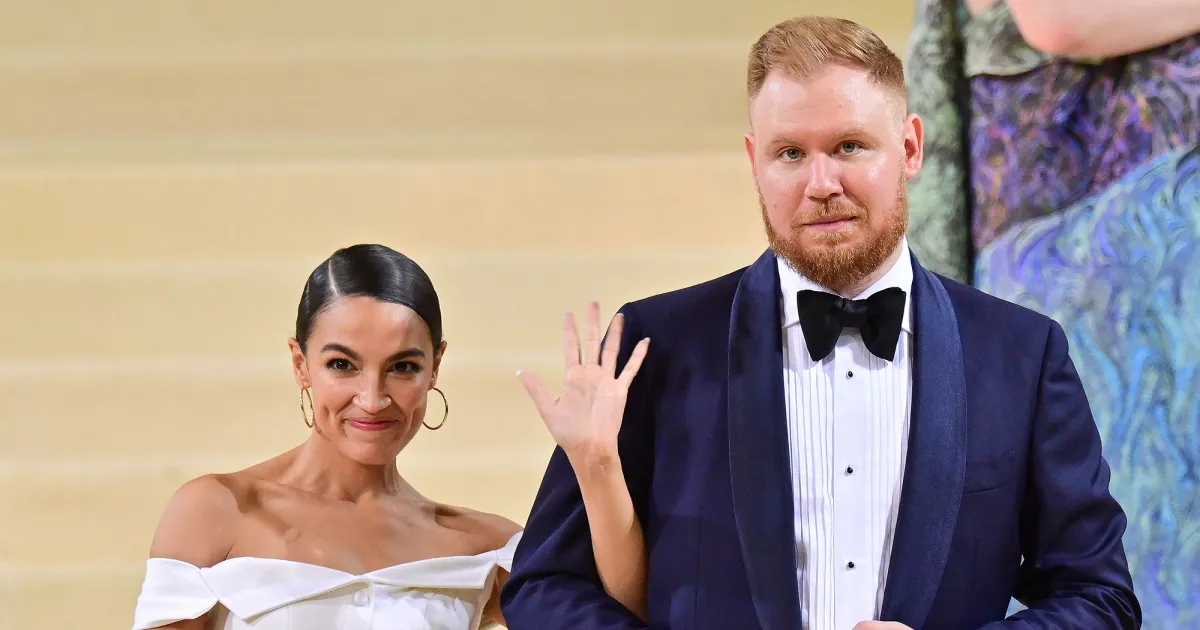
On Wednesday, August 12, Alexandria Ocasio-Cortez stepped out of her carefully managed public world and into an ordinary ritual: walking her dog. There were no cameras waiting for her, no committee hearing, no stage, no microphone. Just a sidewalk, a leash, a woman, and the unremarkable rhythm of an afternoon that was supposed to belong to her. But the ordinary never stays ordinary for someone as visible as AOC. A New York Post reporter spotted her and, with no preamble, asked about Riley Roberts, the man she has been engaged to since 2022, specifically whether the couple were “still together.” The congresswoman, 36, did not stop walking. She did not even blink. “I don’t comment on my private life, but thank you,” she said. The reporter pushed again, this time invoking her mother: Would her mother finally get her wish and see her daughter marry Roberts, 38? Again, Ocasio-Cortez replied with the same phrase, verbatim. “Again, I don’t comment on my private life, but thank you.” The journalist tried a third time, asking if there was anything she could tell them about the relationship. “No, I’m sorry, thank you.” And then she was gone, continuing down the street with her dog, as though the exchange had barely happened. It was not a confrontation. It was not a confession. It was a boundary, drawn without drama and held without apology. Still, the exchange carried enormous weight, because the question was not really about love. It was about a rumor that has been circling for months: the engagement is off, the split happened about two years ago, and the future everyone quietly assumed for AOC has changed.
To understand why Ocasio-Cortez chose silence, you have to understand how carefully she built this relationship. Riley Roberts was not a late addition to her life; he was a chapter from the beginning. The two met at Boston University, long before she had ever heard of the House of Representatives, long before cable news learned to pronounce her name. They were young people figuring out their values, their politics, their futures. What began as a college connection became a through-line in her life. When she surprised the political establishment by winning a congressional primary in 2018, Roberts was in the background—not a spinner, not a handler, not a person seeking credit. He was simply the person who knew her before the myth. In May 2022, the congresswoman confirmed what many fans had hoped: she and Roberts were engaged. She took to X and told her followers that rumors about her relationship status were “true!” She added something warmer to Business Insider: “We got engaged last month in my family’s hometown in Puerto Rico. No future details yet, we’re taking some space to savor this time before diving into planning.” The word “savor” was the one that stayed with people. It suggested a woman who understood that once the details went public, they would be dissected, monetized, and used against her. She wanted to keep something for herself. A GQ profile published that September painted a portrait of a couple with roots—two people who had grown together through the shock of victory, the cruelty of attacks, and the strange isolation of political celebrity. They were not a power couple in the usual sense. There were no glossy magazine spreads of their home, no joint interviews about their love language. There was just a long history, and a decision to protect it.
Then, on August 11, a tweet broke that silence like a stone through glass. Leigh Ann Caldwell, Puck’s chief Washington correspondent, was reacting to Ocasio-Cortez’s recent announcement that she had started freezing her eggs. “AOC and Roberts broke up about two years ago. Perhaps that’s why she’s freezing her eggs,” Caldwell wrote on X. The tweet was admittedly speculative in tone—the word “perhaps” did a lot of work—but it was phrased as if the breakup was widely known. The following day, TMZ picked it up and gave it the force of a report: the engagement was off, the couple had split about two years ago. The story ricocheted through social media, and suddenly the internet was scavenging for evidence. Was there a ring in that photo? When was the last time they were seen together? Had anyone seen her with Roberts at all? Caldwell later walked her original statement back just enough to be more precise, but not enough to retract it. She said she had been “told by a reputable Democratic source about 18 months ago that [AOC’s] engagement was called off.” She claimed that Ocasio-Cortez had “stopped wearing her engagement ring several months before that,” and noted that there had been “no public photos of her and Riley together in recent history.” But then she added a crucial caveat: “Maybe they have gotten back together? I have no idea. Her office has not confirmed nor denied the status of her relationship.” She concluded, “Honestly I thought that her calling off the engagement was much more widely known when I posted my original tweet.” In other words, the strongest available account of AOC’s love life is a puzzle with a missing piece. A source exists. A ring is absent. A timeline is blurred. But the only person who actually knows the answer has refused to provide one. That absence of confirmation is not proof. It is simply a place where speculation has rushed in to fill the void.
The reason the tweet felt so invasive was that Ocasio-Cortez had just offered the public something genuinely vulnerable. On Saturday, August 8, she took to Instagram Stories to explain a decision she had been weighing for years. “I want to share with you all a decision that is very personal that I have made that has taken me time to consider, weigh and save up for,” she wrote. “And it is of a sensitive matter and a personal matter and usually I keep my private life quite private, but I have made the decision to start freezing my eggs.” The announcement was careful, but it was also courageous. She did not have to tell anyone. She chose to, because she understood that reproductive decisions are shrouded in too much shame and secrecy, and because she wanted to claim ownership of her own story. She went on to say that this was “a choice that I am making to feel more in control of my life,” and she explicitly acknowledged that people would make assumptions. “If people want to make assumptions about my decision, let them make those assumptions—I feel empowered to make this choice.” She also recognized her own privilege, calling it “a very privileged position that I’ve been able to make” while noting that changes in technology have made the procedure “more financially accessible” than it once was. That final detail mattered. It showed that even a famous member of Congress had to save up, that she understood the gap between what medicine can offer and what many women can afford. The post was not an invitation for commentary. It was an act of solidarity with every woman who has faced the question of whether, when, and how to build a family. And within days, that act was thrown back in her face, turned into a gossip item, used as evidence that she was single because she had been abandoned. The implicit message was reductive: a woman would only take control of her fertility if a relationship had failed. It ignored the possibility that AOC might be doing exactly what she said—making a proactive, empowered choice for herself, on her own timeline, regardless of whether there is a man beside her.
All of this needs to be placed in a larger context. Ocasio-Cortez is not just any politician. She is one of the most recognizable progressive voices in the country, a lightning rod for both devotion and disgust, and a woman repeatedly described as a potential future Democratic nominee for president. Every choice she makes is already political. Her clothes, her voice, her haircut, her marriage status: all of it is read as evidence of something larger. The questions about Roberts are not merely idle celebrity gossip. They are tests of whether she fits a comforting script. At 36, she should be married. She should have children, or at least be planning them in a way that makes sense. If she is single, she must be sad. If she is freezing her eggs, it must be because something went wrong. The reporter’s question about her mother’s “wish” was especially telling. It reduced Ocasio-Cortez to a daughter who is expected to satisfy her parent, a woman whose adult choices are measured against someone else’s hopes. Imagine, for a moment, a male politician in the same situation. Would a reporter ask a senator whether his father was eager to see him remarried? Would a male representative’s decision to freeze sperm be explained by a broken engagement? The double standard is so familiar that we almost stop seeing it. Women in public life are required to be transparent about everything that men are allowed to keep hidden. Ocasio-Cortez has spent her career refusing to perform that kind of transparency. She has been open when she wanted to be, and silent when that was her right. Her refusal to comment on her relationship is not a failure to communicate. It is a refusal to accept the premise that her private life is a public file. She owes the country her vote, her voice, and her work. She does not owe us the shredded pieces of her heart.
In the end, what do we actually know about Alexandria Ocasio-Cortez and Riley Roberts? We know they met at Boston University. We know they got engaged in Puerto Rico in 2022, and that she confirmed it with a sweetness that made even skeptics smile. We know that she once wanted to “savor” the period before wedding planning. We know that at some point she stopped wearing a ring, or at least she was not wearing it in photographs. We know there have been no recent public photos of them together. We know a reputable Democratic source told a journalist that the engagement was called off. And we know, just as clearly, that the journalist herself admitted she did not know the current state of the relationship. “Maybe they have gotten back together?” she wondered. That caveat is not a footnote. It is the hole in the center of this entire story. Ocasio-Cortez is the only person who can answer the question, and she has chosen not to. That choice is worth respecting. It is not a deception. It is not a scandal. It is the act of a person who understands that some things cannot be explained without being diminished, and who refuses to let the world define her by her most intimate moments. She has given the public so much: her time, her arguments, her vision, her passion. She shared her decision to freeze her eggs—a decision that many women make in private and never mention out loud—in order to help normalize it. But that generosity does not open the door to further interrogation. She does not owe us her grief, her joy, her family, or her future. She does not owe us her mother’s wishes, the history of her engagement ring, or the inside of her heart. So maybe the kindest way to respond to this story is with the same answer she gave three times on that August sidewalk: thank you, and no comment. Let her take her walk. Let her decide what to do with her life. The wedding might happen; it might not. The children might come; they might not. Whatever she chooses, she will be the author of it. That is not too much to ask. It is exactly what all of us want for ourselves.