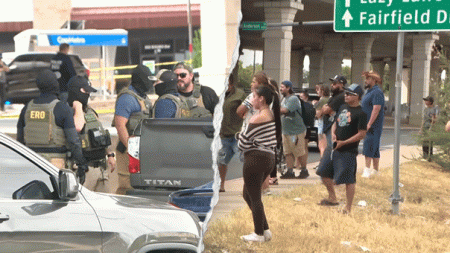






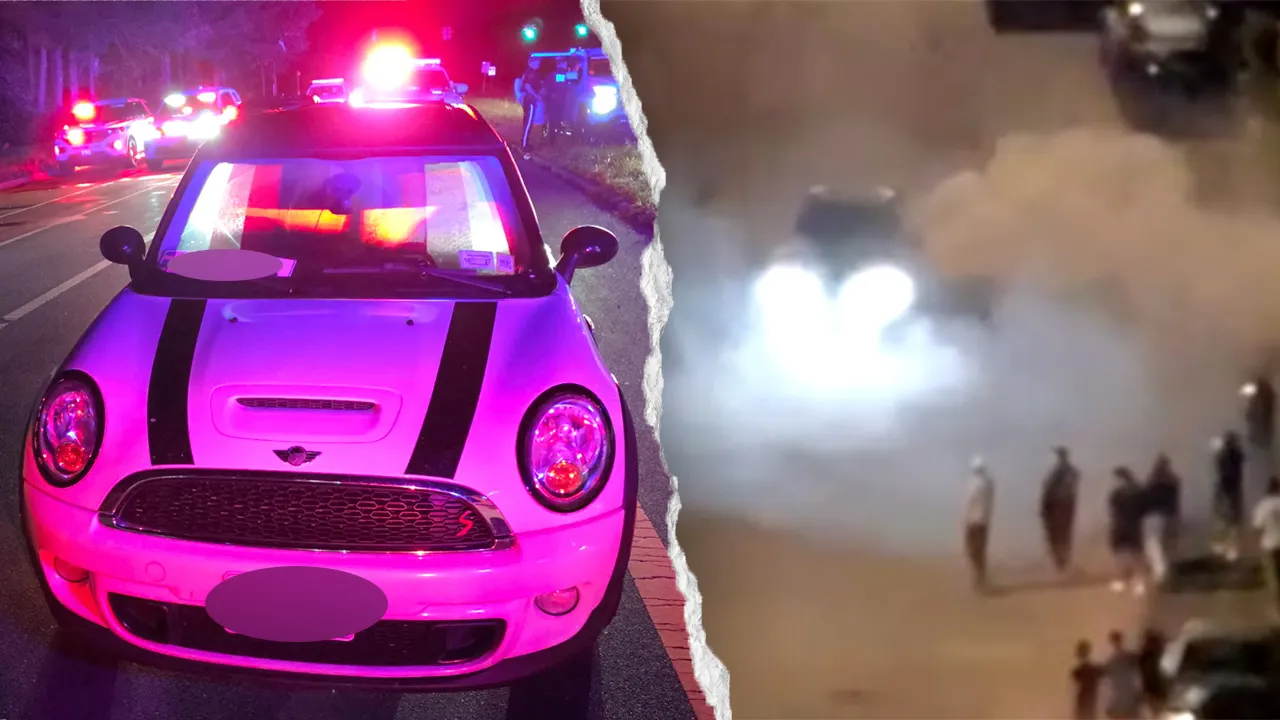
The roar of engines shattered the early-morning quiet, a sound that has become all too familiar to residents of Long Island. Tires screeched, smoke billowed, and the acrid smell of burning rubber filled the air as a crowd of vehicles descended on Sawgrass Drive in Medford, transforming a suburban street into an impromptu arena of chaos. It was just past midnight on a Saturday, and what began as a secretive, social-media-driven plan had devolved into a dangerous spectacle of donuts, burnouts, and reckless stunts that effectively blocked the roadway. But this time, the participants weren’t going to get away with it. The Suffolk County Police Department, armed with advance intelligence and a dedicated task force, was waiting for them. When the dust settled, fifteen people were in handcuffs, seven vehicles were hoisted onto tow trucks and impounded, and a flurry of traffic summonses had been issued. It was a decisive strike in an ongoing war against a reckless subculture that has been terrorizing streets across the nation, and for the officers involved, it was a rare moment of satisfaction in a battle that often feels like a game of whack-a-mole.
The operation that night was a masterclass in modern policing, a preemptive strike made possible by old-fashioned detective work and cutting-edge digital surveillance. Days before the festivities were set to begin, the department’s Street Takeover Task Force—a specialized unit created to combat exactly this kind of lawlessness—caught wind of a planned gathering. Through diligent intelligence gathering and the meticulous monitoring of social media platforms where these events are often openly promoted, investigators learned that a group was preparing to stage an automotive insurrection somewhere within Suffolk County’s sprawling, roughly one-thousand-square-mile jurisdiction. Rather than simply waiting for the disorder to occur and reacting, the task force decided to track the group as it moved through the night, playing a tense game of cat-and-mouse across the eastern two-thirds of Long Island. The first attempts to scatter the crowd came near Commack Road and Sunrise Highway in Islip, where officers broke up an attempted gathering. Then, another was disrupted near Route 112 and Main Street in Patchogue. Each time, the group dispersed, only to reconvene elsewhere, determined to find a patch of asphalt where they could let loose. It was a relentless pursuit, a modern-day pursuit of neon-lit ghosts, until the convoys finally converged in Medford, sealing their fate.
Behind the statistics and the police blotters, there is a deeply human story that often gets lost in the flash of police lights. The fifteen individuals arrested that night represent a cross-section of suburban and urban youth—young men and women who traveled from various communities across Long Island and the five boroughs of New York City, drawn together by a shared appetite for adrenaline and the intoxicating glow of social media fame. For them, a street takeover is not merely reckless driving; it is an event, a performance, an escape from the mundane realities of everyday life. They film themselves, they cheer each other on, and they post the footage online for thousands of likes and views, creating a dangerous feedback loop that glorifies the behavior. Yet, in that fleeting moment of excitement, they rarely consider the consequences. Fourteen of the fifteen suspects were charged with participating in an unlawful speed contest and spectating an unlawful speed contest—charges that carry heavy fines, potential jail time, and the permanent stain of a criminal record. The thrill of the burnout, the roar of the crowd, and the temporary illusion of invincibility now collide with the harsh reality of arraignment court, defense attorneys, and a future clouded by legal battles. It is a steep price to pay for a few seconds of digital stardom, a lesson learned far too late.
This latest crackdown is not an isolated event, but rather the latest skirmish in a broader, more turbulent war that has been escalating across the country. Just weeks earlier, Suffolk County was rocked by a massive takeover of a different scale, an incident that felt more like a riot than a sideshow. According to police, at least two hundred ATVs, dirt bikes, and motorcycles flooded the roads in the communities of Hauppauge and Brentwood, turning residential streets into a cacophony of revving engines and popping wheelies. In that chaotic encounter, officers were vastly outnumbered, and the event highlighted the sheer audacity and organizational capacity of these roving groups. That time, three people were arrested, and ten vehicles were impounded—a figure that seems disproportionately small compared to the scale of the disruption. The juxtaposition of these two incidents illustrates the cyclical nature of the problem: sometimes the crowds are too large to stop, and sometimes, when the element of surprise is on the law enforcement’s side, the crackdown is swift and devastating. Nationwide, cities are bracing for what law enforcement experts describe as a coordinated wave of teen-led takeovers, often targeting malls, beaches, and restaurants, putting innocent bystanders at deadly risk and taxing the resources of local police departments to the breaking point.
The human cost of these spectacles extends far beyond the participants themselves. For the residents of Medford, Islip, and Patchogue, the sound of screaming tires at 1 a.m. is not just a nuisance; it is a terrifying intrusion on their safety and peace of mind. Families with young children, elderly individuals who are easily startled, and everyday workers who need their rest are held hostage by these roaming bands of thrill-seekers. The streets they pay taxes for, the neighborhoods where their children play, are transformed into makeshift race tracks where a single errant maneuver could result in catastrophic injury or death. Bystanders have been struck, property has been destroyed, and the psychological toll of living in a community that is frequently invaded by this lawlessness is immense. While the officers of the Street Takeover Task Force celebrate their arrests, the broader victory is still elusive. The task force, which combines intelligence-led policing with visible enforcement, represents a growing recognition that traditional traffic stops are insufficient. They are the tip of the spear, but they need the support of prosecutors, judges, and the community to ensure that these arrests lead to meaningful deterrence, and not just a revolving door. The message from Suffolk County police is clear: the streets are not a playground, and the reckless pursuit of viral fame will be met with the full weight of the law. As the sun rises over Long Island, the charred marks on Sawgrass Drive serve as a silent warning—and a reminder that the battle for the streets is far from over.