


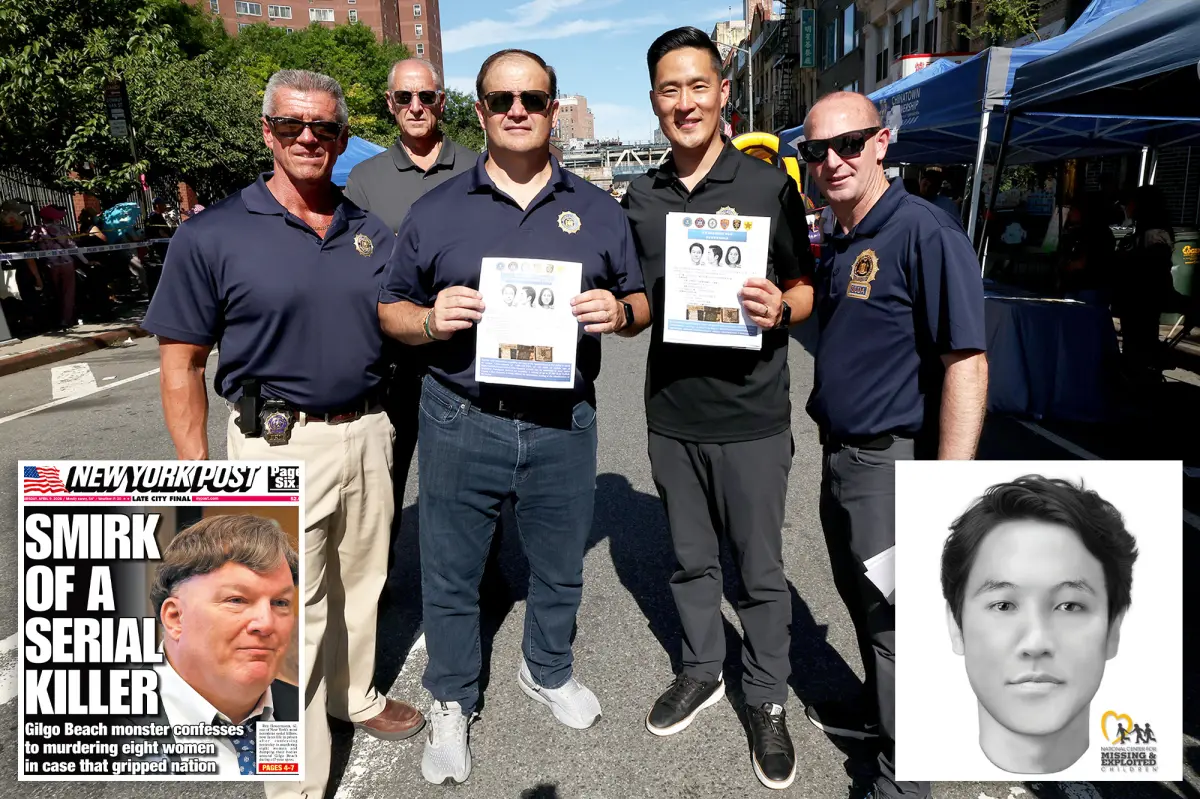
For over a decade, a profound and quiet tragedy has lingered along the windswept shores of Gilgo Beach, Long Island—a place now infamous for harboring the dark secrets of a serial killer. Among the remains recovered from the brush during a grim search in April 2011 were those of an unidentified young person, cataloged coldly by the justice system as “Asian Doe.” For years, investigators struggled to pierce the veil of anonymity surrounding this victim, who is believed to have been a transgender sex worker of Southern Han Chinese descent, brutally murdered by blunt force trauma and left in the sand wearing women’s clothing. Frustrated by the limitations of traditional forensic databases, Suffolk County District Attorney Ray Tierney and his dedicated team recently decided to step out of their sterile office walls and take a deeply human, grassroots approach to solving this mystery. During the lively festivities of National Night Out in Manhattan’s vibrant Chinatown, prosecutors and investigators walked the streets not as distant authority figures, but as fellow human beings seeking help. They handed out flyers, shared the victim’s tragic story, and gently asked community members to volunteer their own DNA. The response was a moving display of communal empathy: twenty-three residents stepped forward, offering their genetic cheek swabs to help build a bridge of ancestry that might finally lead this lost soul back to their real name, their family, and their dignity.
The profile of “Asian Doe” is a heartbreaking testament to the extreme vulnerability of those who exist at the margins of society. Forensic anthropologists estimate that the victim was a young biological male, likely between the ages of 17 and 23, who may have been living and working as a transgender woman or a gender-nonconforming individual. This intersection of identity, youth, and survival sex work made them an incredibly vulnerable target for violence. Investigators believe the victim was murdered and buried in the coastal brush sometime around 2006, meaning they lay forgotten and alone in the earth for at least five years before being uncovered. Over the years, the Suffolk County District Attorney’s Office tried everything within traditional law enforcement channels to identify them, including the painstaking creation and public release of two digital facial reconstructions in 2022—one showing the victim with short hair and the other with long, flowing hair. Yet, despite these efforts, the phones remained silent, and no family members ever came forward to claim the child they had lost. The revelation that the victim was of Southern Han ancestry, a genetic group that comprises more than ninety percent of the population in China, only magnified the scale of the challenge, making the search for their specific family tree feel like looking for a single drop of water in an vast, uncharted ocean.
The primary obstacle preventing a breakthrough in this case is a systemic bias built directly into the world of modern genetic genealogy. While forensic DNA technology has advanced at a staggering pace, allowing investigators to identify suspects and victims by mapping out distant cousins through commercial databases, these databases are overwhelmingly dominated by people of European descent. For marginalized communities, particularly Asian, Hispanic, and Black populations, the lack of representative genetic data in public registries like GEDmatch or FamilyTreeDNA means that victims of color often remain permanently nameless. Tierney’s innovative outreach in Chinatown was designed specifically to dismantle this genetic barrier. To ease deep-seated fears about government surveillance and privacy, the District Attorney’s office made a crucial promise to the volunteers: their DNA samples would not be retained by police, nor would they ever be entered into any criminal law enforcement databases. Instead, these twenty-three precious samples were sent directly to a highly specialized private laboratory, where they will be used exclusively as a compassionate tool to search for genealogical connections to Asian Doe and other unidentified remains of Asian descent, ensuring the process remains entirely humanitarian.
This renewed search for answers takes on an even more chilling urgency when viewed through the shadow of Rex Heuermann, the towering, seemingly ordinary architect from Massapequa Park who was unmasked as the Gilgo Beach serial killer. Heuermann, who recently pleaded guilty to the horrific murders of eight women whose bodies were dumped along the very same stretch of highway, is currently serving multiple life sentences without the possibility of parole in the frigid, isolated confines of Clinton Correctional Facility—colloquially known as New York’s “Little Siberia” near the Canadian border. While Heuermann has not been formally charged with the murder of Asian Doe, the circumstantial links tying him to the victim are deeply unsettling. Beyond the geographical proximity of where the remains were discarded, prosecutors previously made the horrifying discovery that Heuermann’s private internet search history was littered with highly specific, fetishistic search terms targeting young, vulnerable Asian males, including “Asian twinks.” For investigators, the fear that Asian Doe was another victim of Heuermann’s predatory hunting loop is a constant driving force, making the task of identifying them not just a matter of historical record, but a vital step in mapping the full, terrifying scope of a serial killer’s path of destruction.
Engaging with an immigrant community like Chinatown on matters of DNA and police investigations requires an immense amount of trust, delicacy, and cultural humility. Many residents in close-knit immigrant neighborhoods harbor a natural, historical skepticism toward law enforcement, often rooted in language barriers, fear of immigration consequences, or concerns about privacy and genetic profiling. Tierney and his team understood that they could not simply demand cooperation; they had to earn it through face-to-face dialogue and absolute transparency. By showing up during National Night Out—an event specifically designed to foster positive relationships between neighborhoods and the police—investigators met people on equal terms, explaining that the genetic material of the volunteers would be treated with the utmost respect and used solely to perform an act of profound mercy. The fact that twenty-three individuals agreed to participate is a beautiful testament to the shared humanity of the Chinatown community, showing a collective willingness to protect a stranger who had been cast aside and forgotten by the world. It sent a clear message that even those who are pushed to the absolute fringes of society—undocumented immigrants, sex workers, transgender youth, and outsiders—are valued, and that their lives are worth the effort of a massive, multi-jurisdictional investigation.
Ultimately, the effort to identify Asian Doe represents a powerful moral shift in how the justice system treats those who have been marginalized in life and neglected in death. It is an acknowledgment that a cold case is not just a collection of files, skull measurements, and genetic markers, but a story of a human being who once laughed, dreamed, loved, and was loved by someone, somewhere. The twenty-three DNA samples collected in Chinatown are twenty-three steps closer to restoring a stolen identity, and perhaps, eventually, providing a grieving mother, father, or sibling with the answers they have quietly prayed for over the last fifteen years. By refusing to let this victim remain an anonymous footnote in the horrific saga of the Gilgo Beach murders, Ray Tierney’s office is reminding the world of a fundamental truth: every single human being, regardless of their gender identity, their race, or how they had to survive in this world, deserves to have their name spoken aloud. As scientists in the private laboratory begin the delicate process of analyzing these new genetic threads, there is a quiet, collective hope that the silence hanging over Gilgo Beach will soon be broken, and that Asian Doe will finally be given the dignity of their own name and a proper path home.