

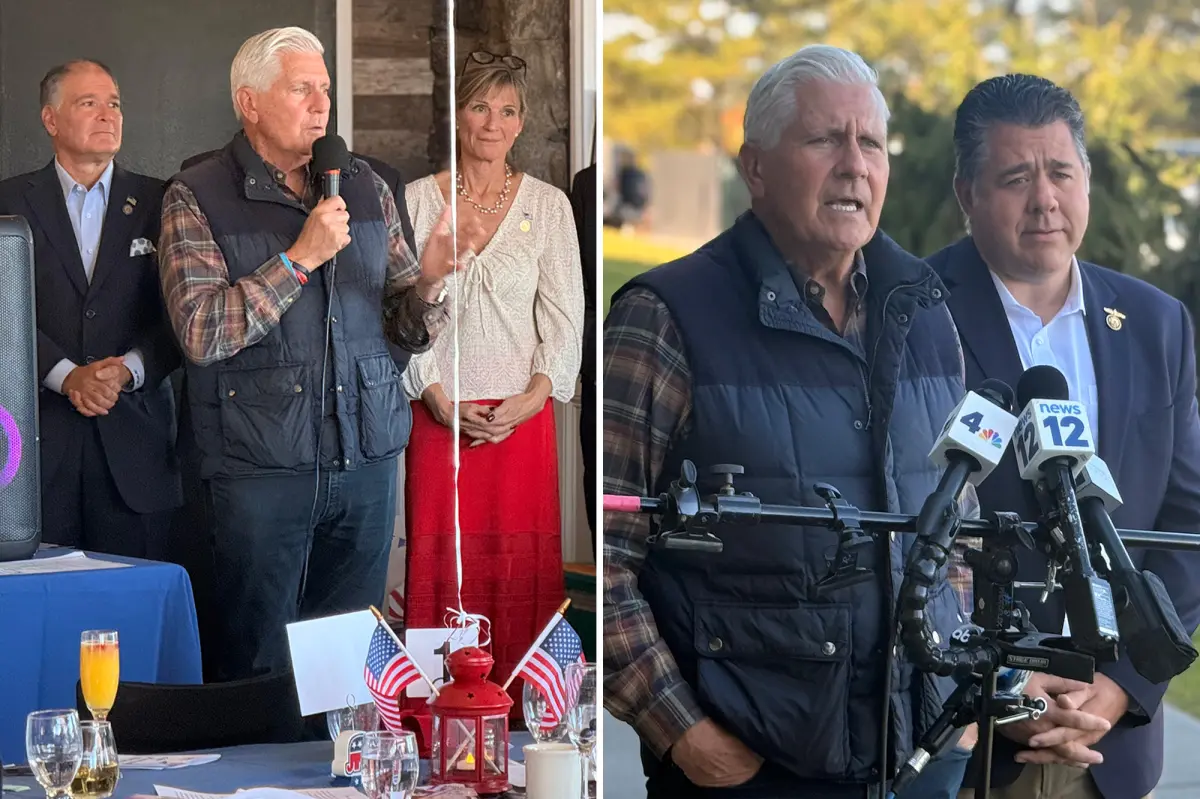
On a cool Sunday morning at a golf course in Northport, Long Island, Bruce Blakeman stood in a small room packed with supporters, donors, and fellow Republicans and made a promise that sounded almost defiant: “We are leaving no stone left unturned.” The Republican candidate for governor of New York was not speaking in a grand arena. He was in a place that felt more like a clubhouse than a campaign headquarters, surrounded by people who had watched their party lose statewide races for years and were hungry for a different ending. But in the next 48 hours, Blakeman planned to do something extraordinary. He would crisscross New York by plane, hitting roughly eight cities, from the North Country to the Southern Tier, from the Great Lakes to the Hudson Valley, and finally into the heart of Manhattan. He would end his tour the day before Election Day in the most Democratic city in the state. It was a final push, a last stand, a desperate and hopeful gamble. The people in that room knew the odds. They knew the polls showed him trailing by double digits. They knew registered Democrats were flooding the early vote, even on Long Island, the GOP’s own stronghold. But they also knew that Blakeman was not the kind of candidate who would surrender quietly. He was going to fight until the last moment, fly until the last flight, and ask every New Yorker who felt ignored or forgotten to give him one chance. The golf course, usually a place of leisure, had become a launching pad for a campaign that refused to accept the conventional wisdom.
From Northport, the itinerary looked almost punishing. Sunday would take Blakeman to Oswego, then Albany, then Rensselaer County, before flying back to Long Island for the night. Monday would be even more grueling: Buffalo, Rochester, Syracuse, and Binghamton, followed by a final event in Manhattan, the day before voters went to the polls. These were not random dots on a map. They were communities where the Democratic machine is strong, where a Republican candidate rarely spends his final hours. But Blakeman’s strategy was not to preach to the converted. It was to find the unreached, the frustrated, the independent-minded voters who might be convinced that the state needs a change. He planned to fly to each stop, shake hands, deliver his message, and get back in the air. There would be no long dinners, no rest, no time to savor the scenery. Just a series of brief, intense encounters with voters who might decide the race. The human reality of such a tour is exhausting. Candidates live on adrenaline and bad coffee. Their voices grow hoarse. Their aides juggle schedules and weather delays. But there is also something almost romantic about it: a person willing to spend his last hours before an election in a cramped plane, chasing every possible vote. It is retail politics at its most desperate and most hopeful. Blakeman seemed to embrace that. He wasn’t asking for a landslide. He was asking for a chance. And in a democracy, a chance is all any candidate can really hope for. Each stop was chosen with a purpose. Oswego, a small city in the North Country, is not a place where statewide campaigns usually end. Albany is the capital, a Democratic stronghold, but also a place with working-class neighborhoods that feel forgotten. Rensselaer County has a complicated mix of voters. Buffalo and Rochester are blue cities in a blue state, yet they have neighborhoods where crime, taxes, and the cost of living are daily concerns. Syracuse and Binghamton are old industrial cities, places where the economy has shifted and people are looking for someone to speak to their anxieties. Manhattan, the final stop, was the symbolic heart of the Democratic Party. Ending there was a statement: Blakeman was not going to hide. He was going to walk into the lion’s den and make his case.
The numbers, however, were not kind. Multiple major polls showed Blakeman trailing incumbent Governor Kathy Hochul by double digits. Registered Democrats were outnumbering Republicans in early voting around the state, and even on Long Island, the GOP stronghold where Blakeman had launched his campaign, the early vote was tilting blue. On paper, the race looked like a long shot. But Blakeman and his team pointed to a familiar pattern: Republicans are less likely to vote early. They tend to cast their ballots on Election Day. Several studies have shown this. The early vote numbers, therefore, were not necessarily a forecast of the final result. They were a snapshot of a moment, not a verdict. In the Blakeman camp, the hope was that a wave of Republican voters would show up on Tuesday and erase the Democratic advantage. It was a theory, not a certainty. But in politics, theories are all you have when the polls are against you. Hochul, as the incumbent, had the advantages of name recognition, institutional support, and a massive fundraising machine. She could afford to campaign as if victory were inevitable. Blakeman could not. He had to fight for every vote, every hour, every mile. The gap between the two campaigns was not just ideological. It was emotional. One side was defending a lead. The other was trying to overcome it. And the candidate who is trying to overcome a lead often has something the front-runner lacks: a burning sense that this is their last chance. Early voting data can be misleading. In a state like New York, Democrats have long dominated absentee and early ballots, while Republicans have historically preferred the ritual of going to the polls on Election Day. That does not guarantee a Republican surge, but it does mean the early returns should not be read as a final score. Blakeman’s advisers understood this. They knew that the electorate on Tuesday would be different. They knew that a high-turnout Election Day could shift the margin. The question was whether the shift would be enough.
Still, a recent survey by the pollster Convos found that 83 percent of Long Islanders had already made up their minds about the race, and that nothing would change their vote before Election Day. The poll did not measure head-to-head support between Hochul and Blakeman, but the finding was sobering for any challenger. It meant the pool of persuadable voters was tiny. It meant that all those hours in the air, all those handshakes and speeches, might only be reinforcing decisions that had already been made. But there was another way to read the same data: if 83 percent of voters were locked in, then the race would be decided by the remaining 17 percent, and by whether each candidate’s base actually showed up. For Blakeman, that was not a reason to despair. It was a reason to focus on the disgruntled New Yorkers who were considering sitting out the election entirely. These are the voters who tell pollsters they hate both parties, who believe their vote doesn’t matter, who have stopped paying attention because they are tired of broken promises. They are not in the 83 percent. They are the people who might stay home on Tuesday unless someone gives them a reason to leave the house. Blakeman’s final tour was aimed at them. He wanted to be that reason. He wanted to stand in their cities, look them in the eye, and say: I know you’re frustrated. I know you think nothing will change. But if you stay home, nothing will change. Come out and vote for something different. It is a hard sell, especially in a state where Democrats outnumber Republicans. But it is not impossible. Apathetic voters are not necessarily Democratic voters. They are simply voters who have stopped believing that their voice matters. A candidate who can restore that belief, even for a day, can change an election.
Blakeman, for his part, dismissed the public polls with a phrase that captured his defiance: “Forget about the university-woke-polls.” He claimed to have seen two statewide polls in the last three weeks that put him less than four points behind Hochul, within the margin of error. He called the race a “dead heat.” He predicted that Republicans would surge with in-person voting on Election Day. “This is a turnout election,” he said. There is a kind of confidence that sounds like denial to outsiders. To his supporters, though, it sounds like courage. A candidate who admits defeat before the votes are counted has already lost. Blakeman was not going to make that mistake. He had spent months on the trail, raising money, giving speeches, answering questions, enduring the endless small talk of politics. He had watched the polls, seen the early voting numbers, and listened to the pundits explain why he couldn’t win. And still he stood in that golf course, in that small room, telling people that the race was close, that the polls were wrong, that the energy was real. Maybe he was wrong. Maybe the polls were right. But in the final hours of a campaign, there is no room for maybe. There is only the message, the plan, and the belief that the people will surprise you. Blakeman’s message was not complicated. He wanted to flip the state. He wanted to give New Yorkers a choice. He wanted to prove that a Republican could win in a blue state by appealing to the things that unite people: safety, opportunity, fairness, and the simple desire to be heard. It was an uphill battle, but uphill battles are the ones worth fighting. His confidence was contagious in that room. Supporters nodded when he talked about the margin of error. They cheered when he said the word “turnout.” They wanted to believe. That is the magic of a campaign: it turns statistics into stories, and stories into action.
Tuesday will bring the answer. Blakeman’s final stop will be Manhattan, the day before Election Day, a symbolic ending in the most Democratic city in the state. It is a strange place for a Republican to make his last stand. But perhaps that is the point. Blakeman is not running to be the mayor of Manhattan. He is running to be the governor of all of New York, and he wants to look the heart of the opposition in the eye and say: I am not afraid of you. The next 48 hours will be a blur. There will be flights and motorcades, short speeches and quick photographs. There will be moments of exhaustion and moments of exhilaration. There will be the quiet fear that comes before an election, the feeling that you have done everything you can and now it is out of your hands. And then, on Tuesday, the voters will speak. They will decide whether Blakeman’s gamble was audacious or foolish, whether his “dead heat” was real or imagined, whether the Republican surge on Election Day will be enough to flip a state that has not elected a Republican governor in years. Whatever happens, one thing is certain: Bruce Blakeman did not go quietly. He did not leave any stone unturned. He did not sit back and wait for the polls to change. He got on a plane, flew across New York, and made his case to anyone who would listen. That is what democracy looks like. It is messy, exhausting, and often heartbreaking. But it is also hopeful. In the end, the election is not about the pundits or the pollsters. It is about the people who show up. Blakeman is betting that enough of them will show up for him. And in that small room on Long Island, surrounded by supporters, he believed it with all his heart. The voters will have the last word. But for now, the candidate is still flying, still fighting, still hoping. That is the human story at the center of every campaign, and it is the story that will unfold across New York in the next 48 hours.