




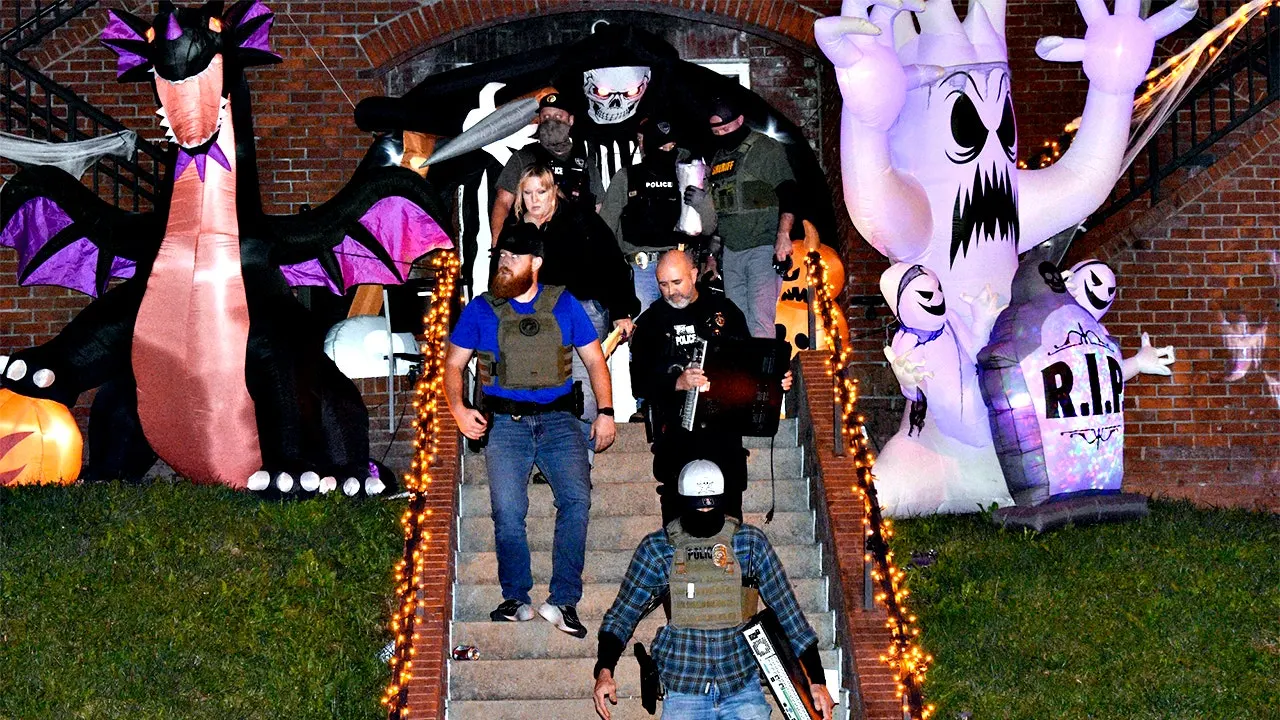
On a chilly late-October evening in Morgantown, West Virginia, the usual sounds of college life were swallowed by something far more unsettling. Outside the Lambda Chi Alpha fraternity house at West Virginia University, music blared from speakers with a kind of defiant loudness, while hundreds of students and onlookers lined the street, some leaning from windows, others standing in clusters on lawns, all of them watching a scene that felt both theatrical and deeply somber. Police officers from the campus and local departments moved through the multi-level brick house with the quiet, practiced focus of people executing a search warrant, carrying out bags, boxes, and evidence cases and loading them into waiting patrol cars. It was October 26, and the performance of a normal party had collided with the reality of an investigation. Just over two weeks earlier, on October 9, the university had already placed the Lambda Chi Alpha chapter on interim suspension after what a university spokeswoman described only as “anonymous allegations of hazing.” Now, with the search warrant executed, the community was left to piece together what had happened behind those walls. The scene was jarring not because a frat house was being searched — college towns are familiar with the sight of police near Greek life — but because of the emotional whiplash: the celebratory music, the excited crowd, the grim law enforcement process, and the quiet heartbreak of knowing that, somewhere in that building, young people may have been hurt in the name of belonging. It felt like a scene from a documentary about a crisis, except that the camera was real, and the people watching were not extras but students, neighbors, and family members trying to understand how a tradition meant to build brotherhood could leave so much damage in its wake.
The search at Lambda Chi Alpha was not an isolated event. On the same day, authorities also served a search warrant at the West Virginia University chapter of Pi Kappa Alpha, a fraternity widely known as PIKE. Social media posts from WVU Safety and Wellness confirmed the warrant, and PIKE found itself under investigation for hazing allegations, though as of that date the university had not placed the chapter on suspension. Together, the two investigations made West Virginia University the latest focal point in a wave of fraternity hazing probes spreading across the country. Hazing, at its core, is the practice of requiring new or potential members to endure strenuous, humiliating, or dangerous tasks as a rite of passage. It can be as old as the institution of Greek life itself, but the law enforcement response is changing. Michael Ayalon, a hazing prevention expert and the CEO of Greek University, told Fox News Digital that the recent uptick in police involvement does not necessarily mean that hazing is becoming more common. Rather, he believes, the increase reflects a broader cultural shift in awareness — one driven, at least in part, by policy. In December 2024, Congress passed the Stop Campus Hazing Act with bipartisan support, a federal law that demands far greater transparency around hazing allegations at colleges and universities. That legal change, Ayalon explained, has forced institutions to confront incidents they might once have handled quietly, or perhaps not at all. Universities now face heightened expectations for openness, and with that openness comes a spotlight that can feel both necessary and painful. What was once whispered about in dorm hallways or passed along as rumor is now being examined in the open, with law enforcement officers carrying evidence bags out of brick houses while a crowd watches from the street. For parents, alumni, and students alike, the message is clear: the culture of silence that long protected hazing is beginning to crack.
But the increased visibility of hazing also raises a question that lingers in every conversation about college Greek life: why now? Ayalon suggests that hazing has always been underreported, largely because of fear. Students who endure it often fear retaliation from the very people they hoped would become their brothers or sisters. They fear being ostracized. They fear losing their place in an organization that promised them friendship, status, and a home away from home. They fear being seen as weak, or as someone who could not take the heat, and so they keep the abuse to themselves. In a strange way, the victims of hazing are often the most loyal defenders of the practice, because to admit that the ritual was harmful is to admit that their own suffering was meaningless, or worse, that they are complicit in passing it on. This is why the new federal transparency requirements are so important. The Stop Campus Hazing Act essentially says that colleges and universities can no longer hide these incidents behind the veil of student privacy or institutional reputation. It demands that the public know when hazing allegations surface, and it holds schools accountable for how they respond. Ayalon’s point is subtle but crucial: the increase in hazing investigations we are seeing across the country is likely not because there is more hazing, but because the scales have finally fallen from our eyes. For every one incident that surfaces in a police report, there are countless others that never come to light — incidents that happened decades ago, or last semester, or maybe last night in a basement where music was turned up loud specifically so no one would hear the shouting.
For fraternity members, Ayalon says this moment should be a wake-up call. The public perception of Greek life is being shaped, in real time, by the stories of abuse and tragedy that dominate headlines. And that is a heavy burden for the thousands of fraternity men and women who do genuine good on their campuses — who volunteer, who raise money for charities, who build friendships that last a lifetime. Every hazing incident, Ayalon notes, makes it harder for good chapters to recruit new members. It makes it harder for alumni to defend the fraternity experience that shaped them, and it makes it harder for universities to justify partnering with organizations that, in the public eye, have become synonymous with risk rather than community. For students currently considering whether to pledge, or alumni wondering what has happened to the Greek system they once loved, the reputational damage is real. But the deeper issue is not just public relations; it is the flawed logic that continues to justify hazing. Despite decades of education, national policy changes, and a long list of tragic deaths, some chapters still cling to the belief that hazing is a necessary part of earning membership. The reasoning, Ayalon explains, is deeply circular: members justify the abuse by telling themselves, “I had to go through it, so you have to go through it too.” It is a generational cycle of pain, disguised as tradition. Fraternity chapters often promote the idea that hazing builds brotherhood and creates loyalty, but Ayalon challenges that assumption head-on. There is, he says, a profound difference between working through a meaningful challenge together as equals, and being humiliated or controlled by people who hold power over you. One builds trust; the other builds trauma. One creates bonds that last; the other creates scars that are carried for a lifetime.
Ayalon’s insights also highlight the uncomfortable reality that hazing is not a one-size-fits-all problem. It takes on different forms in different communities, shaped by history, culture, and expectations. In traditionally white fraternities, often known as IFC fraternities, hazing most frequently involves forced alcohol consumption. Startlingly, 82 percent of hazing deaths are linked to alcohol, which means that what might be dismissed as just a wild party can quickly turn fatal. In historically white sororities, the Panhellenic organizations, hazing typically takes a subtler but no less damaging form: mental abuse, what Ayalon describes as “mean-girl behavior” that ostracizes and humiliates new female members. This kind of hazing may not leave visible bruises, but it leaves deep wounds in the form of anxiety, depression, and a fractured sense of self. In historically Black fraternities and sororities, the organizations of the National Pan-Hellenic Council — often called the Divine Nine — the abuse can be physical or mental, according to Ayalon. And in recent high-profile cases, hazing has involved drugs, adding another layer of danger to already risky rituals. What emerges from this picture is not a single monster, but a many-headed one. Hazing is a shape-shifter; it adapts to its environment, hiding in plain sight. It can look like a keg stand, a late-night study session turned interrogation, a room full of pledges covered in food in a sweltering basement, or a forced ride in the back of a pickup truck. Each scenario is unique, but the underlying dynamic is the same: a misuse of power, wrapped in the language of brotherhood and tradition. Recognizing these patterns is an essential step toward prevention, because you cannot stop a problem if you cannot see it in all its forms.
As the investigations at West Virginia University move forward, the university’s official response has been cautious and careful. “West Virginia University takes seriously the safety and well-being of our students,” a university spokeswoman said. “Due to the nature of the investigations, no other details will be released at this time. We will provide updates as they become available.” Fox News Digital reached out to Lambda Chi Alpha and Pi Kappa Alpha for comment, but the silence around the investigations is itself a reminder of how far we still have to go. In the absence of details, rumors fill the void, and the community is left to wonder what exactly happened in those frat houses. But perhaps the most important thing is not the sordid details of any one incident, but what these moments ask of all of us. They ask us to stop treating hazing as a harmless rite of passage and start seeing it as what it so often is: abuse. They ask us to listen to the students who have suffered, and to believe them when they speak. They ask us to support the fraternity members who are trying to do things differently, who are trying to build organizations that can be proud of their traditions without harming anyone in the process. The music that blared on that October night in Morgantown will eventually fade, and the police cars will pull away, but the work of changing a culture is much quieter and far longer. It happens in conversations between friends, in policy decisions made in university administrative buildings, in the courage of a pledge who decides to report what happened to them, and in the willingness of a brother or sister to say, “This is not who we are.” That is the hopeful part of this story: the culture is not doomed. It is being challenged, more openly and more relentlessly than ever before, and with every search warrant, every investigation, and every act of accountability, the wall of silence crumbles a little more. What remains to be seen is whether the Greek system will rise to meet that challenge — or continue to repeat the mistakes of the past.