



Paragraph 1
On a crisp Sunday afternoon in Ann Arbor, the University of Michigan campus hummed with the usual rhythms of student life—conversations drifting between lectures, the rustle of autumn leaves, and the low murmur of a small gathering beneath a simple banner. That banner posed a question both ancient and urgent: “Is Islam Compatible with the West?” It was a discussion meant to provoke thought, not fury. A handful of students and visitors had stopped to listen, some to challenge, others to learn. Among them was a young conservative influencer named Lizzy Benichou, who had traveled with a group for a “Liberty Under Fire USA” tour stop—an event designed to celebrate free expression in a time when that right often feels under siege. The mood was tense but civil. Then, without warning, a female student broke through the circle, her face flushed with anger, her eyes wild. She began shouting at two men seated behind the table, demanding to see their “f—king permit” and calling the entire exercise “f—king stupid.” Her voice rose above the chatter, a jagged shard cutting through the calm. Bystanders pulled out their phones, recording the meltdown even as it spiraled out of control. No one knew yet that within minutes, this outburst would escalate into an assault—one that would echo far beyond the Quad, touching on issues of political violence, campus free speech, and the very fabric of American democracy.
Paragraph 2
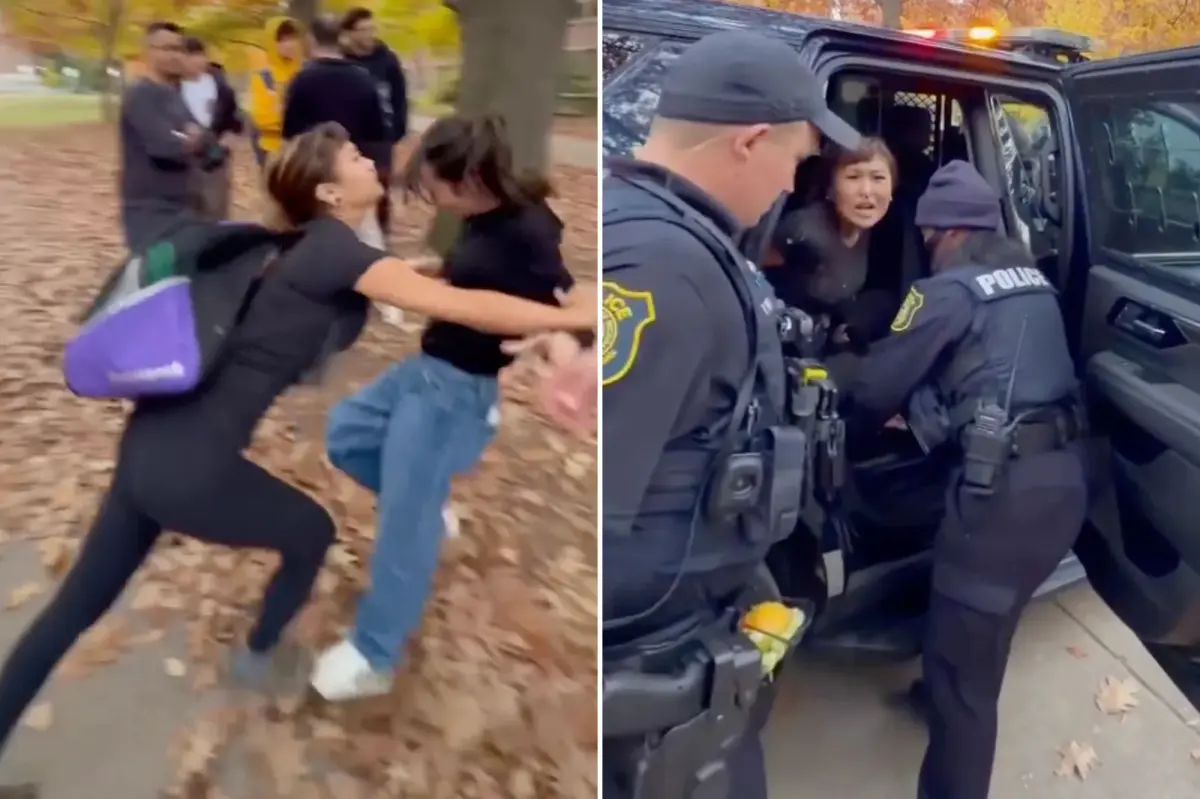
The student’s rage found its first target. She leaned into the face of one of the men, then clapped her hands directly in front of his eyes, making him flinch backward. He later told an off-camera officer that she had struck him, but she vehemently denied it, even as the crowd insisted everything was on video. “I have several f—king eyewitnesses, I didn’t do f—king shit,” she yelled, then accused the man of “victimizing himself as a fully-grown man.” Her words spewed in a torrent of expletives, but the confrontation was far from over. As she spun around, her gaze landed on Lizzy Benichou, who had been quietly observing. Benichou, composed and articulate despite the chaos, asked a pointed question to a nearby bystander: “Am I wrong? If you walked around like this in Iran, what would happen to her?” She was referring to the student’s attire, but the question was rhetorical—a challenge to the hypocrisy of those who claim to defend religious freedom while ignoring authoritarian abuses. The student heard the remark and snapped. She lunged at Benichou, shoving her hard to the ground before charging again. A male onlooker grabbed the enraged student, but she broke free, shrugged off her backpack, and tried to launch another attack. Only the swift intervention of a campus police officer and another bystander stopped her. Benichou lay on the pavement, shaken but conscious, as the officer wrestled the screaming assailant to the ground.
Paragraph 3
What followed was a scene of surreal, ugly defiance. The student fought the officer as he tried to handcuff her, yelling, “What the f—k are you going to do to me? Because I hit a dumb ass bitch in the face?” The officer ordered her to stop resisting, but she thrashed and spat until another patrol car arrived. Only then, with two officers working together, were the cuffs secured. As they guided her into the backseat, she showed not an ounce of regret. “I’d do it again every f—king time, you stupid f—king c—t!” she screamed. Then came the threat that stunned even the shell-shocked onlookers: “I should’ve f—king killed you when I had the f—king chance.” A gasp rippled through the crowd. “Are you kidding me?” someone asked. “No, I’m not f—king kidding you,” she sneered. A bystander shouted back, “You’re sick, you’re sick. Go to a mental hospital, bitch.” The student’s reply was chilling: “I’ve already been to a mental hospital. And I’ll go again if it means killing you.” With that, the door slammed shut, and the police car drove off. The day had turned from a think-tank debate into a raw demonstration of hatred—a reminder that words, even those spoken for free, can ignite the darkest passions.
Paragraph 4
Later that evening, Lizzy Benichou took to X (formerly Twitter) to reassure her followers that she was “OK” and expressed gratitude for the officers who protected her. “Political violence has NO place in the United States of America,” she wrote. “I am incredibly grateful to the law enforcement officers who acted immediately to protect me. I am now in a safe location receiving care and I am going to be OK.” She added that the assault occurred during a “Liberty Under Fire USA tour stop” and claimed her attacker had been “identified as a supporter of Abdul El-Sayed”—the Democratic candidate for U.S. Senate in Michigan. That detail thrust the incident into an already heated political season. Just two days before, Michigan voters were set to choose between El-Sayed and former Republican Rep. Mike Rogers in the Senate race. The attack, coming so close to Election Day, blurred the line between personal violence and political warfare. It also drew attention to the vulnerability of those who exercise their First Amendment rights in increasingly polarized spaces. Benichou’s words were measured, but her message was clear: this is what happens when we let our disagreements turn into dehumanization. The incident was a microcosm of a national malaise—where shouting matches become shoves, and shoves become threats of murder.
Paragraph 5
University of Michigan police provided a terse official statement, noting they were responding to an “unpermitted event” on campus just before 5 p.m. when one of their officers witnessed the attack. “As the group was packing up to leave, officers witnessed a University of Michigan student assault a woman not affiliated with the university,” the department said. “The student was taken into custody, processed and released pending warrant authorization. No injuries were reported.” The statement painted a clinical picture, but it couldn’t capture the fear in the eyes of the onlookers, the trembling of Benichou as she gathered herself, or the haunting question that hung in the air: how did we get here? The incident wasn’t just about one unhinged student; it was about a culture that too often rewards outrage and punishes nuance. The event, though not officially sanctioned, was an exercise in dialogue—exactly the kind of conversation campuses are supposed to foster. Instead, it became another battlefield in the culture wars. The attacker’s alleged political affiliation, whether true or not, added fuel to the fire, but the deeper tragedy is that both sides retreat further into their echo chambers after such episodes. The campus police report noted “no injuries,” but the psychological wounds linger. Every student who witnessed the scene must now question whether safety in public spaces is guaranteed for those with contrary beliefs. The university, the state, and the nation must reflect on how to protect free speech without enabling violence—a task that grows harder with each passing headline.
Paragraph 6
In the end, this is a story about human fragility—the way fear can curdle into aggression, and how a moment of political passion can spiral into criminal behavior. The student who attacked Benichou was not a caricature of evil; she was a young person carrying the weight of grievances, mental health struggles, and a society that too often validates rage as a response to discomfort. Her chilling threats—“I should’ve killed you”—were not just hateful; they revealed a soul in crisis. Yet we cannot excuse her actions. Nor can we minimize the courage of those who stand up in public spaces to speak their truth, even when the crowd turns hostile. Benichou’s calm after the incident, her refusal to be silenced, is a lesson in resilience. She reminded us that democracy is not a comfortable enterprise; it is messy, ugly, and occasionally dangerous. But it is also the best system we have for airing our differences without resorting to murder. The scene at Ann Arbor could have been far worse, and we must be grateful that no one was seriously injured. As Michigan voters headed to the polls days later, they carried with them the image of a young woman’s boiling fury and the echo of her threats. That image is a stark warning: if we continue to treat political opponents as enemies rather than citizens, we will inevitably reap a harvest of violence. The question “Is Islam Compatible with the West?” was never answered—it was drowned out by screaming. That is the tragedy. In the quiet after the police car departed, the only sound was the wind in the trees and the murmured words of a bystander: “We have to do better.” We owe it to Lizzy Benichou, to the frightened students, and to ourselves to honor that plea. Freedom is precious, but it is also fragile. It requires we listen not just with our ears, but with our hearts—and that we remember the human being behind every argument, even those whose views we despise.