






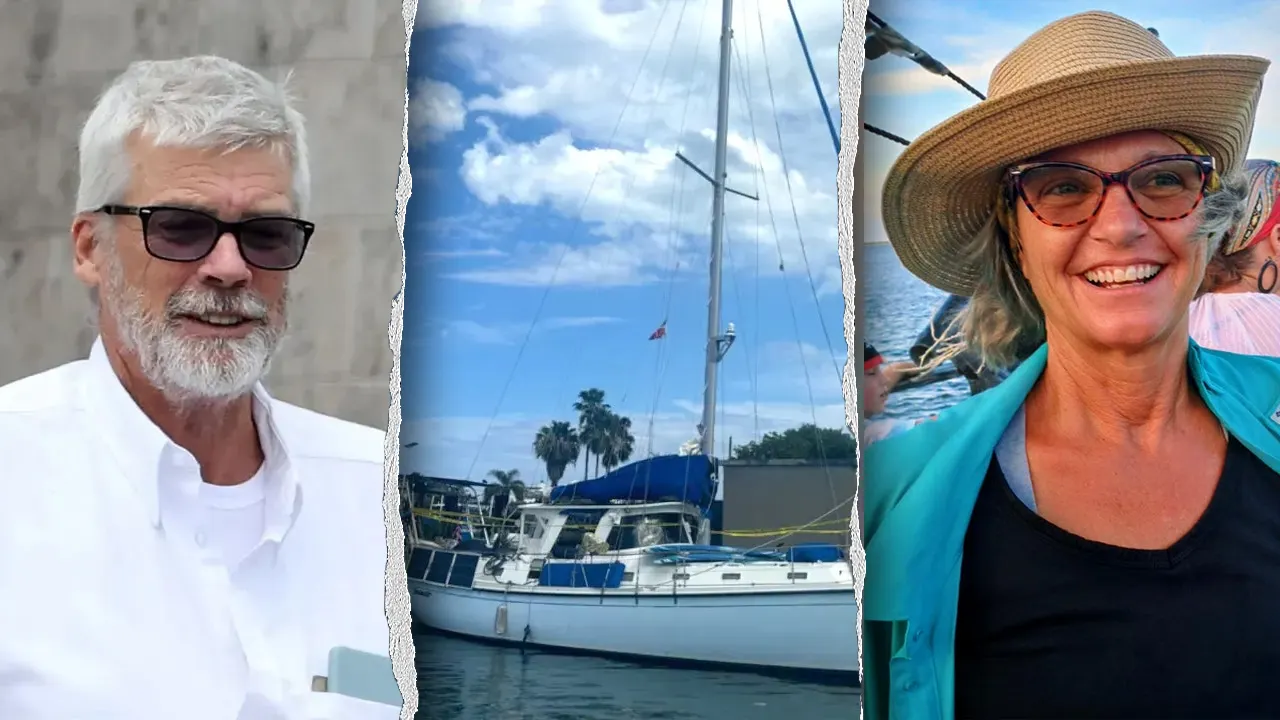
For many, the ultimate dream of retirement is to cast off the bowlines of domestic life, leave behind the predictable routines of the mainland, and surrender to the timeless rhythms of the sea. This was the vibrant reality envisioned by Lynette and Brian Hooker, a couple who had dedicated their golden years to navigating the warm, crystal-clear waters of the United States and the Caribbean aboard their beloved sailboat, Soulmate. It was a life of shared adventure, quiet sunsets, and the tight-knit camaraderie of the live-aboard cruising community. But on the dark night of April 4, near the picturesque harbor of Hope Town in the Bahamas, this idyllic retirement dream dissolved into a terrifying maritime tragedy. According to Brian Hooker, rough, unforgiving waters tossed Lynette overboard from their small dinghy around 7:30 p.m. as they made their way back to their floating home. While Lynette vanished into the blackness of the Sea of Abaco, Brian claimed he was left to battle the elements alone, ultimately paddling to shore and arriving at Marsh Harbour some eight and a half hours later, exhausted and empty-handed. In the agonizing days that followed, what began as a desperate search-and-rescue mission swiftly pivoted into a deeply unsettling mystery, fueled by shifting narratives, silent depths, and a devastating audio recording that has forced both loved ones and law enforcement to question everything.
The fragile peace of the cruising community was shattered when Blaine Stevenson, a fellow boater and close friend of the couple, received a phone call from Brian just two days after Lynette’s disappearance. It was during this emotionally raw conversation, which Stevenson recorded, that a crucial detail slipped out—one that threatened to dismantle the foundational timeline Brian had provided to the Bahamian and American authorities. In the recording, Brian can be heard describing a frantic, chaotic struggle against the elements, speaking of five or six waves washing over the small dinghy, forcing him to bail water repeatedly. However, amid details of a broken oar pin, a dropped oar, and the deployment of an anchor in the dark, Brian made a stunning admission: “when we were f—— around trying to get back in the boat.” He also casually mentioned a flare pistol that had slid down near the stern and referenced Lynette being “hit” with it. To those listening, this plural struggle to “get back in the boat” strongly suggested that Brian was not safe aboard the dinghy watching his wife drift away, but was instead in the water with her. This inadvertent slip of the tongue presented a stark, alarming contradiction to his official statement, in which he claimed he remained inside the craft the entire time while his wife was swept away by the wind and current.
This glaring inconsistency caught the immediate attention of maritime legal experts, who saw in the recording a story that was rapidly unraveling under its own weight. Kenneth Engerrand, an adjunct professor of maritime law at the University of Houston Law Center and a seasoned attorney, observed that Brian’s various accounts of that fateful night simply do not align with physical or logical reality. On one hand, Brian described a desperate effort to bail water out of a vessel that was rapidly flooding, a task that requires one to be firmly inside the craft. On the other hand, his recorded words placed him in the waves, struggling alongside Lynette to re-board the dinghy. Engerrand noted that a person cannot simultaneously be in the water fighting to climb back into a vessel while actively bailing it out to keep it afloat. To legal professionals looking at the evidence, these shifting accounts suggest a narrative constructed under duress rather than a factual recollection of a tragic accident. Engerrand remarked that the case is “getting more damning by the minute,” painting a portrait of a husband who appears to be fabricating details in real-time as he grapples with the terrifying reality of his wife’s disappearance and the scrutiny of the law.
As suspicions mounted, the investigation took a dramatic and highly technical turn, shifting from a tragic missing-persons case to a potential homicide inquiry. Federal investigators with the U.S. Coast Guard Investigative Services, working in tandem with Bahamian authorities, secured critical GPS data from Brian Hooker’s cell phone. This digital footprint revealed sharp discrepancies between his initial timeline of events and the physical location of his device on the night Lynette vanished. Armed with this new forensic evidence, the Coast Guard launched a renewed search operation, taking physical possession of the couple’s dinghy to analyze it for forensic clues. The GPS data prompted American authorities to request special permission from the Bahamian government to search a specific, previously overlooked sector of the Sea of Abaco. Divers and search vessels focused their efforts on a localized, twenty-five-foot-deep stretch of water, desperately seeking any sign of Lynette’s body. The transition from a routine search to an active, targeted recovery mission marked a grim realization for investigators: they were no longer just looking for a lost sailor; they were searching for evidence in a suspected crime scene.
Amidst the swirling allegations and the cold precision of forensic tracking, those representing Brian Hooker have urged the public to pause and consider the chaotic, disorienting nature of trauma. His Michigan-based defense attorney, Crystal Marie Hauser, made a poignant public appeal, asking observers to extend the benefit of the doubt to a man who has just lost his wife of many years. Hauser argued that human beings do not react to profound shock, terror, and grief in uniform or predictable ways. She reminded the public that in moments of extreme crisis—such as watching a spouse disappear into a pitch-black, stormy sea—the human brain can fracture, leading to disjointed memories, erratic speech, and inconsistent retellings of the event. To judge a grieving husband solely on the frantic, disorganized words spoken in the immediate wake of an unspeakable tragedy, she argued, is to ignore the complex, fragile realities of human psychology under life-threatening stress. Yet, for the tight-knit global sailing family that once embraced the Hookers, this appeal for grace exists in a painful tension with the cold, hard contradictions of the recorded audio and the shifting physical evidence.
Ultimately, the tragedy of the Soulmate leaves behind a profound void and a lingering sense of sorrow that stretches far beyond the deep waters of the Bahamas. Lynette Hooker is remembered by her friends not as a tragic statistic, but as a spirited, incredibly determined woman who possessed a deep love for the sea and a quiet resilience that defined her life on the water. Her husband’s own recorded voice, describing her as “f—— determined” even in the midst of a crisis, stands as a bittersweet testament to the vibrant soul who now lies somewhere in the silent depths of the ocean. As the tides continue to wash over the Sea of Abaco, the truth of what happened on the night of April 4 remains partially obscured, locked away in the wreckage of a fractured retirement dream and the ocean’s depths. For Lynette’s family, friends, and the cruising community who watch from the shoreline, there is only the agonizing wait for answers, the hope that justice will eventually float to the surface, and the quiet grief of a beautiful journey that ended far too soon in the dark.