







The quiet coastal town of Duxbury, Massachusetts, remains cloaked in the shadow of an unimaginable tragedy that unfolded on a cold January day in 2023, a catastrophe that has now culminated in a deeply agonizing courtroom battle. Inside the courtroom, Lindsay Clancy—once a dedicated labor and delivery nurse at Massachusetts General Hospital who spent her career welcoming new life into the world—stands accused of taking the lives of her precious children: five-year-old Cora, three-year-old Dawson, and her tiny eight-month-old baby, Callan. This heart-wrenching trial has transcended a standard criminal proceeding, transforming instead into a profound and painful examination of the fragile boundaries of the human mind, maternal devotion, and the clinical realities of mental illness. At its core, the legal battle is a devastating clash between a family’s private, unimaginable grief and the cold, empirical focus of the criminal justice system. While the community and the public wrestle with the sorrow of three young lives cut tragically short, the court is tasked with dissecting the interior landscape of a mother’s fractured psyche. The legal dispute does not center on whether Lindsay committed these terrible acts—a haunting truth both sides concede—but rather on the deeply complex and polarizing question of her sanity, her intent, and the exact state of her mind during those fateful moments of crisis.
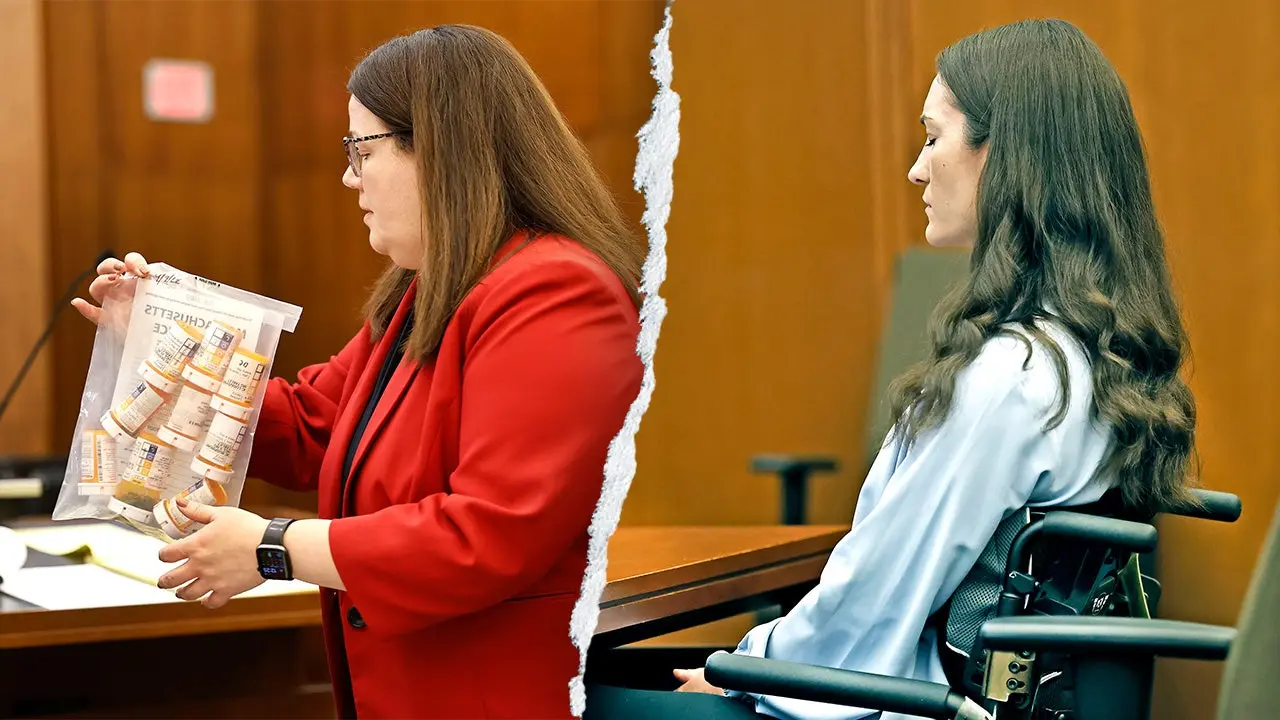
In a pivotal moment of the trial, the prosecution delivered a tactical blow to the defense’s primary narrative, which seeks to paint Lindsay as a victim of severe psychiatric overmedication. Assistant District Attorney Shanan Buckingham stood before the jury holding a physical bag of evidence containing nine prescription pill bottles, confronting the chilling physical reality of the medications Lindsay had been prescribed. Through sharp, deliberate questioning of Lindsay’s ex-husband, Patrick Clancy, the prosecution systematically chipped away at the image of a woman hopelessly sedated by a chaotic cocktail of overlapping, mind-altering drugs. When Buckingham held up the bag of medications Patrick had personally surrendered to police, she pointedly highlighted that many of the bottles still contained the vast majority of their pills, suggesting that Lindsay’s actual consumption did not match the sheer volume of drugs she had been prescribed over the months. Under the weight of this cross-examination, Patrick was forced to acknowledge the disparity, quietly admitting that while many pills had been prescribed, it was entirely possible that only a fraction of them had actually been ingested. By highlighting these unused pills, the prosecution sought to disrupt the defense’s momentum, shifting the jury’s focus from a helpless mother poisoned by pharmaceuticals to a woman who, in reality, may have been taking far fewer medications than her defense team claimed.
The emotional heart of this grueling trial undoubtedly lies with Patrick Clancy, a man who has had to endure the ultimate betrayal and loss, yet who walked into the courtroom to testify with a quiet, devastating dignity. Taking the stand to recount the “big spiral” of his ex-wife’s deteriorating mental health, Patrick painted a painful portrait of a family desperately trying to navigate a worsening psychiatric crisis in the months leading up to the tragedy. Yet, under the prosecution’s rigorous questioning, he found himself caught in the agonizing middle ground between his lingering compassion for his ex-wife and his obligation to the absolute truth of what happened to his children. When asked about the concurrent use of these drugs, Patrick estimated that Lindsay was taking at most three or four medications at any given time, a number that Buckingham further refined by suggesting she was rarely prescribed more than two or three simultaneously. Patrick’s soft-spoken admission that this revelation was not “terribly surprising” underscored his own exhaustion and perhaps a blind trust in a medical system that both he and Lindsay had hoped would save her. His presence on the stand served as a raw, humanizing reminder of the collateral damage of this tragedy—a father left completely alone, trying to make sense of the debris of his shattered family while answering questions about the specific chemical compounds that may or may not have paved the path to his children’s deaths.
This strategic deconstruction of the defense’s “overmedicated” argument was viewed by legal experts as a masterful preemptive strike by the prosecution to control the narrative before the defense could fully weaponize it. Former federal prosecutor Neama Rahmani pointed out that a crucial aspect of prosecution is anticipating the opposition’s strongest defense and defusing it before it can take root in the minds of the jurors. Rahmani noted that by introducing the half-empty pill bottles and clarifying the timeline of the prescriptions, the prosecution prevented the defense from utilizing the “bag of pills” as a dramatic, emotional prop to claim involuntary intoxication or drug-induced psychosis. Psychiatric treatment, as Rahmani explained, frequently involves a trial-and-error process where doctors systematically titrate, switch, and discontinue various medications like Zoloft, Ativan, and Seroquel in a desperate bid to find a combination that works. By contextualizing the high number of total prescriptions as successive trials rather than a concurrent pharmaceutical cocktail, the prosecution is attempting to show that Lindsay and her medical team were engaged in standard, albeit challenging, psychiatric care, rather than subjecting her to a toxic, mind-altering overdose that could legally absolve her of criminal responsibility for her actions.
Beneath the clinical debate over pharmaceuticals lies the prosecution’s harrowing and deeply unsettling portrayal of Lindsay Clancy as a calculated, methodical killer. Prosecutors argue that the deaths of Cora, Dawson, and Callan were not the sudden, chaotic result of a psychotic break, but were instead “deliberately and meticulously” planned and executed. To build this case, Shanan Buckingham laid out a precise timeline of the afternoon of the killings, emphasizing that Lindsay allegedly engineered a window of undisturbed opportunity by sending her husband out of the house on highly specific, time-consuming errands. By instructing Patrick to drive to a distant restaurant to pick up takeout food and to stop at a pharmacy for medication, Lindsay allegedly guaranteed herself exactly enough time to carry out her dark designs. The prosecution described how she then used an exercise band to strangle each of her three young children, one by one, before attempting to take her own life by jumping from a window. This narrative of cold calculation directly challenges the defense’s portrayal of a woman entirely detached from reality, presenting instead a chilling picture of a mother who understood the physical parameters of time, distance, and lethal force, and who acted with catastrophic intentionality.
As the trial moves forward, the immense burden of deciding Lindsay Clancy’s fate falls squarely upon the shoulders of the jury, who must navigate the fine line between severe postpartum mental illness and criminal culpability. Defense attorney Kevin Reddington has conceded the physical horror of the killings, choosing instead to focus all attention on the turbulent, unseen storm raging inside Lindsay’s mind, arguing that she was in the throes of severe postpartum psychosis and could not comprehend the wrongness of her actions. As Judge William Sullivan reminded the jury, the legal threshold requires the Commonwealth to prove beyond a reasonable doubt that Lindsay was criminally responsible and possessed the necessary intent when she ended the lives of her children. This case forces a deeply painful societal conversation about the gaps in maternal healthcare, the devastating, hallucinatory reality of postpartum psychosis, and how the legal system defines sanity in the wake of unspeakable tragedy. Ultimately, no matter what verdict the jury reaches, there are no victors in this courtroom; there is only a grieving father left to mourn his entire family, a shattered former nurse facing a lifetime of ruin, and the quiet, permanent absence of three beautiful children who will never grow up.