





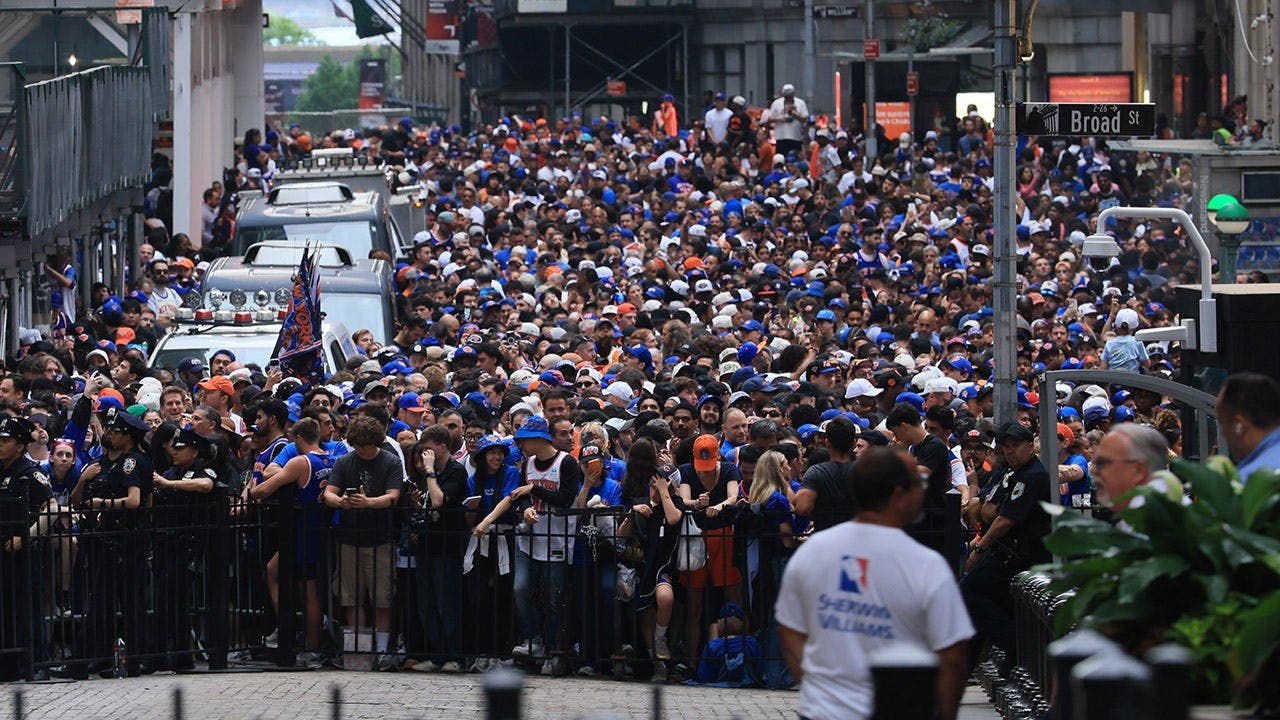
For more than half a century, the long-suffering fans of the New York Knicks carried a heavy cross of athletic heartbreak, enduring decades of unmet expectations, roster rebuilds, and tantalizing near-misses that made the dream of an NBA championship feel more like a distant myth than an achievable reality. When that glorious day finally arrived, sending shockwaves of pure, unadulterated ecstasy through the five boroughs, the city did not merely celebrate—it erupted in a spectacle of historic proportions. Lower Manhattan was instantly converted into a sprawling, chaotic arena of blue and orange, as hundreds of thousands of passionate devotees flooded the historic Canyon of Heroes. Confetti poured from the high-rise office windows like colorful snow, blanketing the streets where legends walked, while the thunderous roar of horns, cheers, and chants echoed off the concrete facades. It was an atmosphere charged with an almost spiritual electricity, a collective exhale of fifty years of pent-up tension that drove the city’s populace into a state of absolute, boundary-pushing euphoria. In the midst of such overwhelming, once-in-a-generation communal joy, the typical rules of metropolitan life seemed to temporarily dissolve. Intoxicated by victory and the sheer magnitude of the historical moment, parade-goers climbed atop city buses, scaled traffic lights, and danced on top of municipal vehicles to feel closer to the action, hungry to preserve any memory of this legendary milestone. But as the afternoon progressed and the boundary between passionate fandom and reckless abandonment began to overlap, a deeply bizarre incident occurred that would quickly shift the public narrative from a celebration of athletic achievement to a sobering masterclass in modern digital accountability. It proved that even in the middle of a massive, crowded metropolis of millions of people, you are never truly anonymous, and the choices made in a fleeting moment of excitement can ripple outward to reshape the entire trajectory of your personal and professional life.
At the center of this sudden storm was Angie Báez, an accomplished corporate executive who, until that fateful morning, occupied a prestigious and highly coveted seat within the upper echelons of the global financial industry. As the parade swept through the concrete canyons, a video began circulating across social media platforms that would quickly capture the attention of millions and trigger a wave of collective disbelief, condemnation, and eventual dark amusement. The footage, captured on a high-definition smartphone by a bystander amidst the swirling ticker tape, depicted a professional woman approaching a distinct, blue-and-orange New York Knicks-themed public litter basket that the city had specifically placed along the sidewalk to decorate the route. Without hesitation, and in full view of the passing crowd, she tipped the heavy metal container over, dumping piles of accumulated street trash directly onto the public pavement before hoisting the bulky, commemorative trash can empty into her arms and triumphantly marching away with it. Her face was clearly visible, illuminated by the bright summer sun, capturing a moment of apparent triumph that would prove to be incredibly short-lived. To the casual observer, it was a mind-boggling display of civic disrespect—a complete disregard for the sanitation workers tasked with maintaining order in the wake of a historic celebration, and an act of casual property theft that left onlookers completely stunned. Within hours, the digital dragnet went to work, as internet sleuths, outrage-driven commuters, and local news outlets quickly cross-referenced the high-definition footage with professional networking platforms. The shock of the theft itself was quickly eclipsed by the shocking revelation of the perpetrator’s professional identity, as she was identified as none other than a high-ranking executive at the financial giant JPMorgan Chase, transforming a localized municipal infraction into an international, viral headline that dominated news cycles for days.
The fallout from the viral video was swift, merciless, and absolute, highlighting the incredibly thin line that separates corporate prestige from sudden public exile in the age of instant online accountability. Before the parade, Angie Báez’s professional profile was the envy of many, listing her as the Executive Director of Community and Industry Engagement for Card and Connected Commerce at JPMorgan Chase—a role that required a deep understanding of corporate responsibility, local community development, and public-facing strategies. Her impressive resume also included substantial leadership roles in diversity, equity, and inclusion, including at food platform The Infatuation, which had been acquired by Chase back in 2021. Yet, the moment the public linked her name to the woman dumping garbage onto a Manhattan sidewalk to steal a commemorative trash can, her career went into freefall. Recognizing the catastrophic public relations implications of having a senior executive associated with public vandalism, littering, and property theft during a celebratory civic event, JPMorgan Chase acted with clinical efficiency. Within a remarkably short window, the banking giant released a blunt, no-nonsense statement confirming that Báez was no longer employed by the company. When pressed for further details by media outlets seeking to understand the decision or see if there was any room for rehabilitation, the corporate communication team offered a cold, unwavering refrain: “This employee is no longer with the company,” making it clear that professional merit could not override the embarrassment cast upon the firm. It was a shocking and devastating professional collapse, demonstrating how decades of hard work, networking, and executive climbing could be entirely erased in a matter of seconds by a single, senseless act of impulse captured on a smartphone camera. While some argued that losing a high-paying corporate career over a trash can was an overly harsh penalty, the majority of commentators viewed it as a deserved consequence for an act of public disrespect.
While the loss of her corporate livelihood was undoubtedly the most devastating consequence of the incident, the municipal gears of New York City were also turning to ensure that civic order was preserved and that laws were upheld. The New York City Department of Sanitation (DSNY), known for its hard-working workforce, took the matter very seriously. On Wednesday morning, nearly a week after the parade had concluded and the streets had been cleared of celebration debris, Angie Báez quietly made her way to a sanitation facility to return the stolen commemorative Knicks litter basket. Upon her arrival, she was met not just with the relief of returning the property, but with real legal consequences delivered by the Sanitation Police. The department issued her two official summonses: a seventy-five-dollar fine for littering—addressing the moment she dumped the existing trash onto the sidewalk—and a one-hundred-dollar fine for impeding Department of Sanitation operations. These fines, totaling one hundred and seventy-five dollars, represented the absolute maximum allowed by local law for first-time offenses of this nature. Interestingly, while the Sanitation Department took swift action, the New York Police Department indicated that it had no active criminal complaint report on file regarding the incident, suggesting that the city opted to handle the matter through administrative and civil channels rather than pursuing formal criminal charges for petty theft or vandalism. This administrative resolution allowed the city to reclaim its unusual piece of public property while still imposing a formal, legally binding consequence on the former corporate executive, showing that the system, though sometimes slow, had successfully closed the loop on the bizarre theft. These fines carried a heavy symbolic weight, cementing her status as an official offender against the city’s cleanliness. The Sanitation Police, specialized officers who enforce the city’s health and administrative codes, made sure the message was clear: no resident, regardless of their social standing or corporate title, is above the basic ordinances that keep New York clean.
The actual impact of the dumped trash, while visually egregious in the viral video, was practically microscopic when viewed against the staggering scale of the cleanup operation that followed the historic Knicks parade. According to official statistics provided by the Department of Sanitation, the agency’s tireless workers collected a staggering seventy-five thousand, two hundred and sixty pounds of confetti and litter over the twenty-four hours following the event. In a statement to the media, a spokesperson for the department noted that they did not have a specific cost estimate for clean-up efforts related to this single incident, emphasizing that the amount of garbage dumped from the blue-and-orange basket was completely insignificant compared to the literal tons of waste left behind by hundreds of thousands of ecstatic sports fans. Yet, rather than letting the incident pass silently, the DSNY decided to have some lighthearted fun with the situation on social media, turning the entire affair into a teachable moment for New Yorkers. In a cheeky public post celebrating the return of the stolen basket, the department playfully reminded residents that they maintain over twenty-three thousand green and blue litter baskets across the five boroughs, warning that fans never quite know where a special commemorative edition might pop up next. They went on to suggest that anyone harboring a deep, burning desire to own a piece of Knicks-themed sanitation history could easily buy smaller, perfectly legal replica versions online, eliminating the need to commit public vandalism or risk their livelihoods for a piece of city-owned street furniture, bringing a much-needed sense of humor to an otherwise tense public scandal. This playful digital strategy allowed the department to connect directly with the public, transforming a frustrating act of vandalism into an engaging public safety campaign that highlighted the hard work of transit and sanitation employees. It also served to humanize the agency, showing that while they enforce the rules strictly, they can also share a collective laugh with the city.
Ultimately, this bizarre episode serves as a powerful, modern cautionary tale about the intersection of public behavior, viral culture, and the incredibly fragile nature of professional status in the digital age. It highlights how quickly a moment of unbridled, impulsive celebration can turn into an irreversible life-altering disaster when captured by the omnipresent lenses of smartphones. Angie Báez’s story is a vivid reminder that the boundaries between our private impulses and our public obligations are thinner than we think, and that a single act of thoughtless convenience can erase years of carefully cultivated professional success. The incident humanizes both the struggle of a city trying to maintain its dignity amidst a historic party and the fallibility of individuals who lose themselves in the intoxicating atmosphere of a collective triumph. It forces us to look in the mirror and ask ourselves how we behave when we think no one is watching, and what price we are truly willing to pay for a temporary souvenir. While the Knicks’ momentous championship will go down in sports history as a legendary triumph, it will also forever be linked to this strange, fascinating saga of a stolen trash can, an executive’s lost career, and a one-hundred-and-seventy-five-dollar fine that became one of the most expensive lessons in civic pride New York has ever witnessed. In the end, the city got its blue-and-orange basket back, a bank protected its reputation, and New Yorkers were left with a lasting reminder that in the grand theater of Gotham, every action has its price—and sometimes, the currency is your entire future. We learn from this that corporate safety nets disappear when individual ethics fail, and that the city we love deserves our respect even when we are lost in the dizzying thrills of victory.