






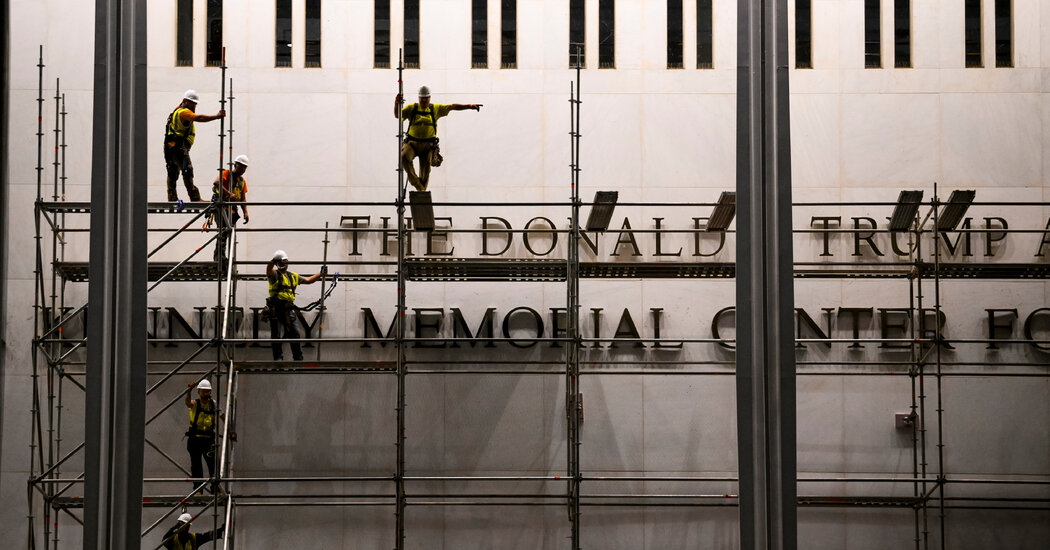
The transition from Friday night to Saturday morning in Washington, D.C., was marked by both meteorological and political turbulence. As a sequence of fierce summer thunderstorms swept across the Potomac River, towering scaffolds rose against the white marble facade of the John F. Kennedy Center for the Performing Arts. Under the cover of heavy white tarps hung to shield the operation from public view, workers labored through the humid night to dismantle a modern political artifact. Just after 3:00 a.m., following an extension granted past a midnight court-ordered deadline, a worker quietly reached out from the scaffolding and pulled the letter “A” from the wall by hand, without the assistance of power tools. The letters, which had boldly proclaimed “The Donald J. Trump and the John F. Kennedy Memorial Center for the Performing Arts,” were being stripped away following a federal judge’s ruling that the rebranding of this national landmark was entirely unlawful. By dawn, the executive director of the center, Matt Floca, filed a sworn court declaration confirming that the name of the nation’s 45th president had been entirely erased from the facade, marking a profound symbolic victory for those who viewed the renaming as an egregious desecration of a monument dedicated to a slain American icon.
For the preceding forty-eight hours, the iconic arts venue had transformed from a temple of high culture into a theater of intense civic drama. Instead of patrons arriving in evening wear for the symphony or the ballet, the plaza was populated by a curious, highly charged crowd of onlookers, activists, and journalists who kept a vigilant watch on the building’s exterior. Nearby, residents of the adjacent Watergate condominium complex turned their balconies into front-row gallery seats, planning impromptu watch parties and setting up high-definition webcams to livestream the facade. Two volunteer organizations, Hands Off the Arts and Free the Kennedy Center, coordinated the digital broadcast, allowing thousands nationwide to witness the unfolding standoff. The atmosphere fluctuated wildly between anticipation and frustration as legal maneuvers played out in real-time. Local residents Christine Lienert and Debra Wilfong kept a celebratory bottle of champagne chilled on ice, returning it to the refrigerator on Thursday night when news broke of a temporary delay, only to bring it out again on Friday as the finality of the court’s order became clear. Among those waiting was 79-year-old Allerton Kilborn, who had traveled from Chevy Chase, Maryland, and spent over twelve hours on the grounds, holding a book to pass the time. Having met John F. Kennedy in his youth, Kilborn viewed the addition of Trump’s name as a sacrilege, describing the urge to see it removed not in political terms, but in deeply spiritual ones as an act of restoration.
The bitter controversy had its roots in a sudden operational maneuver six months prior, when the center’s board of trustees—by then heavily stacked with political allies of President Trump—voted to alter the institution’s name. The justification presented by the board was transactional: the change was a gesture of appreciation for the president’s personal efforts in securing $257 million in federal funding to finance a badly needed and long-delayed renovation of the facilities. However, the installation of the eighteen new marble letters, completed less than twenty-four hours after the board’s vote, triggered an immediate and ferocious backlash. Democratic lawmakers lashed out at the rebranding, characterizing it as an unprecedented display of executive narcissism, while several prominent artists and performers canceled their scheduled appearances at the center in protest. The legal pushback was spearheaded by Representative Joyce Beatty, an Ohio Democrat and ex-officio member of the center’s board, who filed a lawsuit charging that the renaming was a flagrant violation of federal law. Ms. Beatty herself remained on the plaza through the stormy early hours of Saturday morning, standing watch until the work crew finally departed at 4:00 a.m., ensuring that the court’s mandate was executed to the letter.
The primary legal arbiter of the dispute, Judge Christopher R. Cooper of the Federal District Court in Washington, ultimately dismantled the board’s decision by pointing directly to the historical mandate established by Congress. In his late-month ruling, Judge Cooper asserted that the governing board of the Kennedy Center possessed absolutely no legal authority to unilaterally alter the name of the institution, noting that such power rests strictly within the purview of the federal legislature. He cited the original 1964 statute enacted following Kennedy’s assassination, which explicitly designated the center as the sole national monument to the late president, an ardent champion of American arts and culture. Judge Cooper observed that the newly installed signage did not merely honor a donor but fundamentally reordered history by inserting an entirely new identity into the institution’s formal title and effectively relegating John F. Kennedy’s name to a secondary status. When the administration attempted to secure a last-minute stay of the order, arguing that removing and potentially restoring the letters during an appeal would cause extreme public confusion, the judge stood firm, pointing out that the center had already begun seamlessly removing the Trump name from its websites, stationery, and digital footprints without any disruption to its operations.
The polarization of the nation was mirrored directly in the microcosm of the citizens who gathered on the marble plaza to watch the physical removal of the letters. While the dominant sentiment of the crowd was celebratory, with chants of “Take it down” echoing off the concrete, there were those present who viewed the removal with deep regret and frustration. Jeanette Mercado and her husband, Bert, who had traveled to the nation’s capital from the agricultural town of Wasco in California’s Central Valley, found themselves witnesses to history quite by accident during their tour of the city’s monuments. Jeanette expressed her strong support for the president, stating that she believed his contributions deserved public recognition and that his name belonged on the structure as a testament to his support for the arts. Interestingly, her husband, despite sharing her conservative political leanings, expressed a more measured, institutionalist view of the conflict, questioning the wisdom of altering established national memorials and arguing that a vital sense of historical continuity should take precedence over modern political branding. This domestic disagreement highlighted the complex ways in which everyday Americans grappled with the intersection of contemporary political loyalty and reverence for the nation’s historical legacy.
Ultimately, the midnight removal of the marble letters represented a significant check on a much broader, systematic campaign by the executive branch to reshape Washington’s cultural and architectural landscape. Upon entering his second term, President Trump had made the Kennedy Center a primary target for his aesthetic and structural vision, effectively taking control of the institution from within by replacing long-serving trustees with staunch loyalists and attempting to implement sweeping physical modifications, such as painting the center’s signature gold columns a bright, stark white. The legal battle over the name was also closely linked to a highly controversial proposal by the administration to close the center entirely for a two-year period under the guise of maintenance, a plan that critics and plaintiffs argued was a deliberate attempt to mask declining ticket sales and an exodus of creative talent. As the final traces of the president’s name were covered over with tape on parking signs, scribbled out on shuttle buses, and physically chiseled from the grand facade, the quiet dawn over the Potomac left behind a building restored to its original twentieth-century identity, illustrating the enduring power of statutory law and public memory over the transient ambitions of political power.