




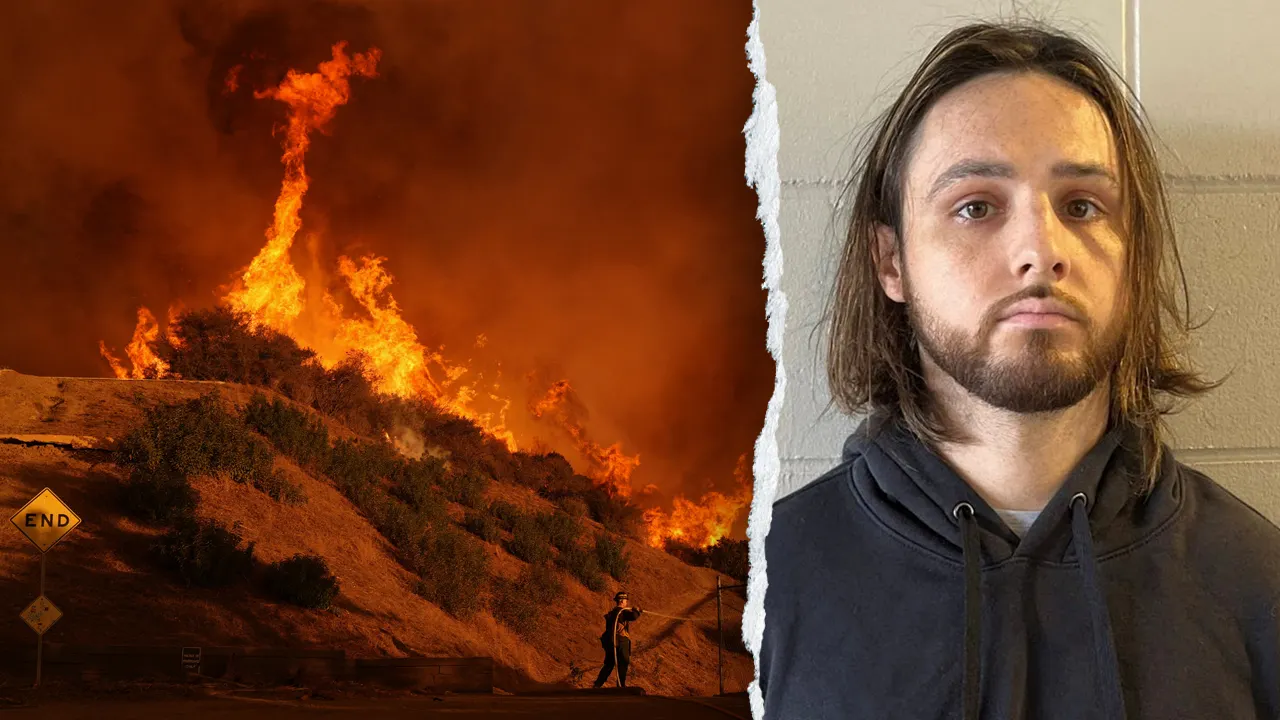
The quiet anxiety of a federal courtroom is a heavy, almost suffocating thing, particularly when the stakes involve the ashes of a community and the loss of twelve human lives. On a tense Thursday afternoon inside a federal courthouse in California, that pressure cooker atmosphere reached a boiling point as jurors deliberating the fate of Jonathan Rinderknecht, the 30-year-old accused of igniting the catastrophic 2025 Palisades Fire, suddenly hit a wall. Just moments after sending a startling note to the judge indicating they had finally reached a federal verdict, the panel abruptly pivoted, sending a second, far more frantic message that revealed deep, seemingly irreconcilable divisions among the twelve citizens tasked with deciding Rinderknecht’s future. The sudden shift from a resolved conclusion to an absolute standstill left lawyers, families of victims, and observers in a state of suspended disbelief, highlighting the immense psychological toll of a ten-day trial that has forced ordinary citizens to grapple with the sheer scale of the most destructive wildfire in the history of Los Angeles County. As the jury foreman starkly wrote of “people on both sides that are dead-set” and “unwavering” in their opposing beliefs, the courtroom was forced to confront the very real possibility that after months of preparation, agonizing testimonies, and visceral accounts of survival, the pursuit of legal closure might dissolve into a deadlocked mistrial.
To understand the profound gridlock inside the jury room, one must look closely at the deeply complicated and disturbing human profile constructed by federal prosecutors around Jonathan Rinderknecht. Far from presenting him as a mere reckless wanderer, the prosecution painted a harrowing portrait of a young man consumed by a toxic cocktail of isolation, compounding resentment, and an obsessive fixation on societal inequality. According to court documents and closing arguments, Rinderknecht was a man drowning in his own loneliness, allegedly drawing dark inspiration from radical figures like Luigi Mangione, and harboring an intense, volatile hatred for the ultra-wealthy. Assistant U.S. Attorney Danbee Kim argued that in Rinderknecht’s eyes, the opulent enclave of Pacific Palisades was not just a neighborhood of beautiful homes, but a grotesque, physical manifestation of a broken economic system where the rich thrived at the expense of the working class. This alleged worldview—a deeply entrenched belief that the wealthy were actively destroying the planet and therefore deserved to watch their own sanctuaries burn—became the central pillar of the government’s motive, suggesting that the devastating fire was not a tragic accident of negligence, but a targeted, politically charged act of vengeful arson meant to level the playing field through ash and embers.
Yet, the defense’s contrasting narrative is precisely what has kept the jury so fiercely divided, centering on the profound human truth that a man’s dark thoughts do not automatically prove his physical actions. Defense attorney Steven Haney fought aggressively to separate the horrifying reality of the fire from the person of Rinderknecht, reminding the jury that prosecutors had failed to produce a single shred of definitive physical evidence, such as DNA, clear video surveillance, or fingerprints, placing his client at the exact point of ignition. The defense raised a compelling, scientifically backed argument that challenged the very lineage of the catastrophe, claiming that the initial, minor brush fire on New Year’s Day—dubbed the Lachman Fire—was entirely separate from the devastating conflagration that arose a week later. By framing the subsequent blowout as an unpredictable act of nature fanned by historic Santa Ana winds rather than a continuous, underground smoldering event tied to Rinderknecht, the defense successfully sowed deep seeds of reasonable doubt. This defense forced jurors to ask themselves a haunting question: is it possible that they are being asked to condemn an angry, marginalized young man simply because he makes an easy scapegoat for a natural disaster that exhausted prosecutors desperately need to blame on someone?
The sheer magnitude of the devastation hanging over this trial makes the jury’s burden almost too heavy for twelve ordinary people to bear. The Palisades Fire was not merely an environmental disaster; it was a deeply human tragedy that permanently altered the landscape of Southern California and shattered thousands of lives in its wake. What began as a seemingly harmless, smoldering pocket of brush on New Year’s Day transformed, under the demonic influence of severe drought and high-velocity winds, into a multi-headed monster that devoured over 23,000 acres of land and reduced approximately 6,800 structures, mostly multi-generational family homes, to charred ruins. For the families of the twelve individuals who perished in the fast-moving flames, this trial was supposed to be a path toward healing, a public rendering of justice for mothers, fathers, and children who were unable to escape the suffocating smoke. The emotional weight of these losses has saturated every corner of the courtroom, making the jury’s inability to find common ground feel like a secondary wound to a community that is still actively mourning and struggling to rebuild its physical and emotional foundations from the ground up.
This profound emotional and scientific complexity explains why the interaction between the judge and the deadlocked jury on Thursday felt so incredibly tragic and exhausting. When the judge, desperately seeking to salvage the trial, offered the assistance of the court—asking if additional clarification on the law or a re-reading of witness testimony could help bridge the divide—the jury’s response was swift, bleak, and uncompromising. “There is nothing the court can do to assist the jury in their deliberations,” the note read, confirming that no amount of legal jargon or dry transcript reading could heal the ideological rift that had formed between the jurors. The defense and prosecution teams, usually adversarial at every turn, found themselves united in a rare moment of shared uncertainty, requesting more time to huddle, research legal precedents, and contemplate the grim reality of starting the entire expensive, painful process over again. Ultimately, the judge chose to push the exhausted jurors one step further, ordering them to return to the courthouse on Friday morning to try, against all odds, to find a sliver of consensus.
As the sun set on the courthouse ahead of Friday’s resumed deliberations, the atmosphere remained heavy with unresolved grief, highlighting the broader, painful societal divisions that this case has dragged into the light. At its core, the trial of Jonathan Rinderknecht is a mirror reflecting some of the modern world’s deepest anxieties: the widening chasm between the rich and the poor, the terrifying unpredictability of climate-driven disasters, and the desperate search for accountability in an unfair world. If the jury remains permanently gridlocked, resulting in a mistrial, it will leave both sides in a painful limbo—the prosecution facing the daunting task of re-trying a highly circumstantial case, the defense continuing to fight for a man who maintains his innocence, and the victims’ families denied a sense of finality. Regardless of whether the jurors can somehow find a unanimous voice in the quiet of Friday morning, the scars left by the Palisades Fire will remain, a stark reminder that while courts can debate laws, motives, and underground embers, they cannot so easily repair the broken spirits of a community or bring back the lives lost to the flames.