






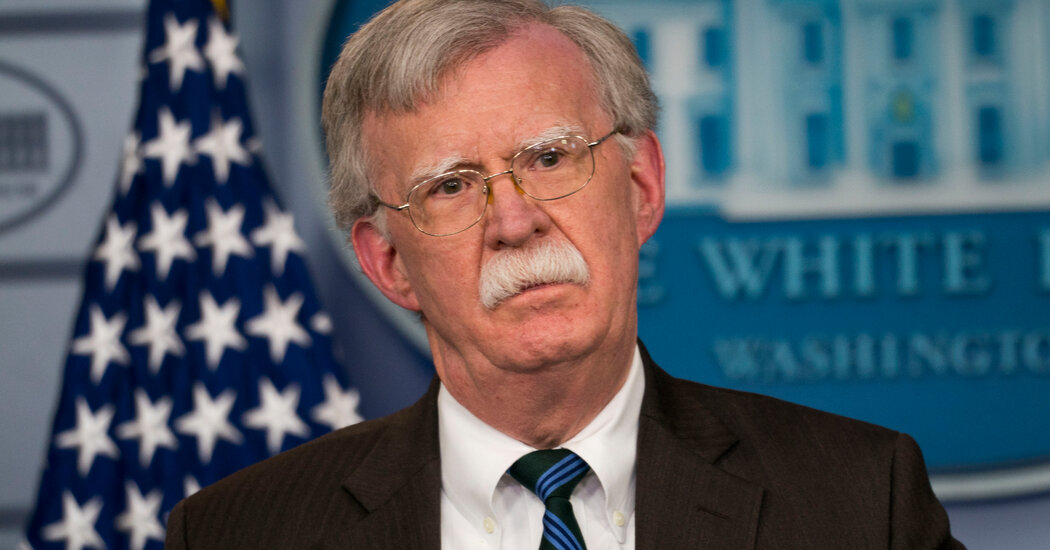
The impending courtroom appearance of John R. Bolton marks a deeply sobering chapter in the life of one of modern American history’s most recognizable and polarizing foreign policy figures. For decades, Bolton traversed the highest corridors of global power, defined by his hawkish resolve, his trademark white mustache, and an unshakeable belief in the projection of American strength. Yet, a notice filed in a Maryland federal court has rewritten his legacy from that of an untouchable architect of statecraft to a vulnerable individual bracing for a criminal conviction. Scheduled for a re-arraignment on June 26, 2026, Bolton has reached a tentative plea agreement with federal prosecutors, signaling his intention to plead guilty to a single count of illegal retention of classified information. The transition from advising the President of the United States in the Oval Office to negotiating a deal to avoid spending his sunset years in a federal prison cell illustrates the devastating gravity of the situation. This legal capitulation represents more than just a procedural landmark; it is a profoundly human drama of a fiercely independent statesman caught in the cold, mechanical gears of the national security apparatus he spent his entire life building and defending.
At the absolute center of this legal storm is not a narrative of espionage or betrayal for financial gain, but rather a deeply human domestic reality gone wrong. As Bolton sought to process and document the chaotic inner workings of his turbulent tenure in the first Trump administration, he compiled over one thousand pages of highly detailed personal notes and diaries. In his eagerness to craft his explosive 2020 memoir, The Room Where It Happened, he bypassed the rigid pipelines of high-level government security and shared these intimate digital drafts with his closest confidants: his wife and his daughter. Utilizing an ordinary personal email account and a commercial messaging application, Bolton sought the counsel and emotional support of his family as he wrote, unwittingly setting a catastrophic legal trap for himself. The original eighteen-count indictment laid bare this domestic collaboration, transforming what Bolton likely viewed as a private family editing process into a major criminal offense involving the unauthorized distribution of vital national defense information. The tragedy of his situation lies in this profound disconnect—a patriarch attempting to share his life’s crowning, albeit stressful, achievements with his loved ones, only to inadvertently drag those very family members into the crosshairs of a relentless federal investigation.
The anxiety of Bolton’s ordeal escalated into a surreal nightmare when the digital vulnerabilities of modern life collided with the unforgiving realities of international espionage. While writing his book, Bolton’s personal email account was breached by a hacker associated with the government of Iran—an adversary that Bolton, a legendary foreign policy hawk, had spent his entire career working to isolate and neutralize. The realization that his private thoughts, family correspondence, and descriptions of classified Situation Room briefings were now in the hands of a hostile foreign state must have been a sickening shock. To make matters worse, the hacker began actively taunting Bolton in July 2021, sending a chilling message that compared the security breach to the infamous Hillary Clinton email scandal and warning him to make contact “before it’s too late.” Though Bolton’s representatives eventually forwarded the threatening messages to the FBI, the damage was already done. The government he had served now had undeniable, digitized proof that Bolton had not only kept highly sensitive national security secrets on insecure personal platforms, but had also exposed those secrets to cybercriminals representing one of America’s most dangerous geopolitical foes.
For former President Donald Trump, Bolton’s pending guilty plea offers a crowning symbolic triumph in his years-long public campaign to prosecute and humiliate his perceived political adversaries. Since Bolton’s departure from the administration in 2019, the former National Security Adviser had transformed into a relentless and articulate critic of Trump’s leadership, making his prosecution a highly charged political event. However, to view this case purely through the lens of partisan vengeance is to misunderstand the apolitical, self-preserving nature of the American intelligence community. Unlike other high-profile investigations into the handling of classified documents—including the federal charges brought against Trump himself for hoarding physical boxes of secrets at Mar-a-Lago—Bolton’s prosecution was driven by a quiet, bureaucratic anger that persisted across administrations. The investigation did not wither away when Joe Biden entered the White House; instead, it gained significant momentum under the current Justice Department as career intelligence officials uncovered deeply troubling evidence of systemic neglect. This continuity reveals a harsh truth about Washington: while politicians cycle in and out of power, the security agencies protect their secrets with an institutional memory that does not forgive, regardless of which party holds the executive office.
Confronted with the immense administrative power of the Department of Justice and the very real prospect of a trial that could have resulted in decades behind bars, Bolton and his veteran defense attorney, Abbe Lowell, had to make a calculated decision for survival. Lowell had initially mounted a fierce defense, publicly arguing that Bolton was being selectively targeted by a weaponized justice system determined to silence administration critics, and pointing out that the allegations had been investigated years earlier without yielding charges. Yet, when faced with the raw mathematics of an eighteen-count indictment, the bravado of political counter-punching quickly dissolved into a sobering quest for damage control. Under the terms of the newly struck plea deal, which still awaits final approval from a federal judge, Bolton will plead guilty to just one count, trade his chance at total exoneration for the safety of a compromise, and pay a significant financial penalty. He now faces a sentencing range spanning from probation to a maximum of five years in prison—a stark and humbling concession, but one that represents a lifeline for an older man who was otherwise facing the very real possibility of dying in custody.
Ultimately, the fall of John Bolton serves as a cautionary tale about the high cost of memory, legacy, and the pursuit of the historical narrative. In the modern political landscape, the memoirs of former officials have become a staple of public life, serving as personal testimonies, historical records, and lucrative therapeutic releases. Bolton’s tragedy was his belief that his status, his intellect, and his long history of service exempted him from the very rules he expected others to follow under his leadership. His upcoming re-arraignment on June 26 stands as a monument to the dangerous illusions of power and the fragile boundary separating history from criminality in our highly digital, deeply polarized age. As he prepares to stand before a federal judge, stripped of his security clearances and branded a convicted felon, Bolton’s story leaves us with a haunting reminder of the ultimate paradox of public service: that the secrets a leader is trusted to keep can eventually become the very chains that bind him, and that in the end, the state always claims absolute ownership over the truth.