






In the high-stakes, hyper-accelerated arena of modern American politics, where public apologies are often viewed by strategists as a sign of weakness and political gladiators rarely concede even a fraction of rhetorical ground to their opponents, Vice President JD Vance’s upcoming memoir, Communion, arrives as both a striking departure and a deeply calculated exercise in personal self-examination. In this highly anticipated volume, Vance directly confronts one of the most polarizing, culturally explosive, and self-inflicted controversies of his political career: his infamous, viral denunciation of “childless cat ladies” within the Democratic Party. Rather than doubling down on the confrontational populism that characterized his rapid, meteoric ascent from a Rust Belt chronicler to the second-highest office in the land, Vance takes full, unsparing responsibility for what he now terms a major political blunder. Writing with a level of introspection that is exceptionally rare for active national leaders, Vance describes his past remarks as “one of the dumbest things I ever said” and characterizes the entire episode as a “boneheaded comment” that succeeded only in generating heat rather than light. Through this candid confession, Vance attempts to pull back the curtain on the performative nature of contemporary political combat, offering a humanizing look at his own personal flaws, his internal struggles with the easy temptations of partisan theater, and the steep intellectual price of prioritizing cultural provocation over genuine policy dialogue. By framing this admission within a broader narrative of his personal and spiritual evolution, Vance seeks to transform his image from a polarizing lightning rod of the culture wars into a more mature, reflective statesman who is willing to look in the mirror and honestly reckon with the collateral damage of his own political ambition. This profound personal reckoning serves as the true emotional anchor of his new book, inviting both supporters and detractors to look beyond the viral headlines and understand the complex, evolving human being behind the rigid political caricature.
To truly understand the massive weight of Vance’s current contrition, one must first revisit the specific origin point of the controversy, which traces back to a political landscape that was heavily defined by media sensationalism, digital performativity, and deep partisan tribalism. The year was 2021, and Vance, then a young political contender seeking to establish his populist credentials ahead of a fiercely competitive Ohio Senate race, appeared as a prominent guest on Tucker Carlson’s highly rated Fox News program. During the broadcast, Vance delivered a sweeping, fiery broadside against the leadership of the Democratic Party, arguing that the nation was effectively being run by a disconnected coalition of corporate oligarchs and “a bunch of childless cat ladies who are miserable at their own lives and the choices that they’ve made, and so they want to make the rest of the country miserable too.” To emphasize his thesis, he went on to single out key progressive stalwarts, specifically pointing to the future Democratic presidential nominee Kamala Harris, Transportation Secretary Pete Buttigieg, and Representative Alexandria Ocasio-Cortez, asserting that the entire developmental future of the progressive movement was resting in the hands of individuals who had no direct personal stake in the upcoming generation through biological children. It was a high-risk rhetorical gamble designed to resonate deeply within the echo chambers of conservative media, specifically engineered to frame the demographic and cultural differences of the American electorate as an existential battle over traditional family values. At the time, the comment served its immediate tactical purpose of generating intense outrage and elevating Vance’s profile among the conservative base, but it also planted a rhetorical landmine that would lie dormant for years, waiting for the harsh spotlight of a national presidential campaign to trigger a massive, career-altering explosion. By reducing complex personal choices, tragic biological struggles, and diverse modern lifestyles to a simplistic and deeply derogatory stereotype, Vance had unwittingly alienated a vast demographic of voters, setting the stage for a massive backlash that would eventually threaten his national ambitions.
According to Vance’s candid reflections in the pages of Communion, the fallout from this particular rhetorical strategy did not manifest as a single, isolated event, but rather as two distinct and highly destructive political firestorms that bookended his rapid rise to national prominence. The first storm swept through the American political ecosystem immediately after the initial broadcast in 2021, sparking sharp criticism from progressive commentators, family advocates, and moderate commentators, though it remained largely confined to cable news cycles and online political subcultures. However, the second, far more catastrophic firestorm erupted years later during the high-stakes environment of the 2024 presidential campaign, immediately following Donald Trump’s decision to select Vance as his vice-presidential running mate. Opponents of the Republican ticket quickly unearthed the old television footage, thrusting the “childless cat ladies” comment back into the center of the national conversation at a time when Vance was trying to introduce himself to a broad, moderate audience of general election voters. The resurfaced remarks quickly went viral, dominating mainstream headlines, television talk shows, and social media feeds, while forcing the newly minted vice-presidential candidate onto a defensive footing from which he struggled to escape for weeks. Vance found himself in the agonizing position of having to repeatedly clarify, contextualize, and defend comments that had originally been crafted for the hyper-partisan environment of late-night cable television rather than the heavily scrutinized stage of a presidential race. This secondary firestorm proved to be a grueling lesson in the permanence of the digital archive, illustrating how the highly provocative statements that help a politician win a primary can easily become a devastating liability when trying to build a broad national coalition. It shifted the campaign’s focus away from crucial economic and border issues, forcing Vance and his team to spend valuable political capital managing a manufactured cultural crisis of his own making.
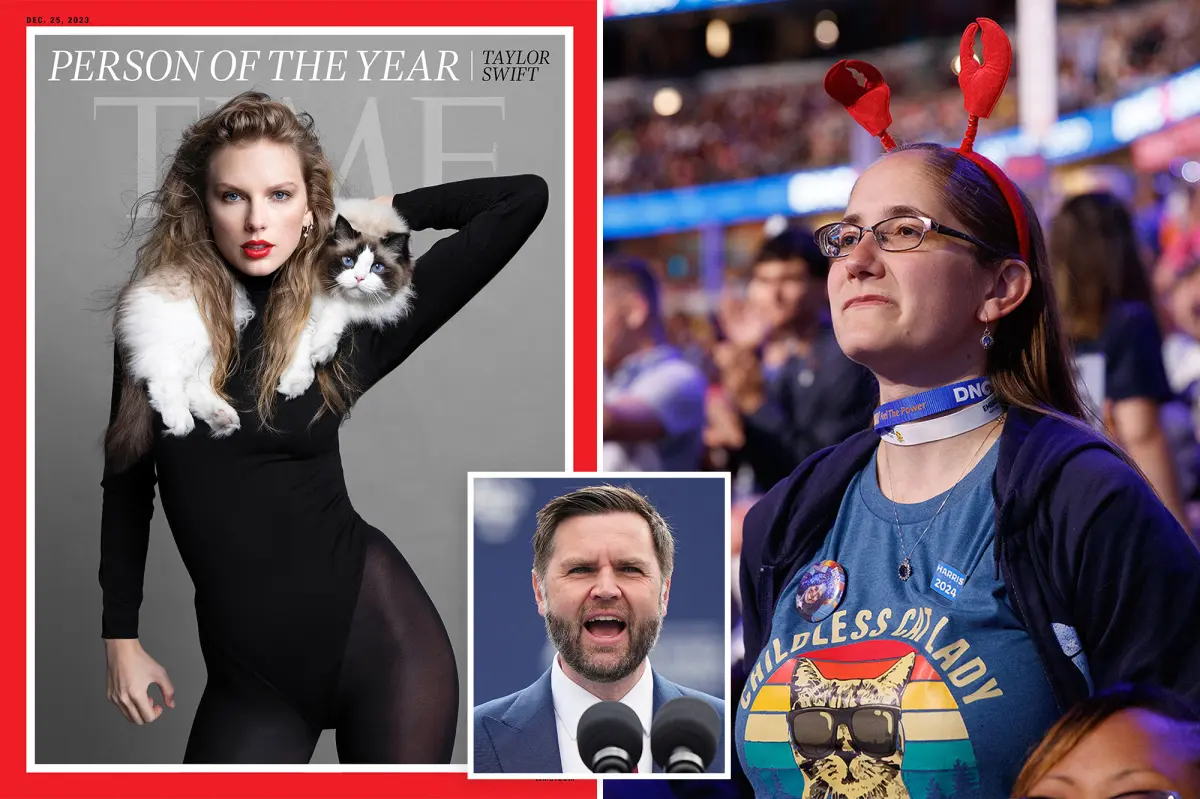
The cultural backlash reached its absolute zenith when the controversy transcended conventional political reporting and crossed over into the realm of global pop culture, illustrating the profound power of modern celebrity to reshape political narratives. Most notably, the global pop superstar Taylor Swift chose to turn Vance’s derogatory phrase on its head, using it as a potent weapon of resistance and community building when she officially endorsed the Democratic ticket of Kamala Harris and Minnesota Governor Tim Walz. In a highly publicized social media post that was viewed by hundreds of millions of people worldwide, Swift ironically signed her endorsement as a “Childless Cat Lady,” posing with her beloved pet cat to create an instantly iconic image that subverted Vance’s intended insult. By claiming the label as a proud badge of honor, Swift did more than just endorse a political candidate; she catalyzed a massive cultural movement that resonated widely with millions of independent, single, childfree, and professional women across the country who felt directly targeted and demeaned by Vance’s original commentary. Suddenly, the “childless cat lady” was no longer a stereotype of isolated misery, but a symbol of modern female empowerment, financial independence, and political agency. This brilliant cultural co-optation fully disarmed the Republican campaign’s rhetorical weapon, turning a calculated political insult into a viral meme that drove voter registration and galvanized key demographic groups that the Trump-Vance ticket desperately needed to win over. This fundamental shift in public perception forced the campaign to realize that what once worked as easy red meat for a niche audience could alienate the very independent voters required to secure national victory. When the political becomes personal, voters often respond not with apathy, but with a renewed sense of tribal solidarity, proving that derogatory generalizations can quickly backfire and mobilize the very groups they were meant to marginalize, transforming a minor joke into a strategic nightmare.
What makes Vance’s public act of contrition in Communion particularly compelling and unique is that it is not framed within the dry context of a secular public relations strategy, but is instead deeply integrated into his personal journey of converting to Catholicism. Scheduled for release on Tuesday, the memoir centers on his recent spiritual transformation, exploring how his search for enduring truth and moral structure eventually led him to embrace the ancient traditions, theology, and spiritual discipline of the Catholic Church. Within this rich religious framework, Vance’s acknowledgment of his past rhetorical excesses takes on a much deeper, more contemplative meaning, transforming a standard political apology into a sincere examination of conscience and a pursuit of spiritual humility. Catholicism teaches that words possess immense moral weight, that pride is a fundamental spiritual hazard, and that true reconciliation requires an honest, unsparing confession of one’s active shortcomings. By admitting in his book that his comments were “intentionally (and successfully) provocative rather than illuminating,” Vance acknowledges that he allowed the corrupting demands of political showmanship to override his Christian obligation to speak with grace, charity, and intellectual integrity. This spiritual lens allows Vance to discuss his political career not merely as a series of strategic maneuvers to win elections, but as a moral landscape filled with ethical pitfalls where the desire for public applause can easily lead to spiritual compromise. His memoir suggests that his conversion provided him with the necessary moral framework to step back from the hyper-partisan fray, recognize the inherent dignity of those he had previously dismissed, and seek a path of public service that is grounded in constructive dialogue rather than divisive, empty theatrics. Through this spiritual introspection, he attempts to reconcile his public duty with his personal faith, showing that true leadership requires the vulnerability to acknowledge when one has strayed from the path of mutual respect, empathy, and truth, ultimately aiming to align his daily political behavior with the transcendent values of his newly embraced Catholic faith.
In the final analysis, Vance’s remarkable self-reckoning in Communion raises profound questions about the future of political discourse in an era dominated by social media algorithms that reward conflict over consensus. Indeed, it also serves as a vivid, instructive case study of a modern politician attempting to navigate the permanent, unyielding digital archive of their own past provocations, while simultaneously trying to build a viable path toward national leadership and a sustainable governing consensus. For many seasoned observers and cynical commentators, this sudden pivot toward internal humility will undoubtedly be viewed as a calculating, highly polished maneuver designed to soften his intensely polarizing public image ahead of future legislative battles and eventual presidential campaigns. Skeptics will certainly argue that admitting a rhetorical mistake after the high-stakes election has already been won is a low-risk strategy, a convenient way to neutralize a lingering political liability without having to suffer any immediate electoral consequences or structural political damage, making it a highly calculated move of political self-preservation. Yet, for others, Vance’s newfound willingness to publicly dissect his own failures offers a rare, profound, and refreshingly human moment of vulnerability in an otherwise sterile, highly scripted public landscape. It suggests that even in our deeply polarized times, the human capacity for growth, self-correction, and spiritual renewal remains a powerful force that can pierce through the loud noise of aggressive partisan warfare. Whether his detailed apology is viewed as a sincere effort to heal cultural divisions or as a masterful stroke of political rebranding, the broader impact of his admission remains undeniable. It challenges both his passionate supporters and his fierce detractors to disassemble their personal ideological defenses, reconsider the value we collectively place on cheap political theater, and urge a return to a more thoughtful, respectful, and dignified style of leadership. By examining his own actions, Vance sets a powerful precedent for his peers, encouraging other politicians to rise above the current toxic culture of mutual mudslinging. As Communion officially hits bookstore shelves this week, it invites the diverse, politically divided American public to participate in a broader, much-needed conversation about grace, redemption, and the possibility of finding common ground in an increasingly fragmented world. Ultimately, Vance’s book proves that while provocative words might provide temporary political fuel, it is only through genuine humility, self-awareness, and constructive connection that a leader can hope to leave a lasting, positive, and deeply felt legacy on the nation they seek to serve.