







A Fragile Breakthrough on the Blue Line: Diplomacy Amidst the Embers of Conflict
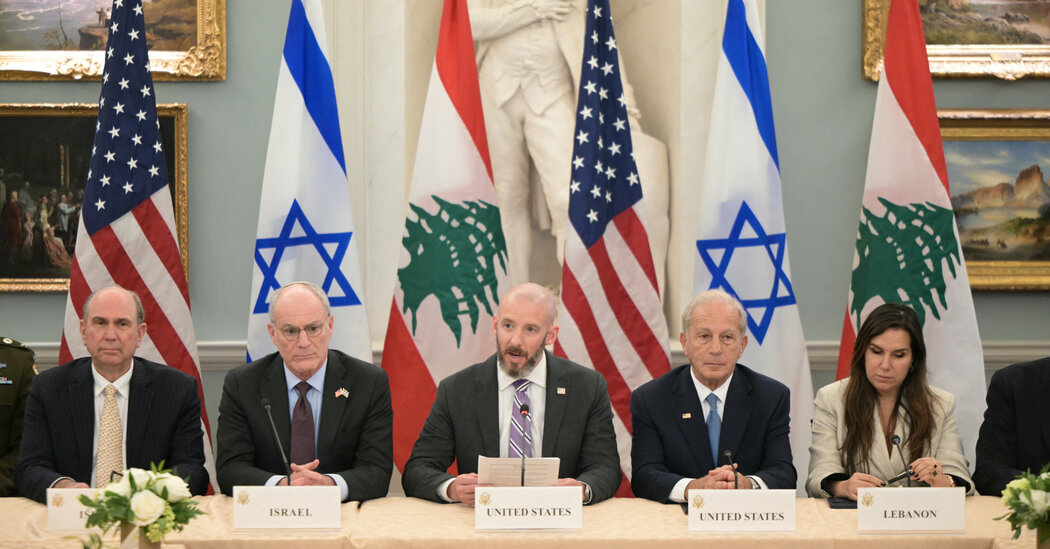
In a diplomatic gambit that highlights both the desperate quest for stability in the Levant and the agonizing volatility of Middle Eastern geopolitics, Israel and Lebanon have formally announced a renewal of their fragile cease-fire, signaling a concerted, United States-backed push toward a “comprehensive” settlement. The joint statement, brokered in the quiet corridors of Washington on Tuesday and Wednesday, arrives as a rare beacon of hope for a region scarred by months of unrelenting violence, yet it remains shadowed by a fundamental paradox that has long paralyzed peacemaking in the region: the looming presence of Hezbollah. Because the heavily armed, Iran-backed militant group operates as a state within a state, completely divorced from the administrative control of the Lebanese government in Beirut, it was not a direct party to these high-stakes negotiations, nor does it acknowledge the legitimacy of direct diplomatic engagement with the Israeli state. Consequently, this newly minted accord—which the U.S. State Department has eagerly championed as a potential breakthrough to unclog stalled diplomatic channels between Washington and Tehran—is tethered to the compliance of an armed faction whose strategic calculus is dictated not by the sovereign cabinet of Lebanon, but by its own ideological imperatives and its patrons in Iran. As diplomats toast the deal in Western capitals, the stark reality on the ground remains unchanged: the viability of this peace rests entirely upon the willingness of a non-state actor to yield the battleground it has spent decades fortifying, turning what should be a sovereign-to-sovereign pact into a complex, multi-layered architectural puzzle where a single miscalculation could collapse the entire structure back into open warfare.
The Litani Litmus Test: Challenging the Shadow of Substate Militancy
At the absolute core of the joint agreement lies an ambitious security blueprint centered on the volatile South Litani Sector—a rugged, fiercely contested swath of southern Lebanon extending from the Litani River to the highly fortified Blue Line border with Israel. According to the official protocol released by negotiating teams, this cease-fire is strictly contingent upon a dual mandate: the absolute cessation of all hostile fire by Hezbollah and the total, verifiable evacuation of the group’s military operatives, rocket stockpiles, and underground infrastructure from this sensitive border zone. In an effort to restore state sovereignty, the agreement outlines the phased creation of “pilot zones” where the underfunded and historically constrained Lebanese Armed Forces (LAF) are slated to “take exclusive control,” effectively shutting out all “nonstate actors” from carrying out military activities near the Israeli border. This represents a monumental logistical and political challenge for Lebanon’s central government, which has long struggled to assert its monopoly on physical force against a militant faction that possesses an arsenal of precision-guided missiles, battle-hardened infantry, and deep social roots in the southern villages. Hezbollah’s formidable leader, Naim Qassem, recently sought to navigate this delicate political terrain in a nationally televised address, signaling a willingness to accept a broader U.S.-led truce that brings relief to a battered Lebanon, yet fiercely rejecting any notions of direct Lebanese capitulation or bilateral normalization with Israel. By committing the Lebanese state to enhance the capacity of its armed forces with robust American logistical and financial support, the agreement attempts to rebuild a shattered security architecture, but observers recognize that transforming the LAF into a force capable of policing—much less disarming—Hezbollah remains an incredibly steep hill to climb.
Echoes of a Shadow War: The Intertwined Destinies of Beirut, Tehran, and Washington
To understand the profound skepticism surrounding this diplomatic breakthrough, one must trace the circuitous, blood-drenched trajectory of the conflict back to its explosive escalation in the early spring, when the cross-border clashes transformed from a contained border skirmish into a full-scale regional conflagration. On March 1, just twenty-four hours after a series of devastating joint U.S.-Israeli airstrikes targeted strategic military installations inside Iran, Hezbollah unleashed a massive barrage of rocket fire across the northern border of Israel, declaring its hand in support of its patrons in Tehran. The Israeli response was swift, overwhelming, and structurally transformative, moving beyond selective border retaliations to launch a devastating aerial campaign hitting Hezbollah positions in the southern suburbs of Beirut, the Beqaa Valley, and deep into the Lebanese heartland, accompanied by a high-stakes ground incursions by Israeli troops into southern Lebanese territory. This intense escalation immediately ran parallel to, and severely complicated, the separate, ultra-sensitive diplomatic negotiations occurring between the United States and Iran aimed at de-escalating their regional cold war. Iranian officials have consistently maintained that any grand bargain with the West must include a comprehensive security guarantee for Lebanon, effectively using the violence along the Blue Line as a lever of geopolitical leverage. This integration of local skirmishes into the grand theater of global diplomacy has created a highly volatile atmosphere where local commanders on both sides of the border find their actions bound to the shifting dynamics of backchannel talks in neutral European capitals, proving once again that true peace in Beirut cannot be decoupled from the strategic alignment of Washington and Tehran.
Domestic Fires and Political Brinkmanship: Netanyahu’s High-Stakes Balancing Act
While foreign diplomats analyze the strategic map of the Middle East, the immediate survival of the cease-fire is equally dependent on the volatile domestic politics of Israel, where Prime Minister Benjamin Netanyahu is currently navigating an intensely polarized political arena. Facing severe pressure from hawkish elements within his own governing coalition and a public weary of northern communities being displaced by drone attacks, Netanyahu has consistently projected an uncompromising stance, declaring on social media that Israel remains in a state of unyielding war to dismantle Hezbollah’s military architecture. This hawkish posture has been fueled by a series of sophisticated, highly publicized drone strikes launched by Hezbollah, which have targeted Israeli military field commanders and strategic assets, with the militant group actively posting high-resolution footage of these successful strikes on social media to damage Israeli morale. The internal political friction reached a fever pitch earlier this week when Netanyahu threatened to launch a devastating bombing campaign targeting the administrative and financial centers of Beirut—a threat he dialed back only after Iran warned it would scrap all ongoing diplomatic engagements with the United States, prompting President Donald Trump to intervene and announce that the Lebanese cease-fire remained viable. Adding to Netanyahu’s political calculations is the vocal opposition of Israel’s far-right National Security Minister, Itamar Ben-Gvir, who publicly urged the Prime Minister to reject any diplomatic compromise, advocating instead for an unrestricted military campaign to permanently crush Hezbollah. This internal push-and-pull illustrates the immense political risks Netanyahu faces, as he must balance the absolute security demands of his domestic constituency with the high-level diplomatic coordinates laid out by Washington, all while knowing that any perceived weakness could fracture his coalition government.
The Human Ledger: Counting the Devastating Cost of a Silent War
Behind the dry jargon of bureaucratic communiqués, joint statements, and geo-strategic maneuvers lies a profound humanitarian crisis that has exacted a catastrophic toll on civilian populations on both sides of the internationally recognized border. Official figures paint a grim picture of the conflict’s human cost, with more than 3,200 Lebanese citizens killed—including hundreds of women and children caught in the crossfire of heavy urban bombardments—and at least 30 Israelis dead as a result of direct rocket fire, anti-tank missiles, and weaponized drone incursions. The physical devastation in southern Lebanon is immense, with entire border villages reduced to concrete rubble, vital agricultural fields contaminated by munitions, and critical infrastructure systematically targeted, forcing hundreds of thousands of civilians to flee north to seek shelter in overcrowded public spaces in Beirut. Similarly, in northern Israel, once-thriving agricultural communities and scenic towns have been transformed into eerie, evacuated ghost towns, as tens of thousands of displaced Israeli residents remain unable to return to their homes under the constant threat of incoming rockets. This widespread displacement has created a deep reservoir of trauma and mutual resentment, making the task of building cross-border trust incredibly difficult for the diplomats tasked with implementing the cease-fire. For these displaced families, the high-level talks in Washington offer little immediate comfort; they understand all too well that previous U.S.-brokered cease-fires, such as the one implemented with great fanfare in April, quickly dissolved into a cycle of reactive violence, leaving them skeptical that this latest diplomatic push will yield a genuine, lasting peace that allows them to rebuild their shattered lives.
Sovereignty Reclaimed or Sovereignty Postponed? The Long Road to June 22 and Beyond
As representatives from Israel, Lebanon, and the United States prepare to reconvene on June 22 to finalize the logistical details of this security framework, the central question hangs over the region: can sovereign diplomacy truly triumph over decades of entrenched militia rule? The joint statement issued on Wednesday made a point of asserting that “the future of the relationship between Israel and Lebanon must be decided by the two sovereign governments,” explicitly rejecting any attempts by external states or armed proxy factions to hold the collective future of the Lebanese people hostage. By securing a commitment from Beirut to enhance the deployment, operational capacity, and territorial reach of the Lebanese Armed Forces, the international community is betting on a traditional state-centric model of security to neutralize a non-state actor that has spent nearly forty years embedding itself into the social, political, and military fabric of the country. For this optimistic vision to succeed, the upcoming June negotiations must establish concrete mechanisms for the dismantlement of non-state military assets and create a reliable system of international observation that does not rely solely on the consent of those it seeks to police. While both nations have explicitly reaffirmed that they harbor no long-term hostile intentions toward one another, the path from a highly fragile, U.S.-brokered truce to a stable, legally binding comprehensive peace agreement is fraught with political obstacles, historical grievances, and regional proxy calculations. The world will watch closely as the mid-summer deadline approaches, knowing that this diplomatic initiative represents a high-stakes test of whether sovereign states can reclaim their borders, or if the destructive cycle of regional proxy warfare will continue to dictate the terms of survival in the Levant.