






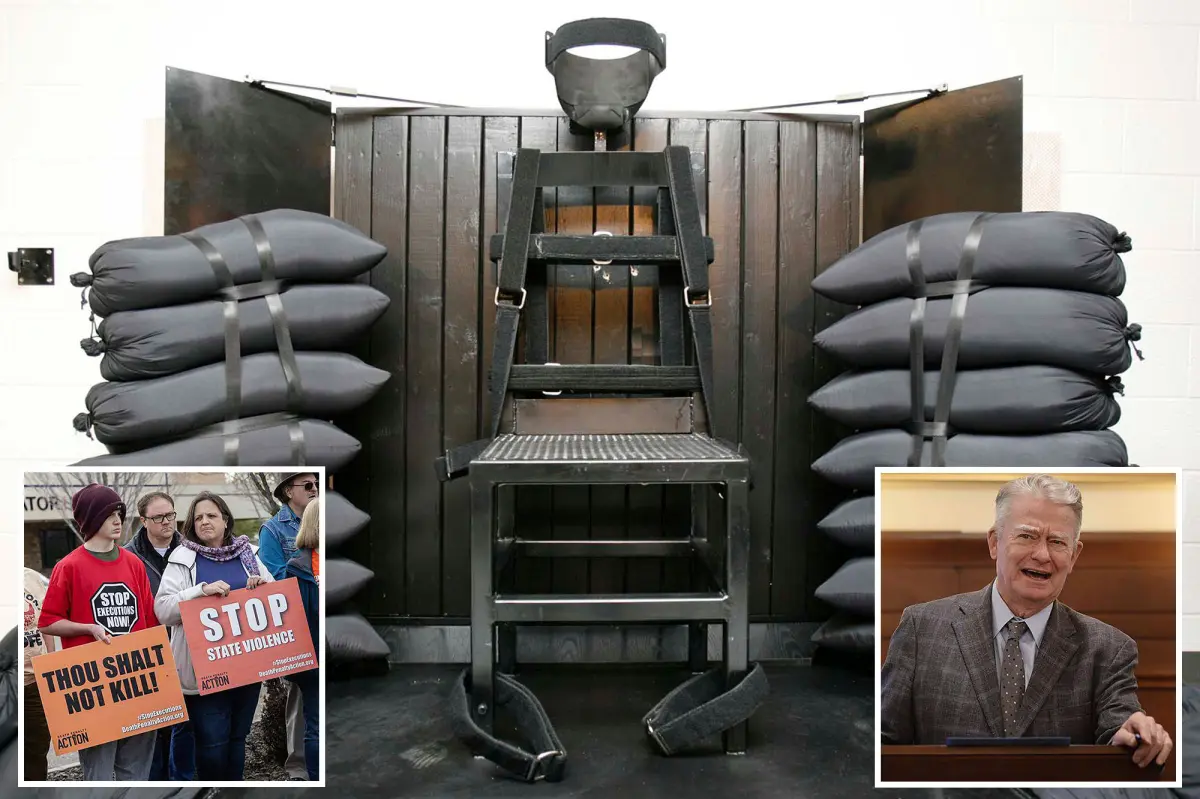
Deep within the concrete and steel perimeter of the Idaho Maximum Security Institution, located on a barren stretch of land fifteen miles south of Boise, eight human beings are quietly living out their final days under the shadow of a profound and unsettling shift in state policy. This stark facility, which houses some of Idaho’s most notorious inmates—including the condemned Chad Daybell, his co-conspirator Lori Vallow Daybell, and the high-profile murder suspect Bryan Kohberger—is now home to a newly constructed, state-of-the-art facility designed for a singularly grim purpose. While some inmates like Vallow Daybell and Kohberger have managed to avoid the ultimate punishment, serving out consecutive life sentences in the quiet, monotonous rhythm of maximum security, seven men and one woman currently sit on death row. For these individuals, the nature of their impending deaths has suddenly evolved from the sterile abstraction of lethal injection to the ancient, visceral violence of the firing squad. The psychological weight of this transition is immense; these condemned individuals are no longer visualizing a quiet sleep brought on by a chemical cocktail, but are instead forced to contemplate the physical reality of high-velocity bullets tearing through their flesh. This policy shift brings a heavy, atmospheric dread to the institution, transforming the abstract concept of state justice into a hyper-focused, mechanical reality that hangs over both the inmates waiting to die and the correctional staff tasked with keeping them alive until their appointed hour.
To fully understand the human experience of this new protocol, one must look at the meticulously mapped-out ritual designed for the final hours of the condemned. For these eight individuals, the journey toward death begins not in a flurry of chaos, but in a quiet, heavily medicated haze designed to blunt the sharpest edges of mortal terror. Recognizing the extreme psychological panic of what is to come, prison officials will offer the inmate a heavy sedative the day before the execution, followed by another dose just hours before they are led into the brand-new, $1.2 million custom-built execution chamber. Once inside this sterile, windowless room, the inmate is strapped securely into a specially engineered metal chair designed to arrest any muscle spasms or movement during the gunfire. Medical personnel, wearing their own masks of clinical detachment, will attach cardiac-monitoring sensors directly to the inmate’s skin, followed by the placement of a stark, canvas target pinned precisely over their beating heart. The prison director will then step forward to read the death warrant—a final, formal recitation of the state’s legal right to end their life. In those final fleeting moments, as the room grows quiet, the prisoner is given a brief opportunity to speak their final words to the witnesses gathered behind heavy glass, and if they choose, they can request an eye covering, sparing them the sight of the protective wall just ten yards away, behind which their executioners stand ready.
But the heavy burden of this new execution chamber does not fall solely on the shoulders of those slated to die; it also rests heavily on the select group of law enforcement officers who must volunteer to carry out the deed. Under newly released state blueprints, Idaho is actively seeking six volunteer officers to form this elite and highly secretive firing squad, a task that demands not only flawless marksman skills but a disturbing level of psychological division. To even be considered for this volunteer duty, an officer must possess at least three years of active Peace Officer Standards and Training certification and a virtually flawless record with a rifle. They must undergo rigorous, repetitive qualification training where they are required to hit a heart-sized target with absolute precision over and over again, leaving no room for human error or hesitation. To maintain their readiness, these volunteers are subjected to frequent live-fire rehearsals and dry-runs, turning the act of ending a human life into a practiced, mechanical reaction. Any officer who has a history of excessive force, firearm misconduct, or any personal connection to the inmate, the victims, or the families involved is strictly disqualified, ensuring that the squad is composed of clinical, objective shooters who will remain entirely anonymous under state law. Yet, despite the clinical training and legal anonymity, these officers are human beings who will eventually go home after the trigger is pulled, carrying the psychological phantom of a life they personally ended.
The state’s preparation for these executions has been characterized by a chilling level of financial investment and technological precision, elevating the act of capital punishment into an efficient, industrial operation. Idaho did not simply purchase basic equipment; the state spent nearly $25,000 on five state-of-the-art Daniel Defense DD5-P battle rifles, complete with highly specialized scopes, suppressors, and bipods designed to maximize accuracy and minimize physical recoil. These heavy-duty weapons are optimized to fire .308-caliber bullets—a devastatingly powerful military round designed to cause instantaneous, catastrophic trauma to the human body. The procedural math of the execution is terrifyingly calculated: three primary officers, standing safely behind a protective wall with a narrow, foot-wide opening, will simultaneously aim their rifles at the canvas target on the inmate’s chest from a distance of exactly ten yards. At the direction of the squad leader, who is responsible for loading the weapons and choreographing the sequence, they will pull their triggers at the exact same moment. Meanwhile, two alternate shooters stand poised in the background, weapons ready, acting as a failsafe; if the cardiac monitor indicates that the inmate’s heart continues to beat after two agonizing minutes of observation, these alternate marksmen will unleash a second devastating volley of gunfire to ensure the job is done.
The road to this highly mechanical, violent return of the firing squad was paved by a profound, agonizing medical failure that shocked public sensibilities and laid bare the limitations of modern execution practices. In February 2024, the state tried to execute Thomas Eugene Creech, a 75-year-old serial killer who has spent nearly half a century on Idaho’s death row after admitting to his involvement in the deaths of up to 26 people across various states. For nearly an hour, executioners and medical staff poked, prodded, and repeatedly punctured Creech’s skin in a desperate, increasingly chaotic attempt to establish a viable intravenous line for lethal injection. As the elderly killer lay strapped to the gurney, the execution team failed over and over again, eventually forcing the department to abandon the execution altogether amidst a storm of legal and ethical controversy. It was this gruesome, botched ordeal that prompted Republican Governor Brad Little to sign the firing squad legislation into law, codifying this dramatic policy shift as a necessary alternative when lethal drugs cannot be secured or administered. Legally active since July 1, the new policy represents a stark admission by the state that when modern clinical science fails, they must look backward to older, more violent, yet physically reliable methods of ending human life.
As these eight death row inmates await their dates with the new firing squad chamber, Idaho finds itself at the center of a fierce national debate over the ethics, humanity, and morality of capital punishment. Robin Maher, the executive director of the Death Penalty Information Center, has strongly criticized the new measures, arguing that the firing squad is a regressive, deeply flawed method of execution that is masquerading as a modern solution. She points out that every new execution method introduced throughout human history has been accompanied by a deceptive promise of being more humane, peaceful, and foolproof than the last, and yet history has proven that these promises of a gentle state-sanctioned death are invariably broken. On the other side of this moral divide stands the leadership of the Idaho Department of Corrections, represented by Director Bree Derrick, who insists that her department will carry out these executions with absolute professionalism, respect, and a strict dedication to the law. As the debate rages on, the $1.2 million chamber stands quiet and ready, a sterile monument to a society still struggling to find a balance between a desire for justice, the harsh reality of vengeance, and the fragile preservation of human dignity under the eyes of the law.