






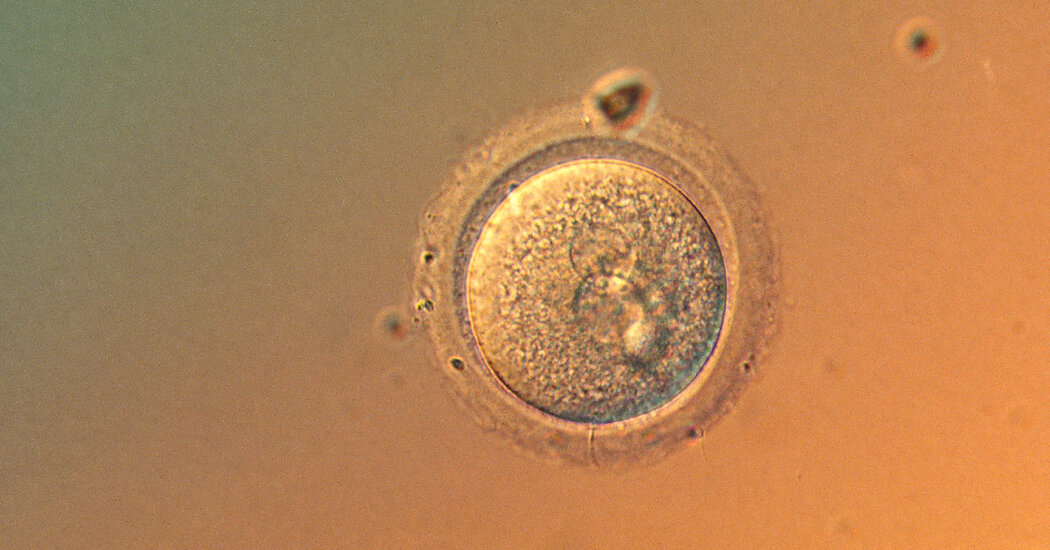
In the quiet, climate-controlled laboratories of Columbia University, a team of researchers has quietly stepped across one of the most profound and intimidating thresholds in human history. Under the direction of geneticist Dieter Egli, these scientists have successfully edited the DNA of early-stage human embryos with an accuracy that was, until recently, entirely unimaginable. The breakthrough represents an extraordinary leap forward in medicine, offering a tantalizing future in which parents could theoretically spare their unborn children from carrying devastating, life-altering hereditary illnesses. Imagine a world where a child destined to inherit a fatal heart condition or a degenerative blindness mutation is cured before their first cellular division. Yet, this incredible scientific marvel does not arrive in a vacuum of pure celebration; instead, it immediately plunges humanity into an intense, deeply uncomfortable ethical storm. For years, the prospect of altering human germline DNA—which affects not only the child but every generation that follows them—has fueled bitter controversies. While the initial hope of this technology is to heal, there is an evergreen, chilling fear that it could soon be co-opted to design children based on desired physical or cognitive traits, a concept that critics warn is a modernized, high-tech iteration of eugenics. Recognizing the immense gravity of what his lab has accomplished, Dr. Egli has not claimed victory, but has instead issued an earnest plea for an open, global discussion on the boundaries of genetic engineering. He quietly emphasizes that his role as a scientist is merely to unlock the technical door and present the data, leaving it to the rest of humanity—parents, ethicists, and society—to decide whether we should ever turn the handle and walk through.
To fully understand the weight of this milestone, we must look back at the dramatic and often turbulent decade that brought us to this point, a history marked by both breathtaking ingenuity and reckless ambition. The modern era of genetic engineering truly began in 2012 with the discovery of CRISPR-Cas9, a molecular tool modeled after bacterial defense mechanisms that essentially functioned as genetic scissors. CRISPR democratized genetic science, giving researchers a cheap, fast, and remarkably easy way to slice through DNA to understand gene functions and seek cures for chronic diseases, such as sickle cell anemia. However, these molecular scissors were notoriously rough; they frequently missed their targets or severed the double-stranded DNA so violently that the cell’s natural repair mechanisms panicked, resulting in unintended mutations. Despite these glaring safety issues, the scientific world was shocked in 2018 when a Chinese scientist named He Jiankui bypassed all international ethical consensus to create the world’s first genetically modified babies, claiming to have immunized them against HIV. The global backlash was swift, severe, and filled with moral outrage, ultimately resulting in a three-year prison sentence for Dr. He, whose unverified claims of producing “healthy, beautiful babies” left a dark cloud over the scientific community. Determined to rigorously evaluate how CRISPR behaves in human embryos, Dr. Egli and his colleagues performed an experiment in 2020 on eggs fertilized with sperm carrying a mutation for hereditary blindness. The results were nothing short of catastrophic: instead of cleanly fixing the mutation, CRISPR caused about half of the tested embryos to undergo massive, destructive DNA deletions, in some cases completely destroying the entire chromosome where the target gene resided, a terrifying outcome that proved to most observers that embryo editing was far too dangerous to ever attempt in clinical medicine.
The turning point that rescued this field of research from a permanent ethical and safety impasse occurred in 2016, when Harvard University geneticist David Liu and his colleagues introduced a dramatically softer touch through an innovation known as “base editing.” Unlike CRISPR’s heavy-handed scissors, which break the double helix entirely, base editors function much like a delicate pencil eraser and ink pen, making a tiny, single-stranded nick in the DNA and chemically converting a single molecular letter into another to correct a mutation. Intrigued by this precise chemical surgery, Dr. Egli and his Columbia team decided to test base editing on human embryos, targeting two crucial genes: PCSK9, which can cause dangerously high cholesterol levels and early heart disease, and HBG, which governs fetal hemoglobin production. When they delivered these base editors into fertilized eggs and two-cell embryos, the results were a revelation: the widespread, devastating chromosomal damage that had defined their previous CRISPR trials was completely absent, and they successfully corrected both targeted genes, sometimes simultaneously. Yet, even in this resounding success, the natural messiness of biology revealed a persistent, maddening hurdle known as genetic mosaicism. Sometimes, the editing molecules failed to modify every cell in the developing embryo, leaving behind a patchwork where some cells carried the healthy, corrected gene while others retained the original mutation. Had these embryos been allowed to develop into living children, this mosaicism could have caused unpredictable, potentially serious health complications, serving as a stark reminder that while base editing represents a monumentally safer pathway, the technology is still far from being clinically perfect. It demonstrates that even the most advanced molecular tools must contend with the chaotic, rapid divisions of early cellular life.
As laboratories continue to refine these molecular tools, the direct involvement of private capital is shifting the conversation from clinical safety to commercial urgency, intensifying public anxiety about a future of designer children. Dr. Egli’s next phase of research is being funded and supported by Nucleus Genomics, a fast-growing, private biotechnology company founded in 2021 with the mission of screening IVF embryos for thousands of genetic disorders. Nucleus Genomics sparked intense public controversy when it launched a provocative advertising campaign on the New York City subway system, urging passing commuters to “have your best baby.” The firm goes beyond traditional embryo screening by attempting to project polygenic risk scores for complex adult diseases like diabetes or heart disease, while also analyzing genetic markers linked to highly controversial traits such as height and intellectual capacity. While many prominent geneticists have dismissed these trait and IQ predictions as highly inaccurate and scientifically misleading, the company envisions a future where base editing acts as the ultimate tool to construct a complete, commercialized “Genetic Optimization” stack. This fusion of market-driven advertising, private funding, and gene-editing research raises the unsettling prospect of a consumer-driven form of eugenics. If wealthy parents are eventually given the tools to purchase biological upgrades, we risk establishing a deeply unfair societal divide where genetic advantages are bought and sold, transforming the sacred, unpredictable mystery of human reproduction into a high-end corporate transaction. When questioned about this potential drift, company representatives defended their mission as a natural, compassionate path toward integration of cutting-edge tech into routine clinical care. Yet, critics argue that referring to human lives as a software “stack” to be optimized diminishes the core value of human diversity and reduces the fragile, beautiful complexity of human life into a mere set of product specifications to be customized at will.
This commercial momentum has catalyzed fierce resistance among leading figures in the bioethical and scientific communities, who challenge the fundamental necessity of editing embryos when safer, time-tested alternatives already exist. Dr. Fyodor Urnov, a renowned geneticist at the University of California, Berkeley, points out that families carrying heritable diseases have safely and successfully utilized pre-implantation genetic diagnosis during IVF for over forty years, allowing them to select healthy embryos without ever rewriting the human genome. Dr. Urnov raises a critical question: why should we abandon a proven process that has safely resulted in fifteen million healthy births since 1978 to chase a highly complex, unpredictable technique that can never be fully de-risked? Bioethicists like Ana Iltis also warn that many of the unintended harmful side effects of base editing might not manifest until years, or even decades, after a child is born, making long-term safety impossible to guarantee before clinical trials begin. There is a deep-seated fear that once these molecular tools are perfected, their application will inevitably drift from curing devastating pediatric illnesses to satisfying the demands of “baby improvers” seeking cosmetic, athletic, or cognitive enhancements. By publishing these highly detailed scientific protocols, researchers may be unintentionally creating a step-by-step instruction manual for crossing ethical boundaries that have united humanity for generations, forcing us to ask whether some genetic thresholds are meant to remain untouched. The worry is that the transition from therapeutic medicine to enhancement will be so gradual and seamless that humanity will only realize it has crossed the point of no return when it is already too late. Once we begin editing out traits we deem undesirable, we risk creating a monoculture of perfection, losing the essential, irregular traits that define our vulnerability and our humanity.
Ultimately, both the glittering promises of genetic optimization and the dystopian anxieties of class-based eugenics must reckon with the humbling, infinite complexity of human biology. The vast majority of complex human traits, including intelligence, creativity, and personality, are not governed by a single genetic master-switch that can be quickly toggled on or off with a base editor; instead, they are shaped by the shifting, delicate interplay of thousands of different genes working in concert with a person’s life experiences, environment, and upbringing. Dr. Egli himself acknowledges these strict biological limitations, noting that as scientists attempt to rewrite multiple genes simultaneously in a single embryo, the mathematical probability of catastrophic errors and unintended mutations increases exponentially. It means that the sci-fi fantasy of engineering a biologically superior, customized super-baby remains, for now, far beyond our scientific grasp. As the research continues to unfold, seeking to tackle the stubborn hurdle of mosaicism and navigate the intense crucible of peer review, the scientific community is left standing at a monumental crossroads. This debate is not simply about modifying base pairs of DNA under a microscope; it is a profound reflection of what we value as a society. Humanizing this technology requires us to remember that our genetic imperfections are not bugs to be edited out of a software stack, but a natural, beautiful part of the shared human condition, and we must proceed with a collective wisdom that prioritizes unconditional love and acceptance over a manufactured perfection. The path forward demands that we step back from the dizzying speed of laboratory breakthroughs and look closely at the kind of society we are constructing. If we are to write the future code of human life, we must do so with humility, empathy, and a deep respect for the natural diversity that has sustained our species for millennia. As Dr. Egli of Columbia suggests, the final decision does not belong to the scientists behind the microscopes, but to all of us, choosing together whether we will use our new powers to heal our brokenness or to fundamentally alter what it means to be human.