


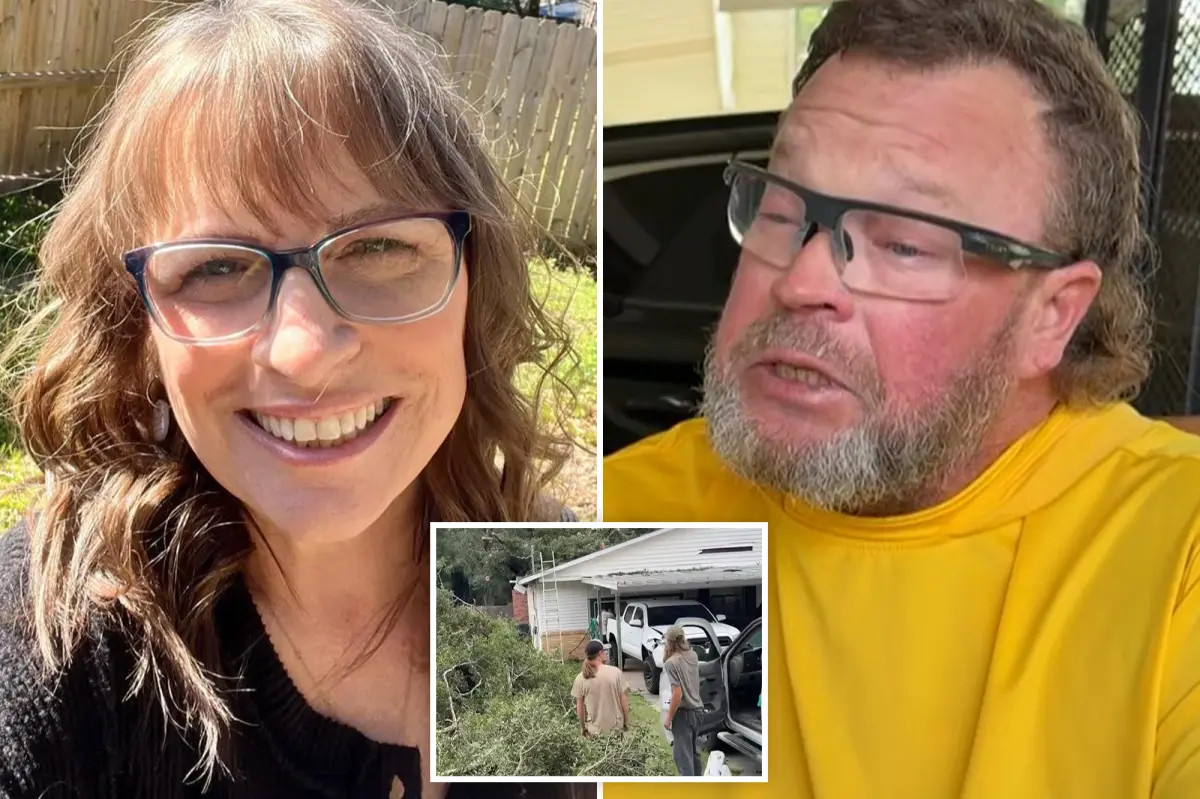
Hurricane Isaias came to Florida not as a sudden, dramatic explosion but as a long, grinding assault of wind and rain. It was the kind of storm that makes people stay indoors, but also the kind that makes them restless, peeking through windows, stepping onto porches to check the sky. Jenn Biggs Williams and her husband Joey were like any couple who had weathered storms before. They had been married for ten years, long enough to know each other’s rhythms, to finish each other’s sentences, to find comfort in standing side by side when the world outside turned hostile. Jenn, 57, worked in human resources, a job that required patience, empathy, and a certain backbone — qualities that also defined her personality. A human resources worker by profession, she was the person friends called for advice and colleagues counted on to fight for them. As the storm battered their Florida home over the weekend, they decided to step outside and survey the damage. It was a practical thing to do, a way to assess what the wind had thrown into their yard, to make sure the roof was still intact, to feel the rain on their faces and remind themselves that this, too, would pass. But the storm had other plans. When they went back inside, a massive tree — weakened by hours of relentless wind, its roots torn loose from the soaked earth — came crashing down. It struck their living room with a sound like the end of the world. In that instant, the ordinary sanctuary of home became a trap of timber and debris. Joey somehow managed to squeeze his body out from under the wreckage. Jenn could not. The tree had fallen on her, and the weight of it was absolute. The storm, which had been a distant threat on the news, had become a personal, devastating reality.
Joey’s escape was a matter of inches and luck, but it left him alone in the chaos. He later described squeezing out from under the fallen tree, leaving his wife trapped behind him, her life hanging in the balance. Outside, the storm was still raging, with winds near 100 miles per hour whipping his property into a blur of rain, leaves, and flying debris. He ran to a neighbor’s house, his heart pounding, his voice raw and desperate. “I’m like, ‘My wife’s trapped under the tree. Please, please,’” he recalled. But there was nothing anyone could do. The tree was too large, the winds too fierce, and the darkness too complete for a desperate handful of neighbors to move the impossible weight. They could only wait, helpless, while the storm roared around them. Someone probably grabbed a flashlight, someone else called 911, but every attempt to approach the house was met with the screaming wind. The moments stretched into an eternity. Joey stood outside in the rain, drenched and shaking, knowing that his wife was only a few feet away beneath a fallen tree, and that he could not reach her. It is a feeling that no one should ever have to know: the guilt of surviving, the terror of uncertainty, and the awful realization that the forces of nature are utterly indifferent to human love. All he could do was wait for emergency responders to arrive, to cut through the tangle of branches and timber, and to hope against hope that somehow, against all odds, Jenn had survived. But even as he waited, the storm seemed to mock him, howling through the broken spaces of his home, as if reminding him that some battles cannot be won.
When rescue crews finally arrived, they worked quickly but carefully, sawing through the tree and lifting the debris piece by piece. By the time they pulled Jenn free, she was already gone. Joey later said that his only consolation was that her death had been pretty instant. There was no prolonged suffering, no chance for fear to take hold, no long struggle for breath. But that comfort was cold. The responders let Joey say goodbye. He knelt beside her, spoke to her, touched her face, tried to memorize the details of a woman he had loved for a decade. Then they placed her in a coroner’s van and drove away. “I watched the love of my life for 10 years go into the back of a coroner’s van and head down that road,” he said. “That’s the hardest thing I ever swallowed in my life.” The image is devastating: a man standing in the aftermath of a storm, soaked and exhausted, watching the only person who made the world make sense disappear down a rain-slick road. There is no way to prepare for that moment. No amount of shared memories can soften the sound of a van door closing. Joey was left standing in the ruins of his home and his life, with nothing but grief and the faint, terrible hope that his wife had not suffered. He had to begin the process of telling family, of making arrangements, of learning to live in a world without her.
Those who knew Jenn were not surprised by the way Joey described her: “the ultra-nice badass person.” She was, by all accounts, the kind of woman who could be both fierce and gentle, who commanded a room with her warmth and stood up for what she believed in without ever losing her kindness. At work, her colleagues adored her; in her marriage, she was Joey’s world. The nickname is telling. “Ultra-nice” suggests someone who was unfailingly kind, generous with her time, quick to smile and slow to judge. “Badass” suggests someone who was strong, resilient, unafraid to speak her mind or get her hands dirty. Together, those qualities made her irreplaceable. “Everybody loved her, right? Even her co-workers. She was the ultra-nice badass person,” Joey said. His grief is not just about the loss of a spouse; it is about the loss of a particular, singular presence that no one else could replicate. In the days since her death, he has found himself doing things that make the loss feel even more acute. He has called her phone five times, just to hear her voice, to tell her that she was his world. The phone rings, and rings, and no one answers. But he calls anyway. It is a way of holding on, a refusal to let her go completely. In those rings, she is still there, still connected to him, even if she cannot pick up. The voicemail, if it plays, might be the last trace of her voice he has left. “I just want to hear her voice,” he said. “I’ve called her phone five times just to tell her … she was my world.”
Jenn was the first known fatality of Hurricane Isaias, a storm that will be remembered by many for its winds and rain, but by Joey for an entirely different reason. The storm, which tore through the Bahamas and then raked the eastern seaboard, also claimed a second victim in Birmingham, Alabama, according to the Jefferson County Emergency Management Agency director. Two families, hundreds of miles apart, now share the same unbearable weight. Hurricanes are measured in categories and wind speeds, but their true toll is written in stories like these: a tree falling at the wrong moment, a husband calling his wife’s phone, a neighbor’s helpless hands. The storm moved on, as storms do. It weakened, spun out to sea, and eventually became a memory on weather maps. But for Joey, the storm will never pass. It is frozen in the sound of a tree breaking, in the image of his wife’s face, in the silence of a house that used to be full of her voice. The community around him has rallied, offering help and condolences, but grief is a solitary road. He will have to walk it one day at a time, surrounded by people who love him but cannot fix this. The world will continue to turn, the sun will come out, and life will go on for everyone else. But for those who loved Jenn, the world has been permanently altered. The loss of someone like her leaves a hole that cannot be filled, a space at the dinner table, a name that no longer appears on the caller ID, a laugh that will never echo through the house again.
Perhaps the only thing that can be said in the face of such loss is that love is real, and it does not end when a body stops breathing. Joey’s words are a testament to that. “I just want to hear her voice,” he said, and anyone who has ever lost someone knows exactly what he means. The voice is the first thing we fall in love with, the last thing we hear before we sleep, the sound that says home. When it is gone, the silence is unbearable. But the love remains. It remains in the calls he makes to her phone, in the memories of her kindness and her strength, in the ten years of shared mornings and ordinary moments that no storm can take away. In time, Joey may find that the grief softens, not because he forgets her, but because she has become a part of him. He will carry her with him. He will tell her story. He will remember the “ultra-nice badass” woman who loved and was loved. And if there is any comfort, it is that her death was instant, that she did not suffer, and that her last moments were in her own home, beside the man she loved, even if she did not have time to say goodbye. The tree fell, and the world changed. But love, in its stubborn, human way, refuses to let go. Joey will keep calling. And somehow, in some way, she will keep answering.