





Restoring the Coral Triangle: How Innovative Concrete Lotus Reefs are Breathing New Life into Malaysia’s Marine Deserts
The Descent of Hope in the Western Pacific
                             _  _
                            ( `_` )
                            .-/  -.
                           /  _/_
                          /  /
                         /_     / _/
                        /   _  /_/
                        _/|  _()_  |_/
                               /  /
                              /  /
                             `----`
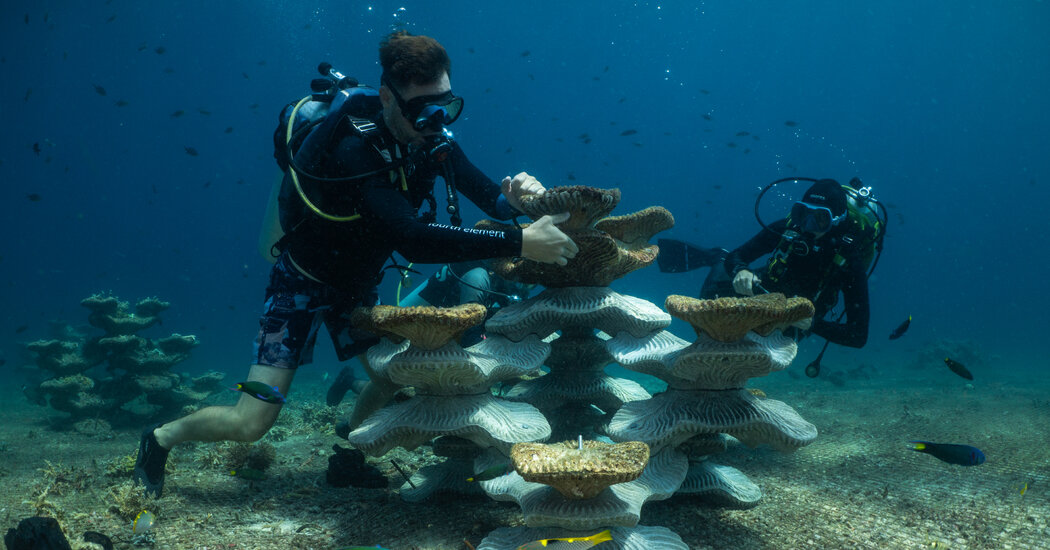
Under the blazing sun of the Western Pacific Ocean, a modest, flat-bottomed boat gently drifted away from the palm-fringed shoreline of a tiny, remote island, carrying a cargo that looked far more suited for a highway construction site than a delicate marine sanctuary. Stacked high on the deck were dozens of heavy, textured concrete blocks, each weighing precisely sixty pounds and molded with intricate, undulating ridges designed to mimic the elegant, organic geometry of a blooming white lotus leaf. As the vessel reached its destination just a few hundred yards offshore, the crew began hoisting the heavy blocks, tossing them one by one into the crystal-clear waters where they plunged through the surface, sending bursts of bubbles toward the sky. Waiting twenty feet below on the sandy seabed, a team of three commercial divers, equipped with heavy-duty steel rods, nuts, and pneumatic bolts, began the slow, meditative process of anchoring the segments together in a interlocking pattern. Almost instantly, as if sensing a monumental shift in their aquatic landscape, hundreds of vibrant, inquisitive blue damselfish emerged from the surrounding shadows to inspect the metallic clanking of the tools, while a trio of majestic green sea turtles glided in slow, lazy circles just above the divers’ heads. Within less than an hour, the underwater construction crew had secured the final bolt, completing a robust, three-foot-tall and ten-foot-wide artificial reef structure that stood as a brand-new sanctuary amidst a scarred, empty underwater world.
   ____________________________________________________
  |                                                    |
  |             THE CORAL TRIANGLE REGION              |
  |  Covering only 1.6% of the planet's oceanic area,  |
  |  yet harboring over 76% of all known coral species |
  |  and supporting more than 3,000 species of fish.   |
  |____________________________________________________|
The Devastating Legacy of Blast Fishing and the Rise of Coral Deserts
This deliberate underwater installation, which took place on a recent clear Thursday morning near the secluded shores of Pom Pom Island, Malaysia, represents a critical grassroots battlefront in the global campaign to save the Coral Triangle—a vast, marine expanse spanning Southeast Asia that represents the absolute apex of global marine biodiversity. Pom Pom Island, a low-lying ring of sand located in the celebs-facing waters off the northeastern coast of Malaysian Borneo, sits in a geographical sweet spot of marine wealth, yet its underwater paradise has been systematically hollowed out by decades of destructive fishing practices. For generations, local fishermen in Sabah have relied on homemade explosives—often concocted from cheap chemical fertilizers and kerosene packed into glass bottles—to execute a highly destructive harvesting method known as blast fishing or dynamite fishing. Despite being strictly illegal under Malaysian law for decades, this highly hazardous practice remains widespread among marginalized coastal communities who argue that conventional handlines and nets can no longer yield enough catch to secure their daily survival in an increasingly depleted ocean. The tragic, unintended consequence of this short-sighted extraction method is the absolute obliteration of the underlying marine architecture; a single blast instantly vaporizes centuries of slow-growing calcium carbonate structures, leaving behind vast, desolate barrens of shifting coral rubble. Robin Philippo, the visionary managing director of the Tropical Research and Conservation Centre (TRACC)—the non-profit organization leading this restoration crusade—grimly describes the current state of these damaged zones: “The seabed here is like an underwater desert, a flatland of lifeless debris where nothing can settle or grow, and this new concrete structure is the primary catalyst bringing biological complexity and vibrant life back to the void.”
       [ DYNAMITE EXPLOSION ]  ==>  [ SHATTERED REEF ]
                                           ||
                                           /
                                [ UNSTABLE RUBBLE FIELD ]
                                           ||  (No settlement possible)
                                           /
                                [ MARINE DESERT / BARREN ]
Engineering Rebirth: The Lotus-Like Micro-Reefs of TRACC
               __--==============--__
            .-'  .---.  .---.  .---.  '-.
           / .-.    /     /     / .-.
          | |   | |-'    '-'    '-| |   | |
          | |   | |   [LOTUS]   | |   | |
          |  '-'  / .-.  _   _  .-.   '-'  |
                / |   |/ _/ |   |      /
            '-_.'  |   |_/ _/|   |  '._-'
               `---'---'       '---'---`
To combat this widespread ecological collapse, TRACC has spent the past two years executing a systematic underwater re-engineering strategy around Pom Pom Island, deploying more than sixty of these custom-designed concrete modular structures at a total cost of roughly $5,000 per reef assembly. Each completed pyramid-style reef weighs approximately half a ton, a calculated weight that ensures the structures remain firmly anchored to the ocean floor during violent seasonal storms and shifting undertows. The innovative design of the individual concrete components is the result of a creative partnership with Reef Design Lab, a cutting-edge industrial design firm based in Melbourne, Australia, which fabricated the highly specialized reusable molds used by TRACC’s conservationists to cast the pieces on-site using locally sourced ingredients. The unique, heavily corrugated surface of these concrete lotus leaves is not merely an aesthetic choice; the rough, micro-textured exterior mimics the natural pre-existing substrate of coral colonies, providing tiny, free-floating coral larvae (planulae) with the perfect, stable anchorage point needed to biological calcify and thrive. Furthermore, the interior cavities and hollow gaps intentionally left between the interlocked concrete plates act as critical biological refuges, offering juvenile fish, invertebrates, and cryptic sea creatures a safe haven from larger pelagic predators that patrol the deep edges of the island’s drop-offs. This clever integration of structural stability and high surface-area complexity represents a masterclass in biomimicry, turning sterile, industrial-grade concrete into a welcoming underwater nursery designed to accelerate the natural ecological recovery process.
   ARTIFICIAL REEF ANATOMY:
   +--------------------------------------------------------+
   | [1] Corrugated Lotus Surface: Anchors drifting larvae  |
   | [2] Interlocking Steel Rods: Resists heavy storm surge |
   | [3] Hollow Internal Chambers: Safe nurseries for fry   |
   | [4] Local Sand/Concrete Mix: Minimizes transportation  |
   +--------------------------------------------------------+
Signs of Life: Early Ecological Success on Pom Pom Island
                  .      .     .      .
                .     _.-.-.     .
                 .  .'      '.  .     .
                   /  (o) (o)     .
                  |     __      |     .
                 .    /__    /  .
                .   '.______.'      .
                  .    /        .
The biological dividends of this innovative intervention have manifested with astonishing speed, surprising even the most seasoned marine biologists monitoring the waters around the tiny, one-mile-circumference island. Within a mere external window of eighteen months following the deployment of the initial concrete pilot structures, marine monitors recorded that over five hundred wild, naturally recruiting hard and soft coral colonies had successfully settled and begun secreting their own calcium carbonate shells across the concrete surfaces. A dedicated team of five resident marine scientists stationed on Pom Pom Island conducts rigorous weekly dive surveys to track the rapid transformation, documenting an exponential increase in both fish abundance and overall species richness in the immediate vicinity of the artificial blocks. Alvin Chelliah, the highly respected chief programs officer at Reef Check Malaysia, a prominent marine conservation non-profit, observed the profound behavioral shift with great optimism, stating, “Before these concrete structures were carefully lowered into place, this entire zone was nothing but flat, shifting coral rubble on the barren seabed where fish simply could not survive or hide, but now, we are seeing a massive homecoming of damsel fish, juvenile groupers, snapper, and brightly patterned butterfly fish utilizing the structures as their primary home base.” Dr. Scott Bryan, a distinguished earth scientist from the Queensland University of Technology who serves as an active technical adviser to the Pom Pom rehabilitation project, echoed these encouraging sentiments, noting, “My field observations show exceptional, rapid recruitment of a highly diverse suite of benthic organisms, including native oysters, encrusting sponges, and multiple genera of hard corals, indicating that the concrete material is highly biocompatible and represents an excellent substitute for natural reef substrates.”
[0 Months: Raw Concrete] -> [6 Months: Biofilm/Algae] -> [12 Months: Coralline Algae] -> [18 Months: 500+ Hard Corals]
Scientific Skepticism: Are Artificial Reefs a Silver Bullet?
                _..._
              .'     '.      _
             /    _       _( )_
            |    (o)    | (_   _)
                      /    (_)
              '._____.'
         =====================
         [ GLOBAL TEMPERATURE ] -> [ MASS BLEACHING EVENTS ]
Despite the undeniable localized success of the Pom Pom Island project, a growing chorus of prominent global marine scientists urges caution, warning that artificial reefs must not be misconstrued as a universal “silver bullet” for the profound, systemic crises facing the world’s oceans. Alvin Chelliah himself freely admits the inherent mechanical limitations of engineered reefs, pointing out that highly rigid concrete structures are inherently incapable of supporting critical, bio-eroding species—such as boring giant clams, sponge species, and specialized marine worms—which naturally drill into and shape biological calcium carbonate reefs to create organic complexity. Furthermore, the broader backdrop for this localized restoration work is increasingly grim; in recent years, Malaysia has permanently lost estimated twenty percent of its total living coral cover, a catastrophic decline driven primarily by escalating global greenhouse gas emissions that trigger prolonged marine heatwaves and devastating mass coral bleaching events. The ultimate stakes of this ecological collapse extend far beyond the borders of Southeast Asia; indeed, the British government recently issued an urgent diplomatic warning highlighting that the wholesale collapse of the primary reef systems across the Coral Triangle would drastically decimate global fish stocks, severely undermining food security, trade stability, and seafood supply chains as far away as Western Europe. Terry Hughes, an internationally renowned coral authority and professor emeritus at James Cook University in Australia, offers a blunt, sobering assessment of the limits of physical restoration: “We must be completely honest that a localized synthetic structure is a microscopic drop in a warming ocean, and pouring highly carbon-intensive, industrial concrete into the sea to save coral reefs is simply no substitute for the urgent, global mandate to rapidly reduce greenhouse gas emissions.”
| Feature of Reef | Natural Coral Reef Reefs | Modular Concrete Reefs (TRACC) |
|---|---|---|
| Primary Material | Biogenic Calcium Carbonate | Local Sand & Low-Carbon Concrete |
| Bio-Erosion Potential | High (Boring clams/worms can hollow) | Low (Too dense for boring organisms) |
| Average Cost | Centurial natural growth ($0) | ~$5,000 per half-ton assembly |
| Storm Resistance | High (Vulnerable if already bleached) | Extremely High (Heavy modular anchoring) |
| Species Diversity | Maximum potential | Mid-to-High (Serves as excellent nursery) |
Scaling the Solution: From Pom Pom to Tioman Island and Beyond
                         /
                        /
                       /       ____
                      /      _/
                     /  /
                    |  |   |   /     |
                    |  |   |  /      |
                       __/_/    __/
                      __________/
                    [ TIOMAN ISLAND ]
          Targeted for high-energy wave testing
               and monsoon-proof scalability
In response to the critical environmental debate surrounding the carbon footprint of concrete-based marine interventions, Dr. Scott Bryan points out that TRACC has developed an environmentally conscious production methodology, utilizing clean sand harvested directly from the island’s dynamic coastal deposits to cast the blocks, which dramatically curtails transportation-related emissions and ensures a remarkably low net carbon footprint for the manufacturing process. Armed with a newly secured $100,000 development grant from the Coral Research and Development Accelerator Platform (an international non-profit research agency based in Saudi Arabia), TRACC’s dedicated conservation team is now moving forward with an ambitious expansion plan to construct and submerge another hundred lotus-leaf reef units directly around Pom Pom Island’s protected marine zone. Looking to the immediate horizon, the organization is also preparing to transport this modular concrete technology to the turbulent, high-energy waters of Tioman Island—a highly popular tourism hotspot situated off the eastern coast of Peninsular Malaysia that is repeatedly battered by destructive, seasonal monsoon storms. Initiating a pilot project in this highly challenging environment will serve as the ultimate proving ground for the concrete structures, demonstrating whether their unique modular geometry can withstand severe underwater turbulence and prove that early local successes can be scaled up to restore damaged coastlines throughout the developing world. As Dr. Scott Bryan thoughtfully reflects on the long-term journey of marine conservation, he offers a message of determined, realistic optimism: “Though we are working on a very small, incremental geographical area at any given time, the physical reality is that these barren zones are actively changing, stabilizing, and improving—and in the grand fight for our oceans, every single patch of recovered reef represents a vital sanctuary of hope for the future.”