


You might not have heard of Flock Safety, but by now, Flock has probably heard of you. That is the uneasy reality at the heart of a fast-moving, bipartisan backlash against one of the most widespread surveillance systems in the country. Flock operates a vast network of automated license plate readers—roughly 120,000 cameras spread across 49 states, according to its own statistics—and those cameras generate an almost incomprehensible 20 billion images. They are mounted on utility poles, overpasses, shopping center entrances, and residential streets, silently logging every license plate that passes by. For years, this kind of technology expanded quietly, often sold to local police departments as a crime-fighting tool and funded by grants with little public debate. But the debate has now arrived with force, and it is coming from some of the most unexpected corners of American politics. Conservative populists, libertarian Republicans, progressive Democrats, and independent-minded senators all seem to agree on at least one thing: the era of unchecked automated surveillance needs to end. The question is no longer whether Flock cameras are troubling, but who gets to lead the charge against them—and what Congress can actually do before the next session begins. That jockeying has turned a niche technology story into a genuine political showdown, complete with legislation, hearings, and plenty of performative outrage in the final stretch before the November elections.
House Republicans are trying to make sure they own this issue when Congress returns. Speaker Mike Johnson traveled to Michigan this week and promised that the House would take up legislation targeting automated surveillance cameras during the lame-duck session, the wrenching post-election window when lawmakers file back to Washington before the new Congress is sworn in. “That bill will be processed in the lame duck right after the election, when everybody returns to town,” Johnson said, according to the Michigan Advance. The measure in question is sponsored by Representative Tim Burchett, a Tennessee Republican known for his plainspoken, anti-establishment style, and it would prohibit federal agencies from buying or accessing automated surveillance systems. Interestingly, Johnson attributed the bill to Representative Tom Barrett, a Michigan Republican and cosponsor who is locked in a tough reelection fight against William Lawrence, a former member of the Democratic Socialists of America. That was no accident. Barrett is exactly the kind of swing-district lawmaker who wants to show voters he is serious about reining in government surveillance, and Johnson’s mention of his name was a clear signal that this issue has political value. Meanwhile, Representative Thomas Massie, the libertarian-leaning Kentucky Republican who has frequently drawn President Trump’s ire, introduced his own separate proposal. Massie’s bill would go even further: it would prohibit federal funds from being used for covered camera systems and would give federal agencies 180 days to dismantle any they already have in place. The fact that Republicans are moving forward on this issue, rather than defending law enforcement’s access to cutting-edge surveillance, tells you how much the political winds have shifted. There is a growing, uncomfortable recognition among lawmakers on both sides of the aisle that the same technology they once supported as a tool for catching criminals can just as easily be turned on ordinary citizens, tracking their movements, associations, and daily routines without a warrant.
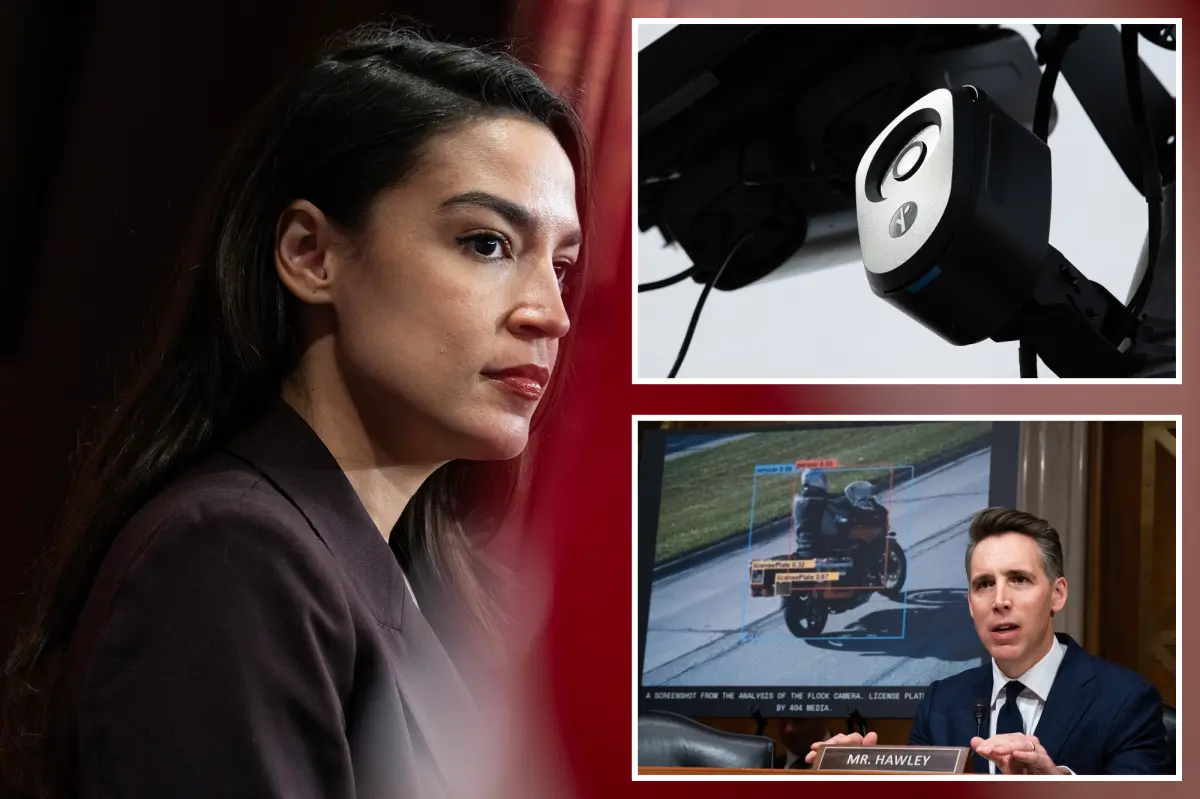
Representative Alexandria Ocasio-Cortez, the New York Democrat known for pushing the party to the left, has jumped on the issue with characteristic urgency. Last week, she released a bill with her ideological ally, Vermont Senator Bernie Sanders, that would place new restrictions on Flock-style surveillance technology. Ocasio-Cortez has been on an upstate New York tour, a stretch of public appearances widely seen as testing the waters for a possible 2028 presidential bid or a Senate run, and she used the opportunity to speak directly about surveillance anxiety. At a town hall in Syracuse, she made her position unmistakable. “To me the idea that flock cameras even exist is unconscionable,” she said, before going on to blast dynamic pricing and surveillance methods at big box stores, a connection that might sound surprising at first but actually makes a certain amount of sense. For Ocasio-Cortez, surveillance is not just about police cracking down on violent crime; it is about corporate power, data extraction, and the quiet erosion of personal autonomy in everyday spaces. If a retail chain can track your car, infer your shopping habits, and adjust prices in real time, she argues, that is not fundamentally different from a police network watching your every move. Her bill with Sanders would likely face serious opposition in a divided Congress, but the political point has already been made. By aligning herself with Sanders on this issue, Ocasio-Cortez is trying to position herself as the leading progressive voice on privacy, a topic that resonates powerfully with young voters, civil liberties advocates, and anyone who has ever felt like their phone, car, or web browsing history is being used against them. It is a savvy move for someone who has been falsely caricatured as a pure economic populist. She is expanding her portfolio to include the tech-privacy fights that increasingly define modern American life. And by announcing the legislation during an upstate tour that was already stirring speculation about her political future, she is making sure the moment gets noticed far beyond Syracuse.
On the Senate side, Missouri Republican Josh Hawley has been waging his own crusade against Flock, and he is doing it with the kind of rhetorical flair that has made him one of the most unpredictable figures in Congress. Hawley held an investigative hearing in late September and opened with a warning that was equal parts memorable and chilling. “If you haven’t heard of Flock, all I have to say is Flock’s probably heard of you,” he said. He went on to describe, in stark language, how the typical American has likely been scanned, surveilled, tagged, and logged multiple times in a single week. Hawley pointed to Flock’s own admission that it maintains a network of 120,000 individual cameras in 49 states, generating 20 billion images. The numbers are staggering, and Hawley used them to make a bigger point about the dangers of mass surveillance in a free society. It is not just about catching criminals, he suggested; it is about building a permanent digital record of where everyone goes, when they go there, and who they meet. That kind of information, he warned, can be abused by future governments, by malicious actors, or by the company itself. Hawley has introduced his own legislation to crack down on Flock cameras, and his involvement represents a remarkable convergence of left and right. You rarely see Hawley and Ocasio-Cortez on the same side of anything, yet here they are, both raising alarms about the same technology. Flock, for its part, has tried to position itself as a responsible actor rather than a villain. The company said it welcomes guardrails and favors “strong policy, accountability and oversight mechanisms.” That response is carefully crafted, but it also reflects a company that knows the political tide is turning and wants to avoid being the poster child for runaway surveillance.
The real question is whether any of this legislation can actually pass in the chaotic post-election landscape. A lame-duck session is a strange and unpredictable thing. Some lawmakers are on their way out the door, others are exhausted from brutal campaigns, and almost everyone is thinking about the next Congress rather than the lingering business of the current one. But it is also a period when deals can get done quickly because some of the usual political constraints no longer apply. Johnson’s commitment to bring the Burchett bill up after the election is a clear attempt to make sure the issue does not die quietly. Yet the path is full of obstacles. One GOP source warned that any Flock legislation could face serious headwinds in a post-election House, especially if Republicans lose the majority and face attendance issues. If the chamber is narrowly divided and members are missing, leadership may struggle to corral the votes for anything, even a popular surveillance crackdown. There is also the question of whether a bill that goes too far will alienate the law enforcement community, which has embraced Flock cameras as a cost-effective way to solve crimes. Many police departments argue that the system has helped them locate stolen vehicles, find missing persons, and identify suspects in serious cases. Forcing federal agencies to dismantle existing cameras, as Massie’s bill would do, is far more aggressive than simply stopping future purchases, and it is not clear whether enough lawmakers are willing to take that step. The politics are complicated further by the personal dynamics involved. Johnson’s shout-out to Tom Barrett was no small thing; Barrett is in a tight race against a former DSA member in a district that could help determine control of the House. If Barrett wins, his election night could be at least partly attributed to his ability to localize a national privacy concern. If he loses, the Flock momentum may lose some of its steam as Republicans reassess what worked and what did not.
At its core, this emerging fight over Flock cameras is about something bigger than any single bill or election. It is about the quiet way surveillance has become embedded in ordinary American life, often without meaningful consent or transparency. Automated license plate readers are not science fiction. They are here, recording our movements every day, and most of us have no idea where that data goes, how long it is stored, or who has access to it. The fact that a conservative speaker, a libertarian Republican, a progressive Democrat, and a populist senator are all rushing to be seen as the one who will stop it suggests that the public’s appetite for privacy is stronger than many political insiders expected. There is something deeply human about that reaction. People do not like the feeling of being watched, especially when they have not done anything wrong. They want to believe that their commute, their errands, their visits to friends and family are their own business. Flock and other companies like it have built their business model on the opposite assumption: that every movement is worth recording, every plate worth reading, and every data point worth collecting. The company says it is open to oversight, but the momentum in Congress shows that lawmakers are no longer satisfied with voluntary promises. They want rules. Whether those rules arrive in the chaotic lame duck, or after the new Congress takes its seats, one thing is clear: the debate has begun, and it will not be but not be easy to put the genie back in the bottle. The cameras are already everywhere, the images already exist, and the legal framework is far behind the technology. But the very fact that politicians from opposite ends of the spectrum are competing to address this anxiety is a sign that American voters are paying attention. They may not know the technical details, but they know that being watched without permission feels wrong. And in a democracy, that kind of discomfort has a way of turning into law.