






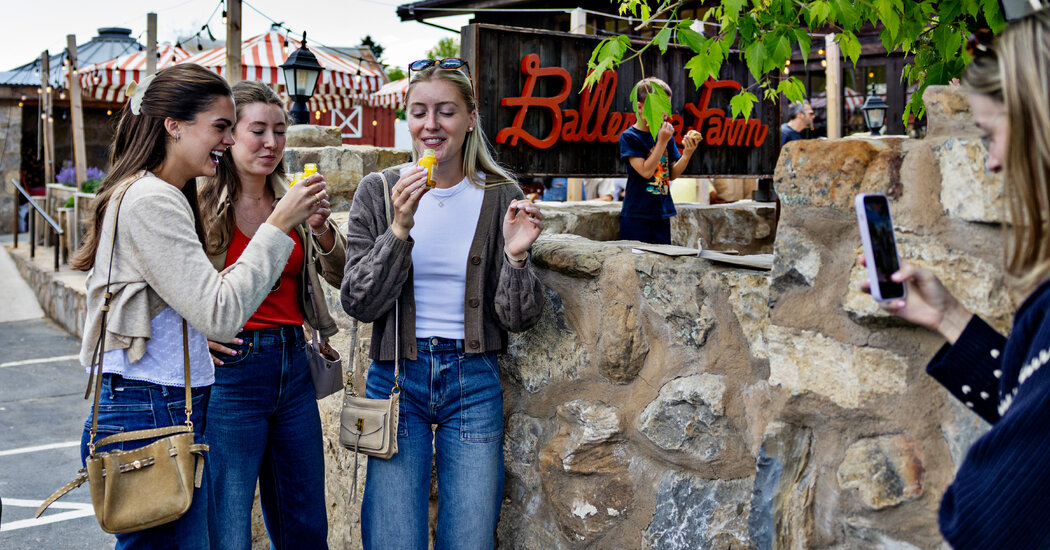
Nestled quietly within the snow-frosted mountains and sprawling cow pastures of rural northern Utah, the storybook village of Midway looks like a slice of the Swiss Alps miraculously transplanted into the American West, complete with historic architecture and a town hall glockenspiel that warbles on the hour. Settled originally by Swiss converts to Mormonism in the nineteenth century, this tight-knit community has long harbored a deep-seated resistance to rapid modern changes; when the very first traffic light was installed on its central Main Street some years ago, local residents reacted with the kind of collective panic normally reserved for the end of the world. Therefore, when the highly anticipated Ballerina Farm Store opened its doors here last July, it triggered what some locals viewed as an absolute, traffic-clogged apocalypse, drawing overwhelming droves of enthusiastic young women dressed in long, flowing dresses and leather cowboy boots. Jennifer Mangum-Whaley, a fifty-six-year-old interior designer who operates Midway’s year-round Christmas shop, recalled visiting the brand’s initial farmstand and discovering lines of teenagers stretching so far it felt like visiting Disney World. These eager visitors packed the local streets to purchase specialized treats like soft-serve ice cream made with the brand’s own vanilla-flavored protein powder or vibrant strawberry whey lemonade, documenting every single purchase on TikTok and Instagram before taking a bite. The sudden influx of eager out-of-town influencers and shoppers jammed the narrow streets so severely that nearby residents resortedly fortified their blocks, placing orange traffic cones and hand-painted signs declaring resident-only parking to keep interlopers from taking over their driveways. For anyone susceptible to the rustic, offline charm of thick-creamed milk, gingham aprons, hand-hewn sourdough knives, enamel candlesticks, or highly realistic candles shaped to look like bundles of asparagus, the physical store became an irresistible destination, bringing a controversial national spotlight to a quiet mountain town.
The driving force behind this massive brick-and-mortar sensation is thirty-five-year-old Hannah Neeleman, a Juilliard-trained ballerina who made the life-altering choice to walk away from a professional dance career in order to cultivate a working farm and raise a family of nine children. Ballerina Farm, the real-world agricultural operation that supplies the Midway boutique, is situated approximately a half-hour’s drive away, tucked deep within the snowy peaks and rural pastures of northern Utah. On social media, Hannah has masterfully built an empire of over twenty-three million followers across TikTok, Instagram, and YouTube by broadcasting warmly lit, intensely romanticized videos of her daily farm life. In these highly aesthetic clips, she is frequently seen performing impressive culinary feats entirely from scratch—such as crafting homemade feta cheese using fresh milk she drew from her own cows—often while wearing traditional prairie dresses, navigating around several of her blond children, and working closely beside her signature, vintage-looking cast-iron Aga stove. Yet, because of her massive digital reach, Hannah has inadvertently become the chief representative and absolute focal point of a highly charged, deeply polarized national debate regarding modern femininity and traditional motherhood. While many viewers find her wholesome content deeply comforting, a significant portion of her massive audience actively dislikes her, or at least intensely objects to the traditionalist lifestyle they believe she is glorifying. At a time when national birthrates are declining and political conversations frequently center on traditional gender roles, her flawless online persona has turned her into a polarizing symbol of the “tradwife” movement, an archetype of domestic perfection that critics argue represents a regressive step backward for women’s societal gains, serving as a picture-perfect ideal of conservative family values that even a television network like Hallmark could not have scripted better.
While the trajectory of Hannah Neeleman’s life—sacrificing an elite classical dance education at Juilliard to milk sheep and herd livestock in rural Utah—absolutely bewilders mainstream internet commentators, this life path is met with far less surprise by residents living around Midway. Throughout this region of Utah, the cultural expectations surrounding marriage and motherhood run deep, and the concept of a large, closely-knit family is deeply normalized rather than an anomaly. Many families in the area share both Mormon roots and active agricultural ties, and it is entirely common to spot massive Mercedes Sprinter vans parked in local driveways, serving as the practical family vehicles required to transport households that easily seat up to fifteen people. For nineteen-year-old Ella Eggertz, a freshman at Utah Valley University who grew up in Midway, these heavy societal expectations are so pervasive that, lacking a husband or a baby, she jokingly admits she feels like a spinster at her young age, though she maintains a lighthearted ambition to eventually build a career outside of the state. Furthermore, the practice of transforming domestic motherhood skills into profitable digital influencing careers, which then transition into physical storefronts, is a highly established path in Utah. Midway itself is also home to the Dainty Pear, a country-chic boutique stocked with Bibles, gourmet tinned fish, and French soaps owned by influencer Sarah Clark, as well as a new local outlet for The Food Nanny, an influential food brand created by Lizi Heaps. According to forty-five-year-old Lindsey Leavitt, co-owner of Midway’s progressive bookstore called Folklore, the local concentration of traditional-wife representation has visibly risen, but the business traffic has also fueled a welcome tourism boom, generating substantial revenue for other shops in the historic district; indeed, the unique cultural tapestry of the region allows these domestic influencers to flourish, seamlessly blending conservative community values with highly successful digital entrepreneurship.
Despite the overwhelming popularity of her aesthetic brand, Hannah Neeleman faces relentless criticism from detractors who argue that her content peddles an unattainable, heavily privileged fantasy of maternal domesticity. Skeptics are quick to point out that this picture-perfect lifestyle of laboring from scratch is heavily cushioned by immense family wealth, specifically noting that her husband Daniel’s father is the wealthy founder of the major airline JetBlue. Although Hannah firmly asserts in interviews that she and her husband have never received any financial help from their families—maintaining that they worked through extremely difficult and taxing years to build their farm independently—critics remain unconvinced. Yet, local women who actually visit the Ballerina Farm Store are rarely fooled by the idealized digital presentation; they openly recognize the immense amount of behind-the-scenes work, extra household help, and carefully orchestrated digital editing required to manage a working farm alongside nine young children. Lori Rutland, the fifty-seven-year-old owner of the local Rocky Mountain Chocolate Factory, views the business success as a modern iteration of the American dream, celebrating Hannah’s ability to earn a living without ever having to leave her home, even as she acknowledges that such a lifestyle remains completely out of reach for the average working-class person. Many local mothers and business owners agree that while the content represents a paying job masquerading as pure leisure, it still demands a level of physical beauty, physical stamina, and financial cushion that few women actually possess. When directly asked to discuss the extent of her household assistance, Hannah declined to share details, with a public relations representative intervening to state she wished to keep details of her children’s lives private, further illustrating the careful boundaries constructed around her digital empire.
This tension between modern reality and pastoral fantasy forms the core appeal of the Ballerina Farm brand, tapping into a profound sense of exhaustion felt by young women navigating today’s high-stress economy. Abbey Wood, a twenty-nine-year-old barista at a nearby restaurant who left the Mormon Church as a teenager, fully understands the feminist critique—particularly amplified by a prominent 2024 profile in the Times of London depicting Hannah as entirely submissive to her husband’s demands—yet she still finds herself drawn to the visual comfort of the brand. For a working professional like Abbey, who lives her daily life strictly governed by a rigid work time clock, the idea of slow-paced, intentional homemaking represents an incredibly beautiful fantasy, even if it feels like an impossible, fanciful luxury in the economic landscape of 2026. This complex mix of skepticism and aspiration was mirrored in a survey conducted by King’s College London, which explored the massive popularity of traditional-wife content among young British women. The study revealed that these young viewers do not watch such channels because they actually support submissive, regressive gender roles; rather, they view it as a soothing escape from the seemingly impossible modern pressure of simultaneously juggling a grueling professional career and family responsibilities. Even young visitors like twenty-three-year-old Bridgett Sorto Ayala, who traveled from Las Vegas and has no desire to have children of her own, admit that the crushing stress of maintaining a full-time career with a family makes the stay-at-home alternative highly appealing, highlighting how the rustic imagery operates as an emotional shelter from twenty-first-century career exhaustion, offering an imaginative portal into a world where value is derived from simple hearth and home.
Amid the cultural storms, the physical store in Midway operates as a bustling monument to this yearning for unadulterated, analog purity, offering high-end goods that serve as a rural alternative to upscale urban health markets. Inside the shop, visitors can purchase a premium, eleven-dollar specialty drink called the Pirouette—a complex blend of cherries, ginger, beets, strawberries, dates, and fresh milk from Ballerina Farm cows, topped with vanilla bean yogurt and marbled with a shot of extra-virgin olive oil. Shelves are stocked with tubs of housemade beef tallow, artisan ketchup, a hundred-and-fifty-dollar wooden egg tray, chili crisp, and harissa, drawing customers like twenty-nine-year-old Kelsea Palmer, who home-schools her four children, makes herbal tinctures, and dreams of off-the-grid homesteading. While defenders like novelist Tiffany Rosenhan point out that social media influencing is a revolutionary profession that allows women to monetize unpaid domestic labor and out-earn men, critics like twenty-five-year-old local schoolteacher Gabby Doe express frustration that the brand sets unrealistic expectations of farm life, even as she admits she is guilty of buying the fresh, local produce there anyway. Hannah herself remains untroubled by the intense digital debate, framing her lifestyle as a cooperative partnership where she and her husband Daniel are equally yoked in both parenting and business. Defining herself first and foremost as a wife and mother, Hannah feels that the modern era uniquely allows women to pursue multiple ambitious paths simultaneously, celebrating the unprecedented opportunities currently available to women. Ultimately, visitors continue to flock to her store, caught in the irresistible pull of a beautifully packaged, fresh, and local dream that, despite its glaring economic contradictions, offers a deeply comforting taste of a simpler, more organic existence.