





There is a unique brand of physical and psychological vulnerability reserved for those who willingly suspend themselves hundreds of feet above the earth, trusting nothing but a network of metal chains and steel beams to keep them from gravity’s unforgiving pull. For decades, massive amusement parks like Six Flags Over Georgia have served as the ultimate testing grounds for human courage, drawing millions of visitors each year who are eagerly seeking the exhilarating rush of highly controlled danger. These sprawling sanctuaries of modern adrenaline offer a carefully manufactured escape from the mundane routines of daily life, transforming primal fear into a consumable, joyous commodity. On any given weekend, the air of the park is thick with a sensory tapestry of whirring machinery, distant pop music, the irresistible smell of freshly made funnel cakes, and a rolling chorus of screams that echo across the park grounds. Riders strap themselves into elaborate harnesses, willingly giving up all personal control to automated ride operators and sophisticated computer algorithms. It is an unspoken, trust-based social contract: we pay for the illusion of mortal peril, completely confident that the unseen hands of expert engineering, daily safety inspections, and rigorous maintenance schedules will always bring us safely back to solid ground. They believe that the laughter, the shared smiles with loved ones, and the wind in their hair are the only things they will take away from the experience. Yet, when the seamless illusion of safety momentarily cracks due to an unexpected halt, the thin, fragile line separating recreational thrill from genuine panic instantly dissolves, turning an ordinary afternoon of lighthearted family fun into an unforgettable, high-altitude test of human patience and raw nerve.
This delicate boundary between pure fun and sudden fear was recently crossed in a dramatic, highly public fashion that quickly captured the internet’s collective interest and sparked a wave of virtual conversation. A group of unsuspecting passengers found themselves hanging suspended in the open air, dangling helplessly from the upper structural elements of the park’s towering SkyScreamer attraction. Among the stranded riders was David Early, a park-goer whose immediate, visceral reaction to the sudden, unexpected halt would soon echo across social media platforms worldwide. Armed with his smartphone, Early captured the raw, unfiltered essence of human anxiety and confusion in a viral video that perfectly encapsulated the dread of being stuck. “Why the f— are we stuck up here, bruh?” he could be heard asking, his voice a highly relatable and potent mixture of disbelief, frustration, and genuine concern as he filmed the empty air beneath his feet. This spontaneous piece of citizen journalism quickly spread across the digital landscape, striking a deeply sympathetic chord with millions of viewers who could easily imagine themselves in his dangling, precarious shoes. The video highlighted a quintessentially modern phenomenon: the immediate human instinct to document our most vulnerable, terrifying, and confusing moments in real-time. By sharing our immediate struggles with a global audience of strangers before a situation is even resolved, we turn private anxiety into public performance. In those tense, quiet moments high above Georgia, the vast sky became a massive stage, and the passengers’ quiet isolation was transformed into a hyper-visible spectacle of suspense. The incident reminded us that in the digital age, a private moment of vulnerability can instantly become a shared public narrative, watched by millions who crave the same adrenaline rush from the safety of their phone screens.
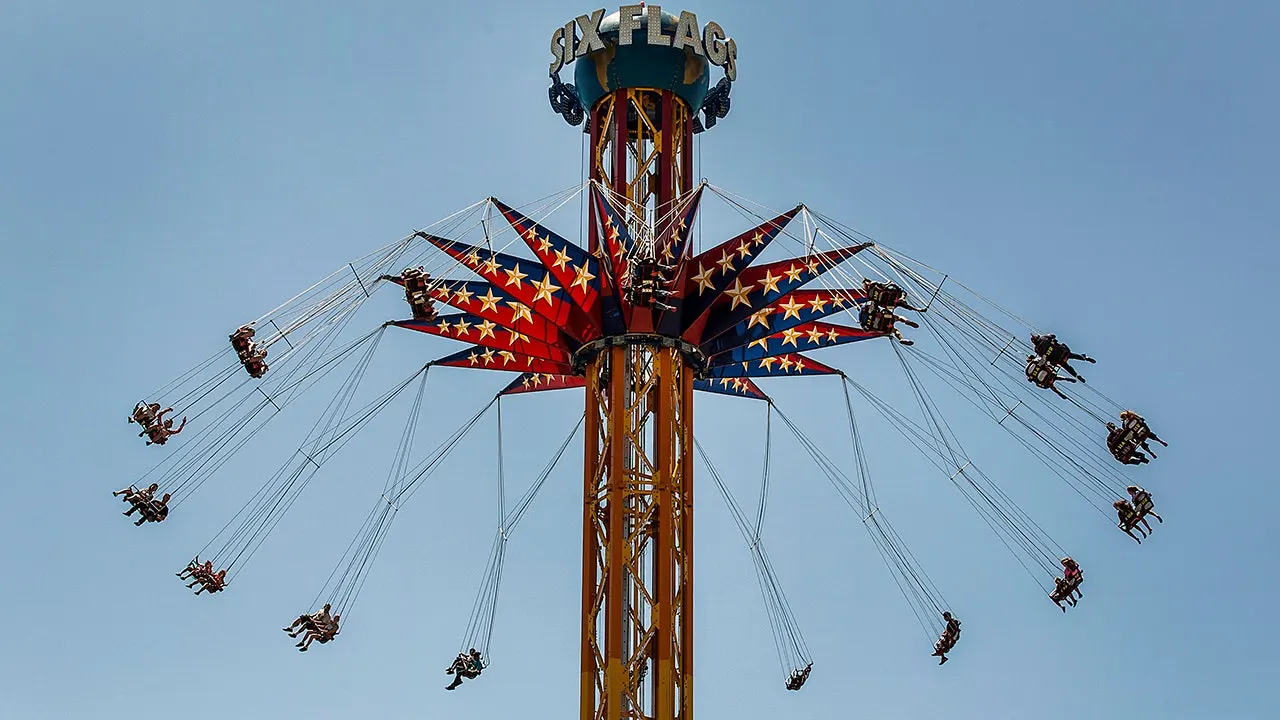
To fully comprehend the sheer psychological weight of this experience, one must understand the daunting nature and sheer physical scale of the SkyScreamer ride itself. According to Six Flags Over Georgia’s official website, the massive attraction is not a standard, comforting carousel, but a mammoth “amusement park swing ride” designed to lift courageous riders a staggering 260 feet into the clouds. At its peak operating height, the ride spins guests in a massive, sweeping circle, offering breathtaking, panoramic views of the surrounding Atlanta landscape while allowing their legs to dangle freely in the empty wind. It is an experience masterfully engineered to evoke the sensation of flying, but when the motion stops unexpectedly, the sensation changes to one of absolute exposure. Suspended at the height of a twenty-story building, without the comforting enclosure of a heavy roller coaster car or the solid, visible presence of a steel track beneath them, the stranded riders were left to confront the sheer scale of the void. At such an immense altitude, even a gentle summer breeze can feel like a threatening force, and every creak of the metal structure is amplified by the sudden, eerie silence of a stalled machine. Ten minutes under normal circumstances is a brief, almost imperceptible blip in a person’s day—a short wait in a grocery line or a brief commercial break. However, when suspended 260 feet above the earth by nothing but thin cables, those ten minutes warp into an agonizing eternity, where every passing second allows the human mind to construct increasingly terrifying “what-if” scenarios. Suspended there, looking down upon the miniature trees and tiny cars, one cannot help but feel incredibly small, acutely aware of human fragility in the face of immense heights and mechanical stillness.
In the aftermath of the viral incident, representatives from Six Flags Over Georgia hastened to de-escalate the growing public alarm by offering a reassuring, mechanical explanation of the event. In an official email statement to Fox News Digital, park representatives re-evaluated the terrifying pause as a routine, highly controlled safety measure, emphasizing that the well-being of their visitors remains their primary concern. “The safety of our guests and team members is a top priority,” the statement began, before framing the dramatic high-altitude pause through a surprisingly mundane analogy: a “technical delay (similar to a check engine light) that paused its operation.” According to the park, rather than representing a catastrophic mechanical failure or an imminent threat to life, the stoppage was actually a demonstration of the ride’s advanced safety systems operating exactly as they were engineered to do. When an onboard computer detects a minor anomaly—ranging from a minor electrical fluctuation to a sensor misalignment—the system is programmed to immediately “fail-safe.” This means halting the ride in a secure, stable position rather than allowing it to continue operating under uncertain conditions. Once the automated system initiated the lockdown, park staff performed a comprehensive, top-to-bottom systems check before safely returning the massive swing to its loading pad. Within approximately ten minutes, the entire ordeal was successfully resolved, and the relieved guests were able to unbuckle their harnesses, take a deep breath, and step back onto the comforting terra firma of the park grounds. This return to normalcy, while quiet and orderly, serves as a testament to the robust engineering standards that govern modern amusement parks, even if the journey to get there involved an anxious, unexpected wait in the clouds.
Perhaps the most fascinating and deeply human twist in this high-up drama is the behavior of David Early himself in the days immediately following the incident. Despite capturing the viral video that broadcasted his profound agitation and explicit frustration to the world, and despite experiencing the spine-chilling sensation of being temporarily stranded in the Georgia sky, WSB-TV reported that Early climbed back onto the very same SkyScreamer ride just two days later. This surprising act of resilience reveals a great deal about the complex, often contradictory psychology of thrill-seekers and the human capacity to quickly rationalize fear. For many people, experiencing a minor mishap that ends safely does not breed lifelong phobias; instead, it can actually demystify the danger and reinforce a profound trust in the underlying technology. By returning to the scene of his viral distress, Early demonstrated a form of benign masochism, proving that the human desire for excitement and the pursuit of adrenaline frequently triumph over the memory of temporary discomfort. His return serves as a powerful reminder that our relationship with fear is dynamic and highly negotiable. Rather than letting the experience paralyze him or turn him away from amusement parks forever, Early chose to conquer the high-altitude setback, reclaiming his sense of personal agency and converting a potentially traumatic memory into a badge of courage and a highly humorous footnote in his personal life. It shows that the human spirit is remarkably adaptable; we possess an innate ability to process fear, laugh at our own panic, and step right back into the fire to prove that we cannot be easily broken by a temporary mechanical glitch.
While the SkyScreamer event ended safely and virtually without any medical incident, it highlights a much broader, ongoing dialogue regarding theme park safety and the power of digital media in the modern age. In an era where almost every theme park mishap—no matter how minor or routine—is instantly recorded, shared, and dissected by millions of internet commentators, amusement parks are operating under an unprecedented level of public scrutiny. Headlines frequently detail rides getting stuck vertically, massive power outages leaving riders stranded, and lifetime bans for reckless guest behavior, creating a distorted public perception that theme park rides are inherently dangerous. In reality, modern amusement rides are among the most heavily regulated, stringently engineered, and statistically safe forms of entertainment on the planet, with safety margins that easily rival commercial aviation. The viral spread of David Early’s video illustrates how easily a harmless ten-minute technical pause, designed specifically to protect riders from harm, can be interpreted by the lay public as a terrifying near-miss. Ultimately, the incident at Six Flags Over Georgia serves as a modern parable about the delicate, unyielding trust we place in technology and human engineering. As long as our collective appetite for high-altitude thrills remains insatiable, we will continue to willingly climb hundreds of feet into the sky, trusting that the invisible “check engine lights” of our favorite rides will keep us safe, even when they bring us to a sudden, breathtaking halt. We will climb aboard, secure our seatbelts, look to our neighbors with a mixture of excitement and nervous energy, and prepare ourselves to be swept away, trusting completely in the silent, watchful guardians of modern engineering.