





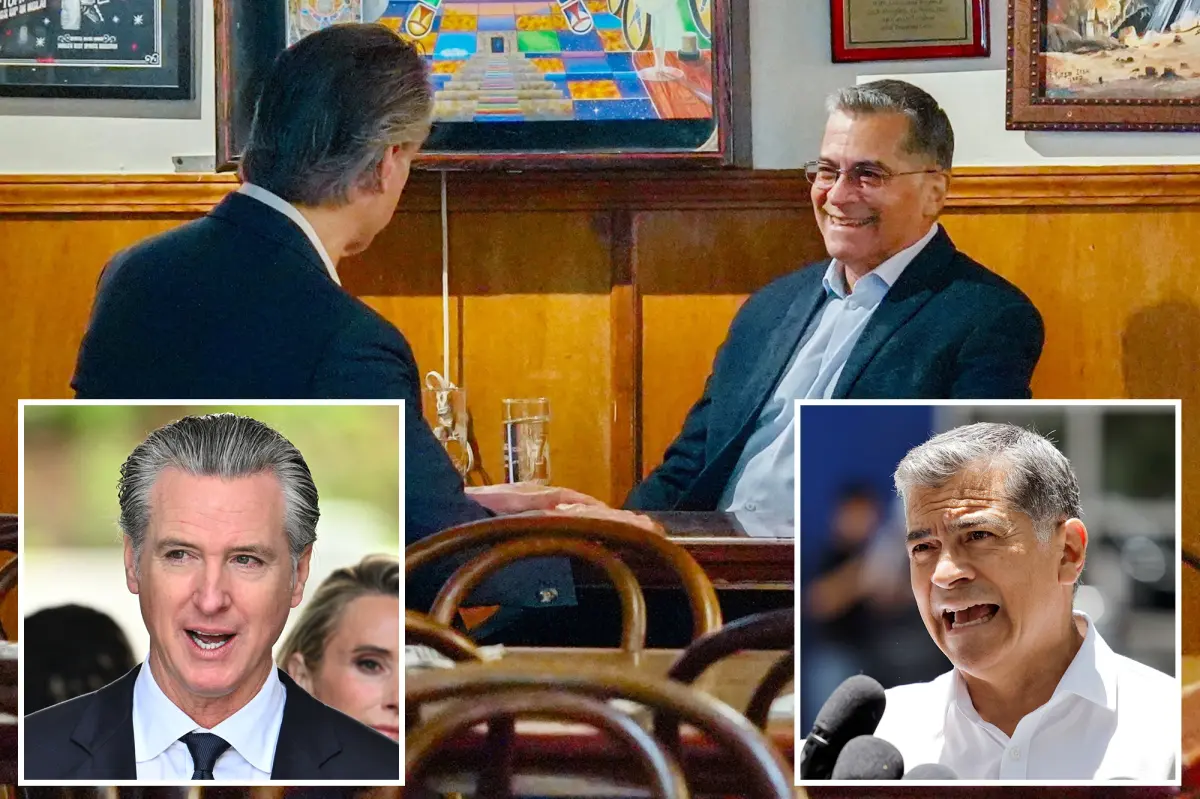
Nestled along the fog-swept expanses of Geary Boulevard in San Francisco’s Outer Richmond district lies Tommy’s Mexican Restaurant, a beloved neighborhood institution that has spent more than half a century serving up authentic Yucatan cuisine and world-renowned hand-shaken margaritas. On a quiet morning this week, the restaurant’s vibrant, family-owned charm served as the backdrop for a highly anticipated political rendezvous between two of California’s most prominent Democratic leaders: Governor Gavin Newsom and gubernatorial candidate Xavier Becerra. The eatery, which is famous for its warm hospitality, traditional chile rellenos, and slow-cooked pollo pibil, was temporarily cleared of its usual bustling clientele to accommodate the high-profile summit. Rather than a table laden with steaming plates of traditional Mayan-influenced delicacies, photos shared on social media revealed a remarkably spare setting. The two powerful politicians sat across from each other at a simple, unadorned wooden table, flanked by empty chairs, with nothing but two tall glasses of ice water between them. The visual contrast between the rich, sensorially indulgent reputation of Tommy’s and the spartan, business-like nature of their table settings captured the dual essence of the meeting—a moment of cozy, localized California tradition juxtaposed with the stark, high-stakes realities of modern political strategy.
The meeting marked a crucial moment of alignment for the two men, whose political fates have become increasingly intertwined as California prepares for a major transition of power. Governor Newsom, currently serving his second term and legally barred from running for re-election, has long been a towering figure in both state and national politics, frequently mentioned as a potential contender for the presidency in 2028. Sitting across from him was Xavier Becerra, the seasoned public servant who previously served as California’s Attorney General before answering President Joe Biden’s call to lead the federal Department of Health and Human Services in Washington, D.C. Now, Becerra has returned to his home state to embark on a campaign to succeed Newsom in the governor’s mansion. While the primary election campaign had seen Newsom maintain a careful, somewhat awkward distance—evading direct questions from local reporters about his preferences among a highly competitive field of fellow Democrats—the political landscape has cleared significantly. With Becerra emerging from the June primary as the sole Democratic candidate to advance to the general election, where he will face off against Republican challenger Steve Hilton, Newsom quickly abandoned his previous neutrality. This face-to-face meeting at Tommy’s, their first formal sit-down since the primary ballots were tallied, served as a powerful public endorsement and a symbolic passing of the political torch.
Beneath the carefully curated visuals of the meeting lay a dense agenda of pressing policy issues that currently define the daily lives of nearly forty million Californians. According to representatives from Newsom’s office, the discussion between the governor and his prospective successor was wide-ranging and substantively heavy, diving deep into the structural challenges facing the Golden State. They grappled with the perennial crises of affordable housing and homelessness, which continue to strain municipalities from San Francisco to San Diego, as well as the broader health of the state’s economy and the survival of the small, family-owned businesses that form its backbone. As the former head of the nation’s health department, Becerra found familiar ground in discussing the future of healthcare access and California’s ongoing efforts to protect reproductive rights and abortion access in a post-Roe national landscape. The leaders also addressed the existential threats posed by climate change—an issue that regularly manifests in California through devastating wildfire seasons and volatile weather patterns—while keeping a watchful, defensive eye on the federal political landscape and the looming platform of the Trump administration. For Newsom and Becerra, these were not merely abstract talking points, but the core pillars of a shared legislative legacy that they are determined to protect and extend.
Yet, in the digital age, a political meeting is rarely just about the policy discussed behind closed doors; it is also about the narrative projected to the public through the lens of social media. Shortly after the meeting concluded, both men took to X, the platform formerly known as Twitter, to broadcast their sense of shared mission and mutual respect to their combined millions of followers. Governor Newsom shared a series of warm, candid-style photographs showing the two men laughing, conversing, and sharing a firm handshake, accompanying the images with a terse, action-oriented caption: “Focused on the work. Committed to the people.” Not long after, Becerra echoed this sentiment of unified resolve by sharing the post and reflecting on their shared history in public service. “We’ve fought side by side for California families—and together, we’re going to keep this state moving forward,” Becerra wrote. This carefully orchestrated display of digital solidarity was designed to project stability and continuity to a Democratic base that is looking for strong, cohesive leadership to navigate the state’s complex future. It was a humanizing attempt to show two veteran leaders stepping away from the sterile offices of Sacramento to connect over shared values in a neighborhood space, asserting that their partnership is rooted in genuine camaraderie and a mutual dedication to the public good.
However, the glossy, unified narrative presented by the Democrats was met with swift and fierce criticism from their political opponents, who viewed the restaurant meeting through a much more cynical lens. The California Republican Party seized upon the shared photographs to mount a scathing critique, posting a direct response on social media that sought to dismantle the humanizing intent of the photo-op. Republican strategists pointed out what they saw as glaring contradictions in the imagery, criticizing both Newsom and Becerra for traveling to a city where neither of them currently resides, clearing out a beloved local business of its paying customers, and failing to actually purchase or consume any of the restaurant’s famous food. “Californians are tired of manufactured photo ops with do-nothing, all-talk politicians while our state gets more expensive and worse to live in,” the California GOP declared, contrasting the scene at Tommy’s with the active campaign of their own candidate, Steve Hilton. This populist counter-argument struck at a raw nerve for many residents, tapping into a growing public weary of rising inflation, high utility costs, and a perception that political elites exist in a different reality than the everyday citizens who struggle to afford a meal at their own neighborhood eateries.
Despite the predictable political crossfire, the quiet morning at Tommy’s Mexican Restaurant highlights the delicate balance that modern political figures must strike as they navigate the transition of power in one of the world’s largest economies. For Newsom, the meeting was a chance to solidify his role as a cooperative party elder and a kingmaker, ensuring that his policy victories on climate, healthcare, and human rights are carried forward by a trusted ally rather than dismantled by political opponents. For Becerra, the rendezvous provided a vital boost of institutional support and a visible connection to Newsom’s formidable fundraising and volunteer networks as the general election campaign begins in earnest. As the state moves closer to the general election, the campaign trail will undoubtedly become noisier, more combative, and increasingly polarized. Yet, for one quiet hour in San Francisco, the future of California’s leadership was hashed out over two simple glasses of water, demonstrating that even in an era of massive digital campaigns and intense partisan division, the most crucial moments of political transition still begin with two people sitting down at a table to talk.