





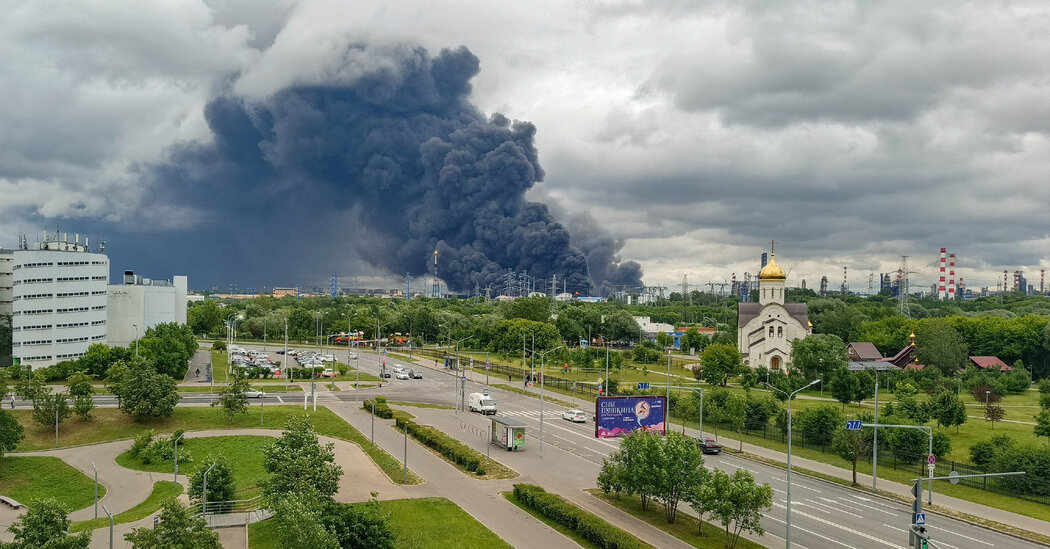
The towering plume of dark, heavy smoke rising above the Moscow skyline this week did more than just signal a successful Ukrainian drone strike; it visually shattered the carefully maintained illusion of safety that the Kremlin has long tried to afford its capital’s residents. For months, geopolitical analysts and skeptical Western politicians, including Donald Trump, had suggested that Ukraine’s options were running out and that its defeat was merely a matter of time. Yet, the dramatic destruction of a portion of Moscow’s largest oil refinery, punctuated by a violent explosion that hurled a fuel storage vessel into the sky, served as a fiery counter-narrative. By bringing the war directly to Russia’s seat of power, Ukrainian President Volodymyr Zelensky signaled a bold new phase of military and diplomatic assertiveness, proving that Kyiv still holds formidable cards and is entirely willing to play them to reshape the trajectory of the conflict.
This display of military reach coincided with a crucial diplomatic triumph in France, where Zelensky successfully rallied the leaders of the Group of 7 industrialized nations to issue a resonant statement of “unwavering support.” The show of solidarity was particularly striking because it materialized in the shadow of comments by Donald Trump, who used the summit to distance the United States from the conflict, asserting that America had “nothing to do” with the ongoing war. While such isolationist remarks from a leader widely expected to force a swift, pro-Russian peace deal might have spelled panic in the past, they instead seemed to catalyze a sense of urgency and resolve among European officials. Rather than backing down, European leaders increasingly view the shifting American stance as an invitation—and a necessity—to take the reigns of the continent’s security and play a more assertive role in resisting Russian aggression.
This European resolve is rapidly translating into concrete, historic commitments that promise to sustain Ukraine’s war effort for the long haul. Just as the smoke was clearing over Moscow, formal negotiations officially began for Ukraine’s accession to the European Union, marking a monumental civilizational pivot away from Russia’s orbit. Simultaneously, Brussels reaffirmed that the disbursement of a massive €90 billion ($103 billion) loan, approved late last year, would commence this month, accompanied by an additional $4 billion in newly pledged Western military aid. Leaders from the Baltic states to Western Europe hailed this moment as a psychological and strategic turning point, with European Commission President Ursula von der Leyen declaring that the momentum was firmly with Kyiv, while Lithuanian President Gitanas Nauseda noted that bringing the physical reality of the war onto Russian soil would inevitably force the public in Moscow to realize they can no longer remain passive observers of a televised conflict.
Naturally, the Kremlin has attempted to downplay the significance of these developments, dismissing the Western alliance’s attempts to negotiate from a “position of strength” as a futile strategy that will lead nowhere. While Vladimir Putin maintained a public silence regarding the brazen assault on his capital, the strain on Russia’s critical infrastructure is becoming increasingly difficult to hide. In a telling moment of damage control, Igor Sechin, the head of the state-run oil giant Rosneft, admitted to nationwide fuel supply issues but euphemistically blamed them on “unscheduled maintenance”—a transparent cover for the systematic and devastating toll that Ukrainian long-range drone strikes have taken on Russia’s refining capacity. Despite Russia’s persistent and brutal missile bombardments of Kyiv, which continue to exploit Ukraine’s ongoing air defense shortages, the underlying confidence in Ukraine is rising, fueled by the belief that a combination of economic pressure, domestic disruption within Russia, and sustained European backing will eventually force Putin to the negotiating table.
This resilient and increasingly bullish national mood in Ukraine was perfectly captured by a viral meme circulating online, depicting a photosuited Zelensky sitting opposite Donald Trump in France, his hands and suit literally overflowing with playing cards. The joke was a direct, triumphant mockery of Trump’s previous assertions that Ukraine had no leverage left. Far from acting like a leader defeated, Zelensky used his face-to-face meeting with Trump to pitch an ambitious, self-reliant defense strategy: requesting the blueprints and licensing for Patriot air defense systems. If approved, this arrangement would allow Ukraine to bypass the agonizingly slow supply chains of foreign allies and manufacture these highly sophisticated missile-defense systems domestically. It is a shrewd bid for military self-sufficiency, signaling that Ukraine is preparing to defend its skies on its own terms, regardless of the shifting political winds in Washington.
Yet, beneath the high-stakes diplomacy, the strategic maneuvers, and the defiant messages on social media, the tragic and heartbreaking human cost of the war remains the ultimate, sobering reality. While Ukraine’s Foreign Minister, Andrii Sybiha, lightheartedly posted that “everything is going according to plan” in Moscow, the raw human toll of the escalating violence refused to be ignored on either side of the border. By Friday, as drone strikes continued, Russian officials confirmed the first civilian casualty of the Moscow barrage—an eight-year-old girl. Almost simultaneously, deep inside Ukraine, a Russian airstrike on the eastern city of Pavlohrad robbed another families of their child, killing another eight-year-old girl in her home. These parallel tragedies serve as a grim reminder that behind the political chess match and the flaming oil refineries, the innocent are still paying the heaviest price for a conflict that shows no signs of an easy end.