







Ejae’s Golden Triumph: From K-Pop Dreams to Global Stardom Amid Illness and Identity Struggles
In the span of just ten months, Ejae has experienced a whirlwind of triumph and tribulation that feels like a condensed lifetime. The animated film “KPop Demon Hunters,” which exploded onto the global stage last June, catapulted her co-written and performed track “Golden” to incredible heights—securing a Golden Globe, a Grammy, and shockingly, an Oscar. Yet, woven into this fairy tale success is a tapestry of illness; Ejae battled eight separate bouts of sickness, from COVID to the flu and bronchitis, suffering through some performances with fever-ridden lungs and a voice that barely held. Despite the physical toll, she powered through with what she calls “muscle memory,” a conditioned response to the spotlight that overrides everything else.
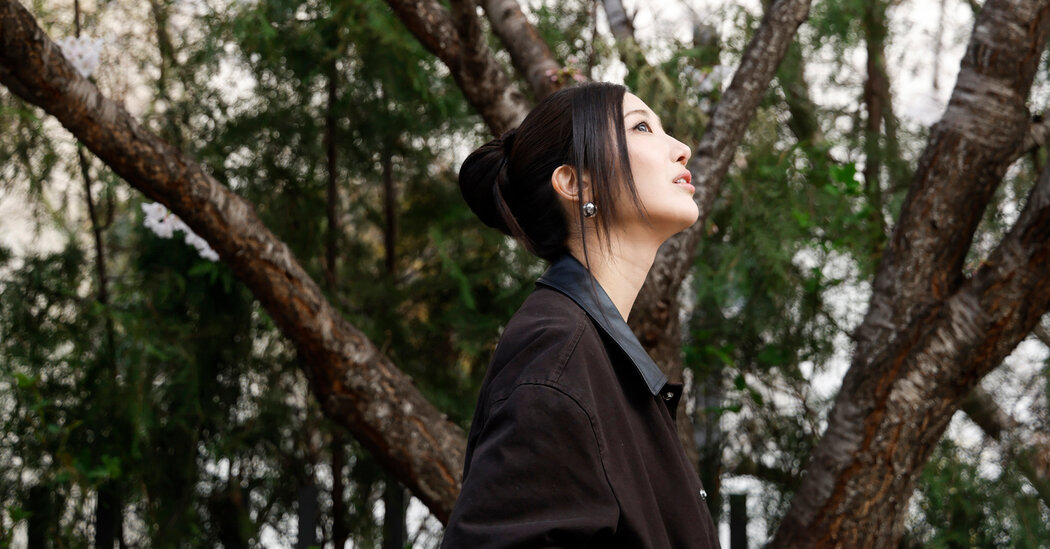
Back in Seoul recently, walking the cherry-blossom-lined streets near her mother’s neighborhood, Ejae reflected on her lightning-speed rise. The city, with its iconic N Seoul Tower looming in the distance—a fixture prominently featured in the film—served as a poignant backdrop for her musings on what comes next. It’s a place steeped in her roots, where she trained relentlessly for a decade to become a K-pop star, honing instincts that now define her. As spring unfurled its petals, Ejae pondered the impermanence of fame and labels, wondering aloud about carving out a path that’s authentically hers.
South Korea has hailed “Demon Hunters” as a masterclass in exporting Korean culture, or “Koreanness,” to Western audiences without sacrificing depth. Critics lauded the film’s intricate details, from the textured Seoul streets to its subtle cultural nods, which resonated powerfully at home. An April news conference buzzed with national pride as reporters recounted watching Ejae perform “Golden” at the Oscars alongside collaborators Audrey Nuna and Rei Ami, their rendition blending traditional Korean music elements with modern flair. However, this celebration unearthed deeper tensions; the film, a joint effort by Sony and Netflix, sparked debates about whether cultural treasures like K-pop are slipping from South Korea’s grasp, much like Champagne belongs to France or bourbon to America.
Ejae, 34, born Kim Eun-jae, is no stranger to these identity debates. Growing up as a U.S. citizen with Korean roots, she faced prejudice in South Korea, where she was derogatorily labeled “black hair” for being a diaspora Korean deemed insufficiently authentic. Now, as “Golden”—a track crafted by a team of K-pop songwriters—scoops up awards, some question its legitimacy as true K-pop. Ejae pushes back passionately: “Isn’t it cooler that Korean Americans utilize that system to share that culture?” She despiles the divisive “versus” mentality, preferring to see it as a collaborative bridge rather than a battleground. This fluidity of identity resonates with her own evolving self-perception, where rigid categories feel increasingly irrelevant.
Roots in Resonance: Navigating K-Pop’s Demanding World and Personal Awakening
Her journey began far from Seoul’s glitzy stages. Born in the city but raised partly in Fort Lee, New Jersey, Ejae encountered K-pop as a niche oddity in the late ’90s—a genre that elicited “ews” from classmates when she eagerly shared it. Returning to Seoul in second grade after her parents’ divorce, she immersed herself in the culture, begging her mother to teach her Hangul just to decode lyrics from boy band g.o.d. This bilingual upbringing left her with a quirky linguistic mix: early 2000s slang mashed with outdated 1970s expressions, a charming anachronism that reflects her unique perspective.
At 10, Ejae’s ambitions crystallized. She and her mother frequented noraebang—karaoke parlors—for vocal practice, leading to auditions with major K-pop agencies. Landing with SM Entertainment at 11, she entered the grueling trainee system, where singing, dancing, and even weight became relentless metrics. Tall at 5 feet 9 inches, she towered over peers and fretted over public weigh-ins, enduring criticism like “Your dancing feels heavy—it’s your thighs.” Her voice, deemed “too dark and husky, too old,” only added to the pressure. Balancing training with studies at NYU’s Clive Davis Institute, where she failed music theory multiple times, she clung to hopes of a solo debut. But by 2014, the industry’s shift to group acts labeled her “too old,” forcing a painful pivot.
Healing Wounds: From Idol Aspirations to Songwriting Salvation
Ejae now views that era with a measured gratitude, though therapy sessions reveal lingering scars. “To be really honest, if I continued on to become a K-pop idol, I don’t know if I’d be here,” she admits. “Yeah, it was that bad.” Redirecting to songwriting—away from performance—she found freedom. Discouraged from production during training, her NYU experience sparked a renaissance. Hours in Seoul coffee shops, tinkering with SoundCloud lo-fi beats, eventually led back to SM, where she co-wrote smashes like “Psycho” for Red Velvet and “Armageddon” for aespa. This detour, ironically fueled by rejection, redefined her artistry.
Fame’s Double Edge: Navigating Fans, Nationalism, and Authenticity
Yet, that decade under the spotlight now shines in unexpected ways. Strolling Hannam, a trendy Seoul neighborhood dotted with gelato shops, Ejae draws swiveling heads—a surreal shift from trainee anonymity. Broaching fame still feels peculiar, but her boundless energy in accepting photos and greetings masks the star-fan divide. “The fans brought me out. They believed in my voice,” she says, emphasizing the debt she owes to supporters who championed her unconventional sound.
This success feeds into South Korea’s “gukbbong”—that intoxicating national pride akin to “nationalism meth”—where cultural exports like “Parasite,” BTS, and now “KPop Demon Hunters” evoke euphoric affirmation, sometimes veering into chauvinism. Even at a cafe ordering an iced Americano, an employee confessed he hadn’t watched the film but brimmed with pride as a Korean. Ejae appreciates representing her heritage at the Oscars, but warns against pigeonholing. “Yes, I did ‘KPop Demon Hunters’ but it doesn’t mean I’m a K-pop artist. I’m just an artist who’s Korean American,” she insists.
The Future of K-Pop: Global Expansion or Lost Identity?
As K-pop surges internationally, debates intensify over its essence. Groups like Katseye, a multiracial LA-based ensemble by Geffen and BTS’s Hybe, embody change, with Hybe’s Bang Si-hyuk suggesting dropping the “K” for global dominance. Ejae disagrees vehemently: “Absolutely not. K-pop is a genre in itself, why would you drop the ‘K’? Does Bad Bunny drop any Spanish?” She frets over companies outsourcing to non-Korean writers for English-heavy tracks—though “Golden,” with its story-driven blend, was an exception. K-pop’s fusion of influences, from J-pop to Black music, excites her, but ceding Koreanness feels like misguided cultural appropriation and poor strategy. “American audiences want something novel. They don’t want to hear the same thing,” she notes.
Breaking Barriers: Aspiring Beyond K-Pop Labels
This tension mirrors Ejae’s personal crossroads: asserting Korean roots in American music while transcending them. “They’re not used to seeing Asian women singing, like Asian women belting,” she observes, wondering if mainstream America is ready for a Korean American artist beyond K-pop pretenses. Since “Golden,” she’s dropped two singles—originally penned for others—testing waters outside genres. For now, songwriting remains her focus, encompassing K-pop hits for artists like Dua Lipa, Ariana Grande, Beyoncé, or Harry Styles. And, of course, the potential sequel to “KPop Demon Hunters.”
In this evolving landscape, Ejae embodies resilience, blending past hardships with future possibilities. Her story, etched in Seoul’s vibrant streets and global spotlights, challenges us to rethink how culture travels—without losing its soul in translation.