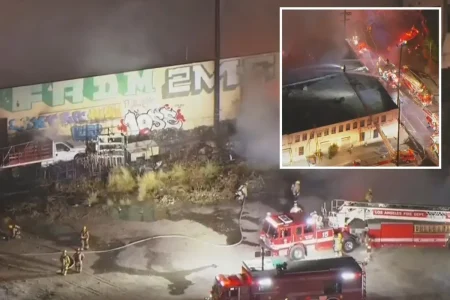






There are moments in life when the ordinary becomes terrifying in the blink of an eye, and for a 41-year-old Florida woman, a routine stop for gasoline turned into a nightmare that no one could have anticipated. It was around eight o’clock on a Thursday evening when Christine Sherbuk pulled her Volvo SUV into a Mobil gas station in St. Petersburg, likely thinking about the end of the day, the drive home, or whatever small errands awaited her. Instead, a stranger approached her, and according to police, deliberately used a lighter to ignite the gasoline pouring into her vehicle. The result was an instantaneous fireball that engulfed the pump area and the car itself, leaving Sherbuk with second-degree burns on her arms and back. What makes the attack even more horrifying is the apparent randomness of it all: police say the two women had never met, that there was no argument, no prior connection, no hint of trouble that would explain such an explosive and violent act. In a matter of seconds, an everyday chore became a life-threatening emergency, and the world around the gas station transformed from a place of routine to a scene of chaos and heroism. The incident left neighbors and investigators alike stunned, not only because of the brutality of the act but because of the terrifying implication that something as simple as fueling a car could be turned into a deadly weapon by a complete stranger.
The victim, Christine Sherbuk, was rushed from the scene to the trauma center at Tampa General Hospital in serious condition, and for a time, her survival was uncertain. Second-degree burns are among the most painful injuries a person can endure, damaging the outer layer of skin and the layer beneath it, often requiring extensive treatment, rehabilitation, and long-term care. She was reported to be stabilized and expected to survive, but the emotional and psychological scars of such an attack would certainly linger far beyond the physical healing process. To be burned while standing at a gas pump, surrounded by fuel and metal, is not just an injury; it is a traumatic event that attacks a person’s sense of safety in the most basic public spaces. Sherbuk’s life was likely changed forever in those few moments, and the road ahead would require not only medical treatment but also strength and resilience. The fact that the attack was unprovoked and carried out by someone she did not know only compounds the sense of violation. She was simply in the wrong place at the wrong time, a phrase that can sound cliché until it actually happens to someone, and then it becomes the defining story of their life. Her ordeal has touched many in the St. Petersburg community, who have expressed shock and sympathy, and her family and friends were left to wonder how a moment so routine could turn into a sudden, vicious assault.
Amid the terror, there was a hero. Scotty Gramling was parked nearby when the violence erupted, and he did not hesitate. As flames swallowed Sherbuk’s vehicle and the fireball rose into the evening sky, Gramling raced to help, pulling the burned and injured woman away from the wreckage and getting her into his truck before calling 911. He described what he witnessed as a “fireball,” a single word that conveys the sheer suddenness and intensity of the explosion. But Gramling’s involvement did not begin with the fire itself. Moments earlier, he had actually called the police non-emergency line because he spotted Crawford across the street involved in some kind of altercation. It seemed to him that someone was trying to pull Crawford out of the roadway, and a fight broke out nearby. That disturbing scene had already prompted him to raise the alarm, and officers were reportedly heading to that disturbance when the gas station attack unfolded. It is a strange and unsettling detail, as if the violent energy in the air was building before it finally erupted in flames. Gramsling’s quick thinking and willingness to intervene highlight the very best of human nature in a situation that revealed the absolute worst. In the face of an unthinkable event, he did not wait for someone else to help; he ran toward the danger and did everything he could to save a stranger. His actions remind us that courage can take root in ordinary moments, and that the same evening that brought such destruction also brought an inspiring act of selflessness.
The alleged attacker, Eleanor Crawford, also 41, did not remain free for long. According to police, after lighting the gasoline, she fled the scene, but officers caught up with her a couple of blocks away within roughly twenty minutes of the incident. The arrest affidavit noted that multiple witnesses saw her ignite the gasoline, and the entire incident was captured on surveillance video, leaving little room for doubt about what had occurred. Crawford and Sherbuk did not know each other, and investigators struggled to identify any motive. Authorities would later describe Crawford as having a lengthy criminal record, including a number of drug- and alcohol-related charges, which raised questions about whether she was under the influence at the time of the alleged attack. While no official determination was made regarding intoxication, the circumstances suggested the possibility of impaired judgment, mental health struggles, or some combination of both. Assistant Police Chief Mike Kovacsev voiced the confusion that many felt when he said, “I don’t know if alcohol and drugs were involved, but indicative of her history, there might’ve been something that diminished capacity there. Why would she even do something like this?” The question hangs in the air, unanswered and perhaps unanswerable, as the legal process begins to unfold and the community tries to make sense of a senseless act.
The aftermath of the attack has left many people wondering how such a thing could happen, and officials have been careful to note the unusual nature of the case. Kovacsev described it as “a unique case” because of its sheer strangeness and the horrific burns that resulted from the deliberate ignition of fuel. He was grateful that emergency responders, including the fire department, were able to stabilize Sherbuk and get her to a hospital in time. “Luckily they were able to get her stabilized, and she’s going to make it,” he said, offering a note of relief in an otherwise dark story. The investigation remains active, with authorities continuing to piece together Crawford’s state of mind and the events leading up to the attack. Her history of substance-related offenses raises important questions about how the justice system treats individuals who may be struggling with addiction or mental illness, especially when those struggles erupt into violence against innocent people. At the same time, the focus is also on Sherbuk, whose physical recovery is only the beginning of a longer journey. Survivors of violent attacks often carry invisible scars; the memory of the fire, the fear, and the sudden realization that a stranger wanted to harm them may stay with her for years. The community, too, must process the fact that such an attack could happen at a local gas station on an ordinary Thursday night, leaving residents to wonder about the safety of public spaces they once took for granted.
In the criminal justice system, Crawford now faces serious consequences for her alleged actions. She has been charged with attempted felony murder and two counts of arson, charges that reflect both the intent to kill and the destructive nature of the fire itself. She is being held on a $350,000 bond while awaiting trial, and a judge ordered that she be fitted with a GPS monitor by the Pinellas County Sheriff’s Office before any release from jail. These legal steps provide some measure of accountability, but they cannot undo the damage that has already been done. Sherbuk must now recover from severe burns, undergo treatment, and try to rebuild a sense of normalcy in a life that was abruptly thrown into chaos. The case remains under investigation, and there are still many questions about what motivated Crawford, whether her capacity was diminished by substances, and what the future holds for both the accused and the victim. What is certain is that a single act of violence changed the lives of everyone involved. For Sherbuk, the road ahead will be long and painful, but she will carry with her the knowledge that at least one stranger raced to help her in her moment of greatest need. For the community, the incident serves as a reminder that heroism can emerge from ordinary bystanders, that the bonds of humanity can shine even in the darkest of moments, and that recovery, however difficult, is possible when people care for one another. The flames may have been ignited out of malice or madness, but they were fought with courage and compassion, and that is a story worth remembering.