


The sprawling, highly visible corridor of Manhattan’s West Side, stretching from the bustling transit hubs of 34th Street all the way up to the historic waterfront near 49th Street, has transformed over recent weeks into a vivid, heart-wrenching canvas of human survival. Against the backdrop of towering luxury apartment buildings, world-class restaurants, and the scenic Hudson River, a makeshift linear village composed of nylon tents, heavy-duty tarpaulins, and discarded cardboard structures has claimed the public sidewalks, sparking an intense urban debate over the limits of civic compassion, public health, and municipal responsibility. At the absolute center of this unfolding political and humanitarian storm is New York City’s progressive mayor, Zohran Mamdani, who recently instituted a high-stakes, compassionate, and highly publicized seven-day deadline for his administration to engage, assist, and ultimately dismantle these illegal encampments. Mamdani’s controversial policy was designed to merge humanitarian outreach with public order, requiring that social service workers and specialized outreach teams be given a full week to connect unhoused residents with critical services, mental health resources, and shelter placement before the New York City Police Department would be authorized to intervene. Yet, when that crucial Monday deadline arrived, the sprawling, blocks-long encampment remained overwhelmingly intact, standing as a physical challenge to the administrative mandates of City Hall. While some frustrated neighborhood advocates viewed this delayed enforcement as a sign of policy failure and bureaucratic paralysis, many of the street’s residents greeted the passing of the deadline with a quiet sense of relief, gratitude, and survival. The lack of comment from city officials on Monday underscored the immense, systemic difficulty of executing sweeping policy changes on the cold pavement, where the deeply complicated lives of vulnerable human beings cannot easily be synchronized with political timelines.
To truly understand the human dimension of this ongoing urban struggle, one must look past the sterile statistics and polarizing policy debates to look directly at the lives of individuals like Liam, a forty-year-old man who journeyed to New York from Washington State only to find himself living on the unforgiving concrete of the West Side. For Liam and his fellow unhoused neighbors, Mayor Mamdani’s delayed enforcement and cautious approach are not viewed as municipal failures, but rather as rare, deeply appreciated acts of basic human decency that stand in sharp contrast to the aggressive, disruptive sweeps of past administrations. Sitting among his few remaining possessions, Liam expressed profound gratitude for the mayor’s philosophical framework, emphasizing that Mamdani possesses a genuine, empathetic focus on the human aspect of the homelessness crisis rather than simply treating unhoused people as a collective aesthetic blight to be swept out of sight. Liam noted that this thoughtful, slow-paced approach felt like a personal acknowledgment of his dignity, as if the mayor were constantly asking himself whether he would be comfortable with such treatment if he suddenly found himself surviving on the streets of New York. This perspective highlights a vital, often overlooked psychological reality: for those living in these makeshift structures, these fragile shelters represent more than just sidewalk obstructions; they are essential sanctuaries of safety, privacy, and community in an otherwise indifferent and overwhelming metropolis. By prioritizing human connection and refusing to rush in with aggressive law enforcement measures, the administration gave people like Liam a fleeting sense of stability, confirming that their safety and well-being are valuable, and treating them as citizens in need of support rather than as a class of criminals to be hidden away.
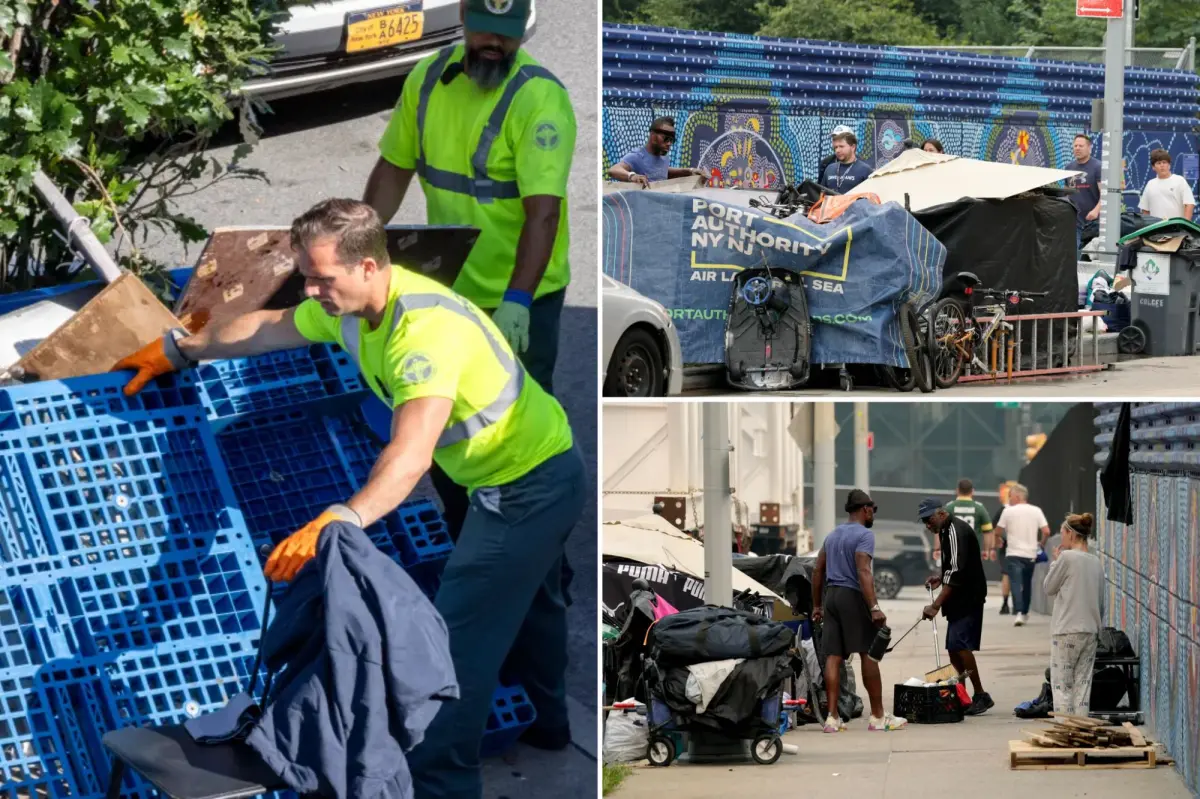
On the hot asphalt of the West Side, the physical execution of the city’s cleanup policy has resembled a hesitant, slow-motion compromise between administrative duty and humanitarian reservation. Throughout Monday, observers noted that while specialized sanitation workers and NYPD officers were present along the multi-block settlement, their operational efforts were moving at an incredibly slow pace, described by many onlookers as a crawl. Instead of a coordinated, systematic dismantling of the entire encampment, only a handful of makeshift shelters were actually taken down, including a highly visible structure situated directly across the street from the family-friendly Intrepid Sea, Air & Space Museum—a major tourist destination and maritime cultural landmark. In a few scattered locations, sanitation crews were observed loading discarded mattresses, worn clothing, and assorted personal items into the back of garbage trucks while police officers stood by quietly, their passive posture reflecting the strict legal boundaries established by the mayor’s office. This careful, almost reluctant pacing is the direct result of Mamdani’s signature policy, which deliberately halts rapid police intervention to give outreach workers a week-long window to earn the trust of those living in the encampments. While this buffer period is designed to prevent the traumatization and displacement of vulnerable people, critics argue that the resulting lack of swift enforcement has created a confusing, counterproductive halfway point. The current reality is a frustrating compromise where unhoused individuals suffer the loss of their few essential belongings to sanitation trucks without being successfully transitioned into more stable housing, leaving the city’s complex social networks stretched thin and policy goals unfulfilled.
For the long-term residents, local business owners, and workers who call the West Side home, the prolonged presence of the sprawling encampment has severely tested the limits of their patience, empathy, and sense of security. Neighbors living near 11th and 12th avenues have voiced increasingly urgent, distressed concerns about the rapid decline in public safety and the visible degradation of their immediate community. Many local residents complain that the garbage-strewn sidewalks, often cluttered with decaying food waste, discarded needles, and massive piles of hoarded items, have made basic daily navigation hazardous and unpleasant for both neighborhood families and international tourists. Reports of illicit transactions, drug distribution, and sexual solicitation occurring within the dense network of tents have fueled a growing sense of alarm, with some residents pointing out that certain encampments appear to be utilized as hubs for stockpiling stolen merchandise. Local parents have expressed intense anxiety when walking their young children past these areas, arguing that the mayor’s hands-off response has effectively disarmed the NYPD, preventing officers from maintaining basic public order. This community-wide frustration is rarely rooted in malice or a lack of basic human sympathy for those experiencing extreme poverty; instead, it arises from a place of desperation for a balanced, functional neighborhood where the shared public space is safe, sanitary, and accessible to all members of the public. The prevailing sentiment among locals is that they have been abandoned by their own leadership, forced to navigate the complex social failures of the city on their own doorsteps without adequate municipal assistance.
A closer examination of the physical footprint of the West Side encampment reveals the remarkable resilience, adaptability, and social organization of the unhoused population, which has successfully maintained its presence across several blocks of prime real estate. Despite the sporadic, slow-paced sanitation sweep on Monday, massive clusters of the shantytown remained fully established near critical intersections on 44th, 47th, and 49th streets along the outer avenues of Manhattan. In these robust micro-settlements, half a dozen unhoused individuals could be seen milling about, organizing their shelters, keeping watch over their neighbors’ belongings, and trying to preserve some semblance of personal space and order in an incredibly harsh environment. These camps are not merely random piles of litter, but rather highly organized systems of survival where the unhoused find mutual protection and a sense of shared community that is often impossible to find in the city’s broader, more institutionalized structures. Many of these individuals purposefully choose to remain on the streets because they perceive the municipal shelter system as a dangerous, chaotic, and dehumanizing alternative where theft and violence are rampant. The absolute persistence of these camps, even after the passing of a highly publicized mayoral deadline, serves as a powerful, undeniable testament to the failure of the city’s existing emergency housing infrastructure. Until the city can offer alternatives that are widely understood to be safe, clean, and respectful of basic human dignity, the public sidewalks will continue to serve as a default living space, illustrating the deep chasm between administrative hope and the daily struggle for survival.
Ultimately, the tense, unresolved standoff on Manhattan’s West Side serves as a compelling and urgent microcosm of the systemic homelessness crisis that continues to challenge major urban centers across the United States. Mayor Mamdani’s progressive, human-first policy represents an ambitious, morally driven attempt to break the historic cycle of cleanups and criminalization, but its slow, uneven progress demonstrates the monumental difficulty of translating idealistic compassion into effective, day-to-day municipal governance. As Liam’s profound question—whether the mayor himself would be satisfied with such living conditions if he were on the street—so elegantly reminds us, the ultimate moral health of a city is measured by how it treats its most vulnerable, marginalized citizens. However, a functional government must also answer to the legitimate demands of its homeowners, business operators, and taxpayers who keep the local economy running, requiring a delicate, masterful synthesis of deep empathy and administrative efficacy. Resolving this deep-seated crisis will require far more than symbolic deadlines, sporadic sanitation sweeps, or polarized political talking points; it demands a massive, systemic investment in permanent supportive housing, easily accessible mental health services, and compassionate addiction treatment, all while simultaneously preserving the safety and cleanliness of public spaces. Until such a comprehensive, well-funded strategy is realized, New York City will remain caught in this fragile, heartbreaking stalemate, where the unhoused and the housed are forced to share an uneasy, unresolved existence on the very same pavement.